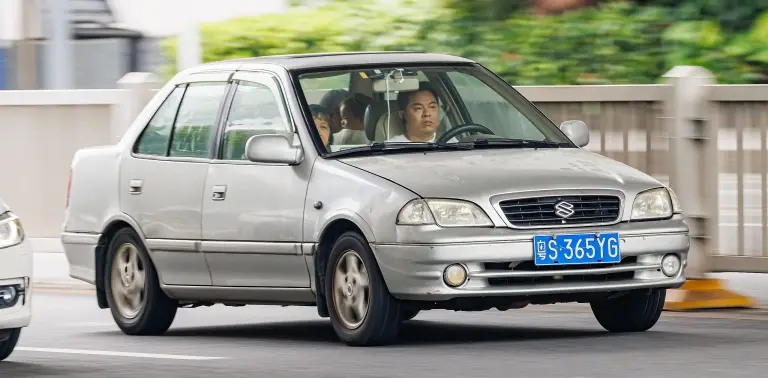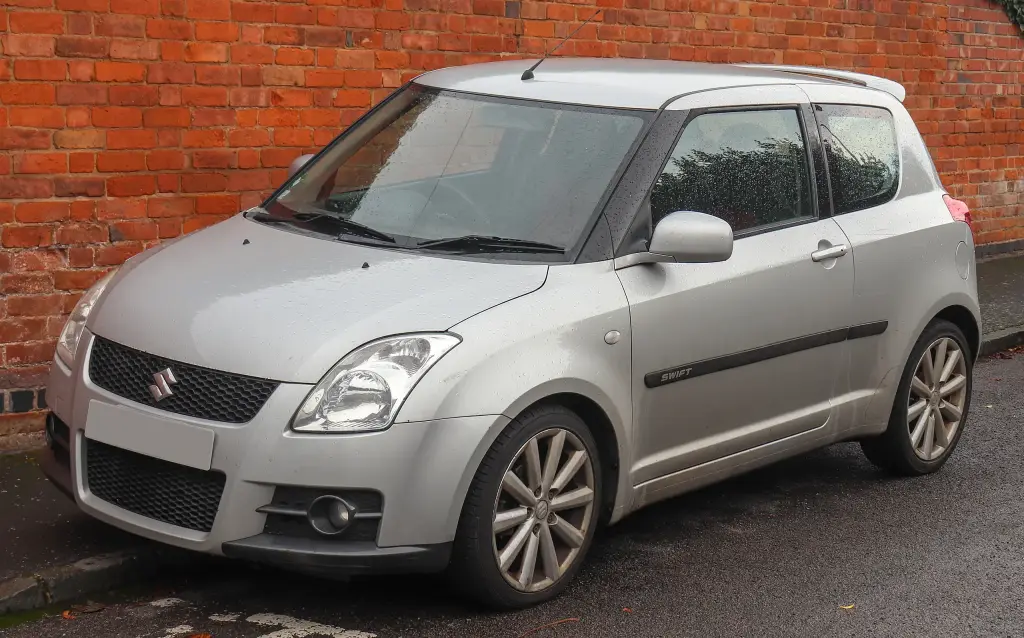
The Suzuki Swift is a B-segment supermini. The name was first used in 1984 for the export version of the Cultus, and the Swift became a model in its own right in 2004; since its global launch it has sold 10 million units.
Suzuki Swift at a glance
| Name used from | 1984, as the export badge of the Cultus |
|---|---|
| Standalone model | from 2004 |
| Segment | B-segment supermini |
| First generation | RS, shown at Paris in September 2004 |
| Engines | 1.3 with 91 PS, 1.5 with 102–110 PS |
| Other engines | 1.25 CVT, 1.3 Fiat DDiS diesel in Europe |
| Drive | front-wheel drive, four-wheel drive optional |
| Bodies | three- and five-door hatchback (five-door in most markets) |
| Built in | Hungary, India, Indonesia, Japan, Pakistan, China |
| Crash rating | four stars, Euro NCAP |
| Sales | 10 million by September 2025 |
History of the Suzuki Swift
The Cultus connection
The Swift nameplate started in 1984 as an export badge for the Suzuki Cultus, the supermini built since 1983 in two generations and three body styles on the G engine family. The same car was sold as the SA310, Forsa, Chevrolet Sprint, Geo Metro, Pontiac Firefly, Maruti 1000, Holden Barina and Subaru Justy, and Swift-badged Cultus production continued in Hungary until 2003.
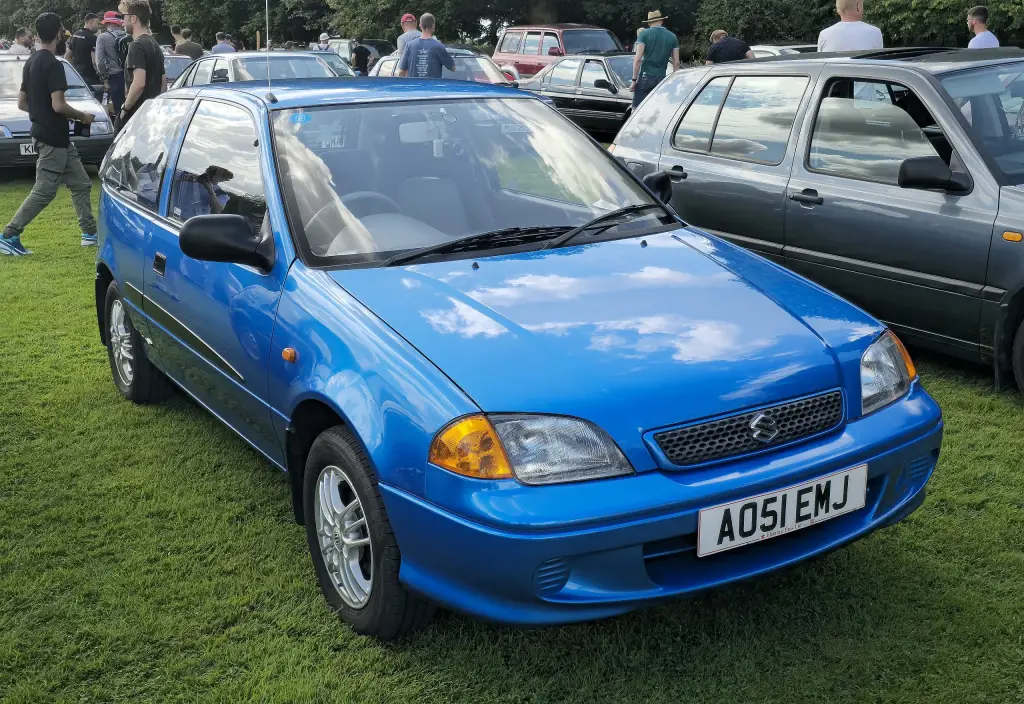
The Japanese Swift and Ignis
In Japan the Swift name returned in 2000 as the replacement for the Cultus, while outside Japan the same car was called the Ignis. It used the new M-family fours of 1.3 and 1.5 litres with five-speed manual or four-speed automatic and front- or four-wheel drive, coded HT51S and HT81S. The three-door formed the basis of the 2003 Swift Sport in Japan and the Ignis Sport abroad, with a 1.5 of 115 PS; the Sport ended in 2005 and the regular 1.3 lasted until 2006, overlapping the new global Swift from November 2004.
The 2004 global Swift
The modern Swift was shown at the Paris Motor Show in September 2004, after the Concept S and S2 studies. It marked a deliberate change from a low-price alternative to a sporty supermini, with its chassis refined through road testing across Europe. It scored four stars in Euro NCAP, won the 2006 Semperit Irish Car of the Year, and its launch campaign in Europe featured Cristiano Ronaldo; sales ran above forecast almost everywhere and reached twice the Japanese forecast. Engines were a 1.3 of 91 PS and a 1.5 of 102 to 110 PS, with a 1.25 CVT and, in Europe, a 1.3 DDiS turbodiesel from Fiat. Four-wheel drive was offered with the 1.3 and 1.5. The car was made in Hungary, India, Indonesia, Japan, Pakistan and by Chang’an in China; Pakistan kept the first generation until August 2021, and Maruti Suzuki launched the Indian Swift on 25 May 2005 with the 1.3 G13BB engine, adding a Fiat-sourced 1.25 diesel in 2007.
The name today
The Swift now sits between the Ignis and the Baleno in Suzuki’s global hatchback range and has recorded 10 million sales since the 2004 global model.
Design and features
- European development: the 2004 car was tuned on European roads for European tastes.
- Sport versions: from the 2003 Japanese Swift Sport to later generations.
- Wide production: built on four continents and sold as a Chevrolet, Geo, Holden and Subaru in earlier lives.
- Ten million sold: one of Suzuki’s most successful nameplates.
Suzuki Swift versions
- Cultus-based Swift (1984–2003): export version of the Cultus.
- Japanese Swift (2000–2006): the Ignis under another name at home.
- Swift Sport (2003): 1.5-litre three-door with 115 PS.
- Global Swift (2004): three- and five-door with 1.3 and 1.5 engines.
- Swift 1.3 DDiS: European diesel with a Fiat engine.
- Swift GTi and convertibles: earlier sporting and open versions of the nameplate.
The Swift grew out of the Cultus, shares its Japanese years with the Ignis and sits above the Celerio in the range. More Suzukis are in the Suzuki collection.
Sources
- Suzuki Swift, English Wikipedia: nameplate history, generations, engines, markets, sales