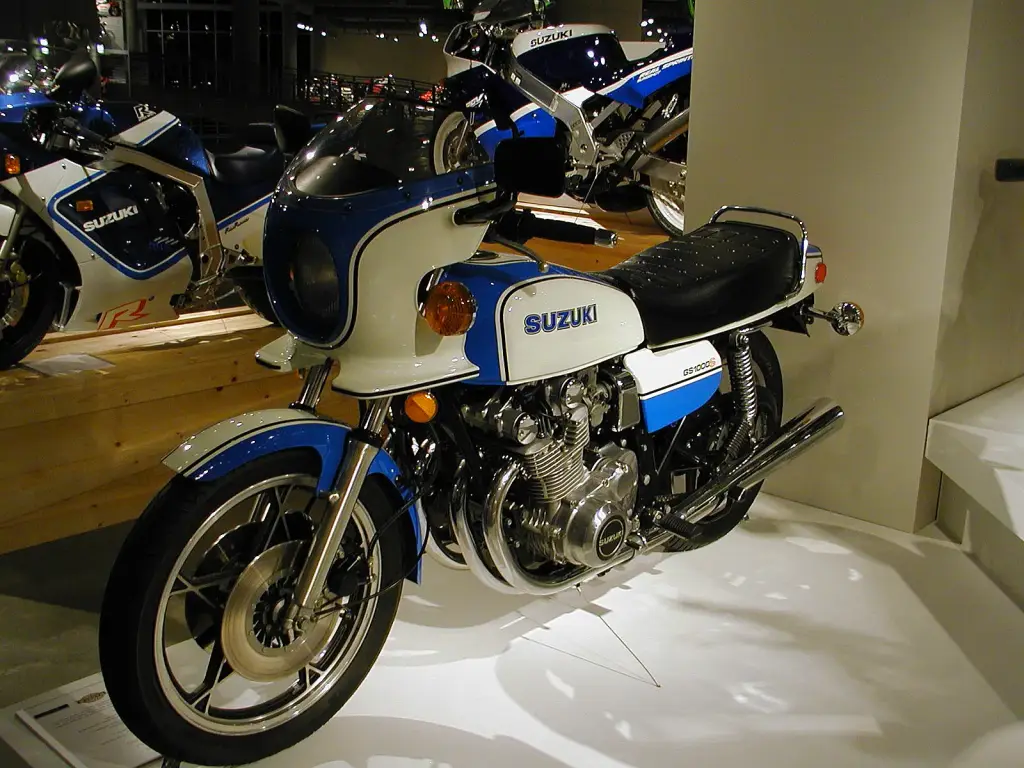
The Suzuki GS series was Suzuki’s first complete range of four-stroke road motorcycles. Before it, the company had built almost nothing but two-strokes; the GS750 and GS400 of November 1976 changed that and set the pattern for Suzuki’s air-cooled fours.
Suzuki GS series at a glance
| First models | GS750 and GS400, November 1976 |
|---|---|
| Type | four-stroke road motorcycles |
| GS750 engine | four-cylinder patterned on the Kawasaki Z1-900 |
| Chassis | dual cradle frame, telescopic forks, twin rear shocks |
| Range | 125 cc singles to 1,150 cc fours |
| GS1000 | added 1977 |
| GS1100 | 1,074 cc, from 1980 |
| GSX split | 16-valve heads from 1980 took the GSX name outside the Americas |
| Shaft drive | G suffix, including the full-dress GS1100GK |
| Racing | Daytona Superbike 1978, Suzuka 8 Hours 1978, AMA titles 1979–1980 |
History of the Suzuki GS series
The first fours
The GS series began in November 1976 with the four-cylinder GS750 and the parallel-twin GS400. The GS750’s engine was essentially patterned on the Kawasaki Z1-900 and became the basis for every air-cooled Suzuki four until the GSX-R. It sat in a dual cradle frame with telescopic forks, twin rear shocks and a single front disc, and its handling was praised as a big step over the Honda CB750 and the powerful but wayward Kawasaki 900. A GS550 and the GS1000 followed in 1977, and the range eventually ran from 125 cc singles to retro-styled machines such as the GS1200SS.
Racing
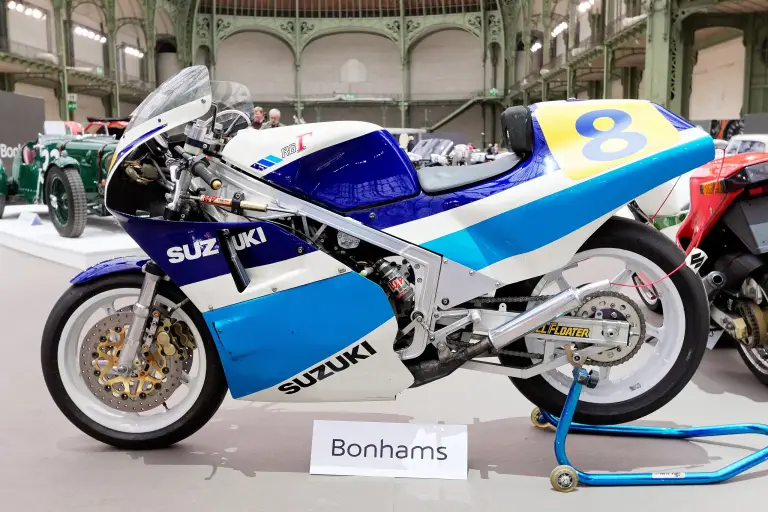
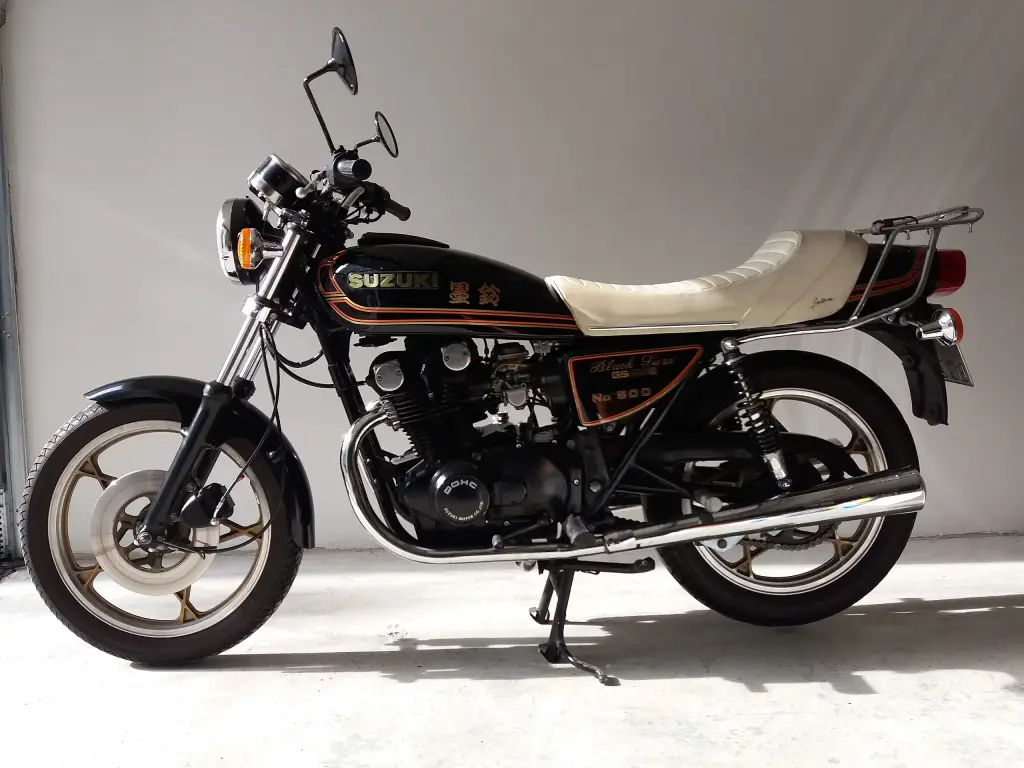
The strong chassis and over-engineered engines made the fours natural racing platforms. A Pops Yoshimura-prepared GS1000 won the 1978 Daytona Superbike race and the 1978 Suzuka 8 Hours, took the AMA Superbike championship in 1979 and 1980 with Wes Cooley, and won the Australian Castrol Six Hour in 1979. In Europe, Yoshimura GS1000-powered Formula 1 bikes gave Graeme Crosby the Formula TT world title in 1980 and 1981.
GS and GSX
The original engines were air-cooled with roller-bearing crankshafts, two valves per cylinder in hemispherical chambers and double overhead camshafts on shim-and-bucket tappets. In 1980 the 750 and 1000 got 16-valve heads with forked rockers and Twin Swirl Combustion Chambers, and the litre bike grew to 1,074 cc; outside the Americas these were badged GSX. The 750 also gained a plain-bearing crank and a higher-geared oil pump, while the 650 moved to plain bearings in the run-up to air-oil cooling. SACS air-oil cooling later separated the GS and GSX models from the GSX-R.
Shaft drive and tourers
The G suffix marked shaft drive: GS450GA, GS650G and GL, GS750G and GL, GS850G and GL, GS1000G and GL, and GS1100G, GK and GL. The G models had flat seats, the GL versions cruiser trim with chrome mudguards and pull-back bars, and the GS1100GK was a full-dress tourer with fairing, trunk and hard panniers. The range helped define the Universal Japanese Motorcycle, a machine equally at home commuting, touring or sporting.
Design and features
- Suzuki’s four-stroke foundation: the design basis for all air-cooled Suzuki fours up to the GSX-R.
- Handling reputation: the GS750 was praised for steering better than its rivals.
- Race-winning: Daytona, Suzuka and AMA Superbike success with Yoshimura.
- Shaft-drive tourers: the G and GL models, up to the full-dress GS1100GK.
Suzuki GS series versions
- GS750 and GS400 (1976): the first of the line.
- GS550 and GS1000 (1977): the range grows.
- GS1100 (1980): 1,074 cc and 16 valves, badged GSX outside the Americas.
- GS450E: the four-valve evolution of the GS400 twin.
- GS1100GK: factory full-dress shaft-drive tourer.
- GS1200SS: a later retro model using Bandit power.
The GS line led to the GSX-R and the GS500, and its 16-valve heads also appeared on the Katana. More Suzukis are in the Suzuki collection.
Video: Suzuki GS 1000 E fastest motorcycle in the world in 1979 open header
Video by SuperCooper on YouTube.
Sources
- Suzuki GS series, English Wikipedia: models, engines, racing, shaft drive