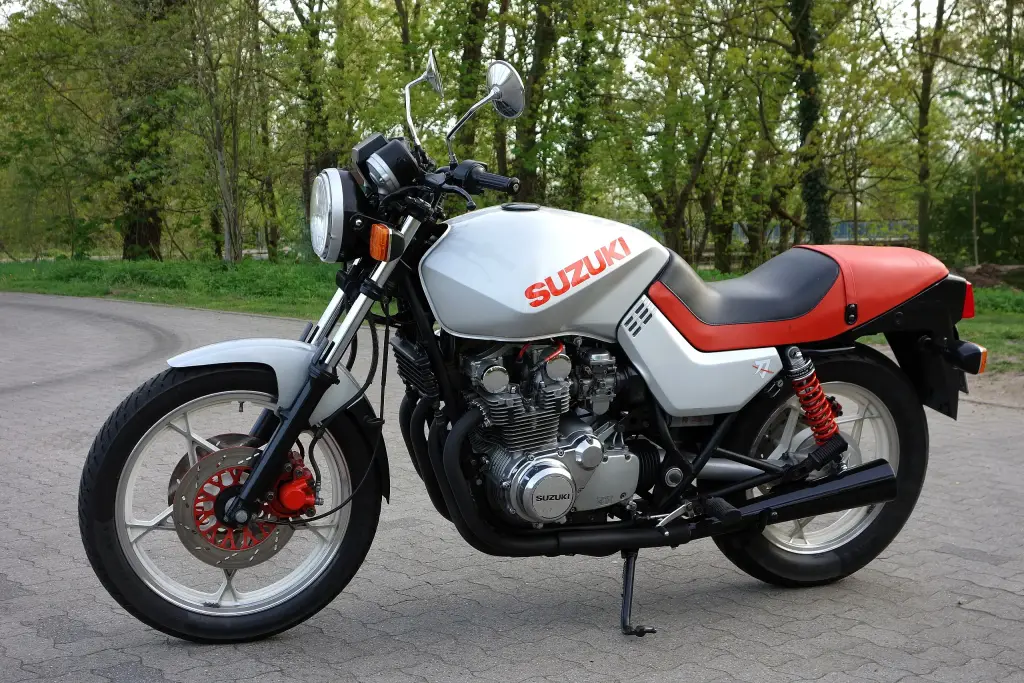
The Suzuki Katana is a street motorcycle designed in 1979 and 1980 by Target Design of Germany and built from 1981 to 2006, then revived in 2019. Its shark-like shape broke with every convention of the time and changed how production motorcycles looked.
Suzuki Katana at a glance
| Designed | 1979–1980 by Target Design, Germany |
|---|---|
| Design team | Hans Muth, Jan Fellstrom, Hans-Georg Kasten |
| Concepts | ED1 unfaired, ED2 faired |
| Production | 1981–2006, then from 2019 |
| First production models | GSX1100S, GSX1000S, GSX750S |
| Unfaired variants | GS550M and GS650G Katana |
| Top speed | 237 km/h in a Cycle Canada test |
| Homologation model | GSX1000SZ, 998 cc |
| Rare factory version | GSX1100SXZ Wire-Wheeler, 20 built for New Zealand |
| Design | flyline, V-shaped tank, silver like a sword |
History of the Suzuki Katana
Target Design
Suzuki contracted a three-man team at Target Design to update the motorcycle’s image: Jan Fellstrom, Hans-Georg Kasten and the team leader Hans Muth, formerly BMW’s chief of styling. After several variants they showed the ED1 and ED2 — European Design — in 1980. The unfaired ED1 had a tall sculpted tank joined to a concave seat by angular side panels, so the rider sat in the bike rather than on it; it went into production as the GS550M Katana and later the GS650G Katana. The faired ED2 was the radical one, shaped for high-speed stability and wind-tunnel tested in Italy; its 1,100 cc form became the prototype for the GSX1100S, GSX1000S and GSX750S.
The flyline
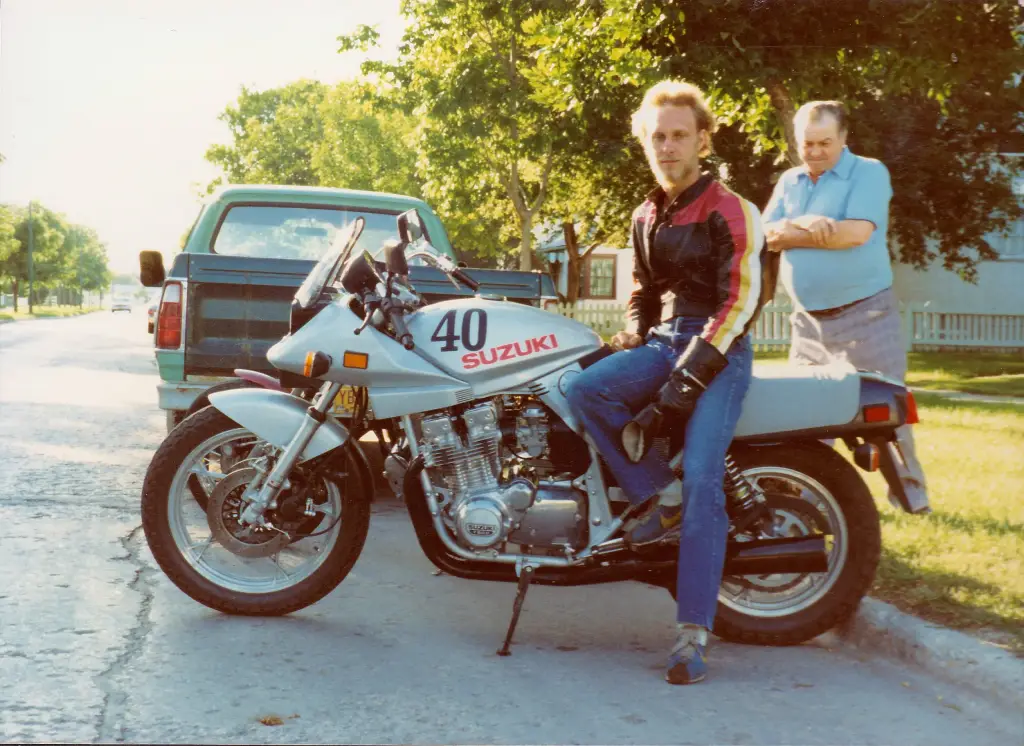
Muth described the design as a dramatic flyline uniting headlight, tank, seat and both mudguards into one aerodynamic whole, with a V-shaped tank that narrows towards the rider and widens at the front. He rendered it in silver, like the sword, and added the Japanese character for katana on the side panel over a red image of the blade. When he presented it to Osamu Suzuki he explained that a katana can be lethal if not treated properly, and that the same is true of a motorcycle. Suzuki’s only demand was to add a small screen.
Production and racing versions
The production 16-valve Katanas of 1981 differed little from the prototype apart from the screen, paired silencers and black accents. On its release Suzuki claimed the GSX1100S was the fastest mass-production motorcycle in the world, and Cycle Canada recorded 237 km/h against 227 km/h for a standard GSX1100E. To homologate the bike for superbike racing Suzuki built the GSX1000SZ, a 998 cc version with a performance inlet camshaft and oval-bore Mikuni carburettors. For New Zealand, where Suzuki held around 42 percent of the market, the distributor asked for a machine to beat the Honda CB1100R and got 20 GSX1100SXZ Wire-Wheelers.
After the original
The original Katana models were discontinued in 1985, but the name was applied to in-house styled sport tourers in North America until 2006, to 50 cc scooters in Europe around the turn of the millennium, and to a new Katana from 2019.
Design and features
- Target Design shape: the flyline and V-shaped tank by Hans Muth’s team.
- Wind-tunnel work: the faired ED2 was tested repeatedly in Italy for stability.
- Speed claim: the GSX1100S was billed as the world’s fastest production motorcycle.
- Racing specials: the GSX1000SZ homologation bike and the 20 New Zealand SXZ models.
Suzuki Katana versions
- GS550M and GS650G Katana: unfaired versions of the ED1 design.
- GSX1100S Katana (1981): the flagship 16-valve model.
- GSX1000SZ: 998 cc homologation special for superbike racing.
- GSX1100SXZ Wire-Wheeler: 20 built for New Zealand.
- Later sport tourers: North American Katanas to 2006.
- Katana (2019): the modern revival.
The Katana’s engine came from the GS series, and its faired 600 cc descendant was the GSX600F. More Suzukis are in the Suzuki collection.
Video: 1997 SUZUKI GSX1100 KATANA Original Condition!!COOL!!
Video by AUTOPRESTIGE JAPAN on YouTube.
Sources
- Suzuki Katana, English Wikipedia: design, production, variants, speed