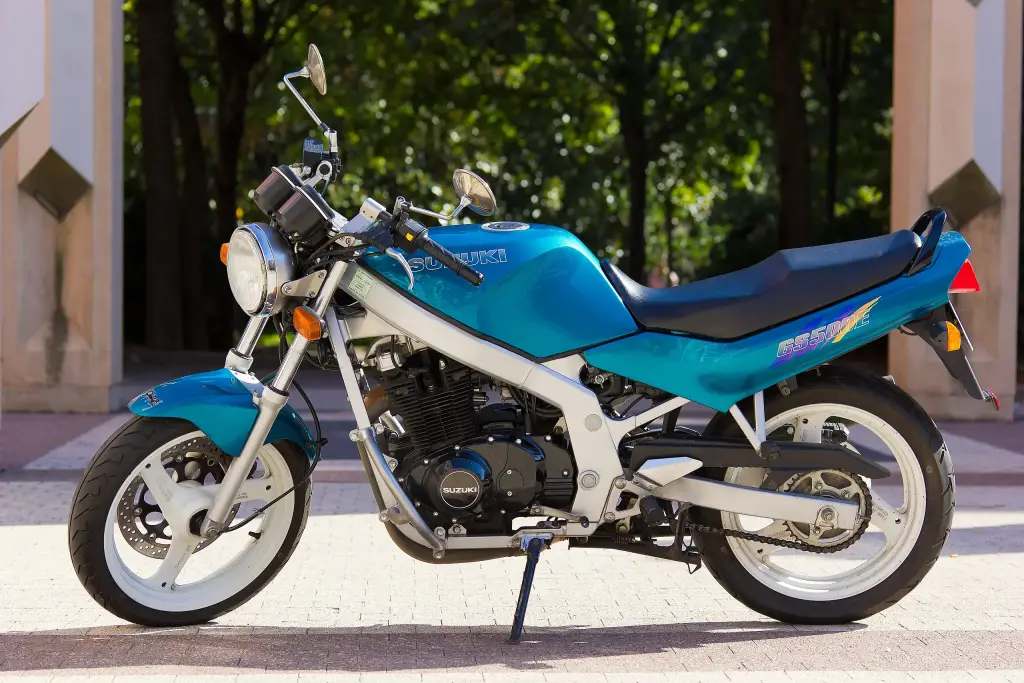
The Suzuki GS500 is an entry-level motorcycle built around an air-cooled parallel twin. Suzuki made the unfaired GS500 and GS500E from 1989 and added the fully faired GS500F in 2004, and the model has long been recommended as a first bike.
Suzuki GS500 at a glance
| Sold | GS500 and GS500E from 1989; GS500F from 2004 |
|---|---|
| First shown | GS500EJ in Britain, 1988 |
| Engine | air-cooled parallel twin, derived from the GS450 |
| Displacement | 487 cc from 1988, up from 448 cc |
| Power | about 40 hp at the rear wheel |
| Carburettors | Mikuni Slingshot from launch, BSR 34 mm from 2001 |
| Fuel tank | 17 litres, 20 litres from 2001 |
| Frame | new design for 1988, light grey with white wheels |
| Restricted versions | U suffix for licence-limited markets |
| Faired version | GS500F, 2004–2013 |
| Late production | built in Colombia for South America |
History of the Suzuki GS500
A twin for beginners
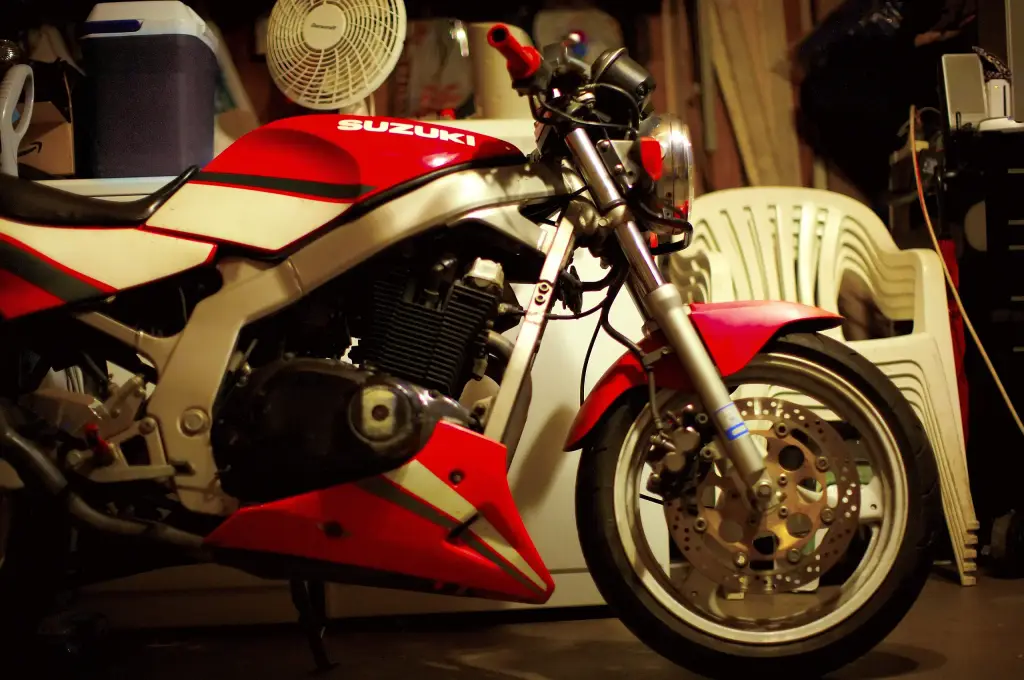
The GS500’s engineering descends from Suzuki’s first modern four-strokes: the 1976 GS750 four and GS400 twin. The GS450 twin introduced a new bottom end with a one-piece 180-degree crankshaft on plain bearings and a counterbalance shaft, and for 1988 its 448 cc grew to 487 cc through a 3 mm larger bore. That engine went into the GS500E with a brand-new frame, running gear and bodywork aimed at urban riders, novices and the budget-conscious. The first British GS500EJ of 1988 came with a black engine in a light grey frame and white wheels, and Mikuni Slingshot carburettors of the kind used on the GSX-R750.
Running changes
The handlebars were raised in 1990, a California model had a smaller 15-litre tank to make room for an evaporation canister, and 1992 brought fork preload adjusters. Wheels changed from white to dark grey in 1996, and 1997 brought new two-piston front calipers. From 2001 the bike gained new bodywork, a 20-litre tank, BSR 34 mm carburettors in all markets and pulsed secondary air injection, and the E was dropped from the name. Suzuki stopped selling the GS500E in the United States after 2002 and left Britain and Spain in 2007.
The faired GS500F
In 2004, after a year’s gap in America, Suzuki launched the GS500F with a fully enclosed fairing that gave weather protection and a sportier look; elsewhere the two versions were sold side by side. Restricted U versions met the power-to-weight limits of learner-approved schemes in Australia and New Zealand and the European A2 licence. By 2016 the GS500 was being built by Suzuki Motor de Colombia for Colombia, Chile and Ecuador.
Design and features
- Friendly twin: two valves per cylinder, strong low-speed torque and about 40 hp.
- Beginner reputation: widely described as a best buy and an excellent first motorcycle.
- Licence-friendly: restricted U versions for A2 and learner-approved markets.
- Long life: nearly three decades of continuous production.
Suzuki GS500 versions
- GS500E (1988–2000): the unfaired original.
- GS500 (2001–): new bodywork, 20-litre tank and BSR carburettors.
- GS500F (2004–2013): fully faired version.
- GS500U: factory-restricted for learner and A2 rules.
The GS500’s twin grew out of the GS series, and its role as a beginner bike was later shared with the SV650. More Suzukis are in the Suzuki collection.
Video: Suzuki GS 500e – Summer 2013 GoPro HD
Video by cube7x on YouTube.
Sources
- Suzuki GS500, English Wikipedia: history, engines, model changes