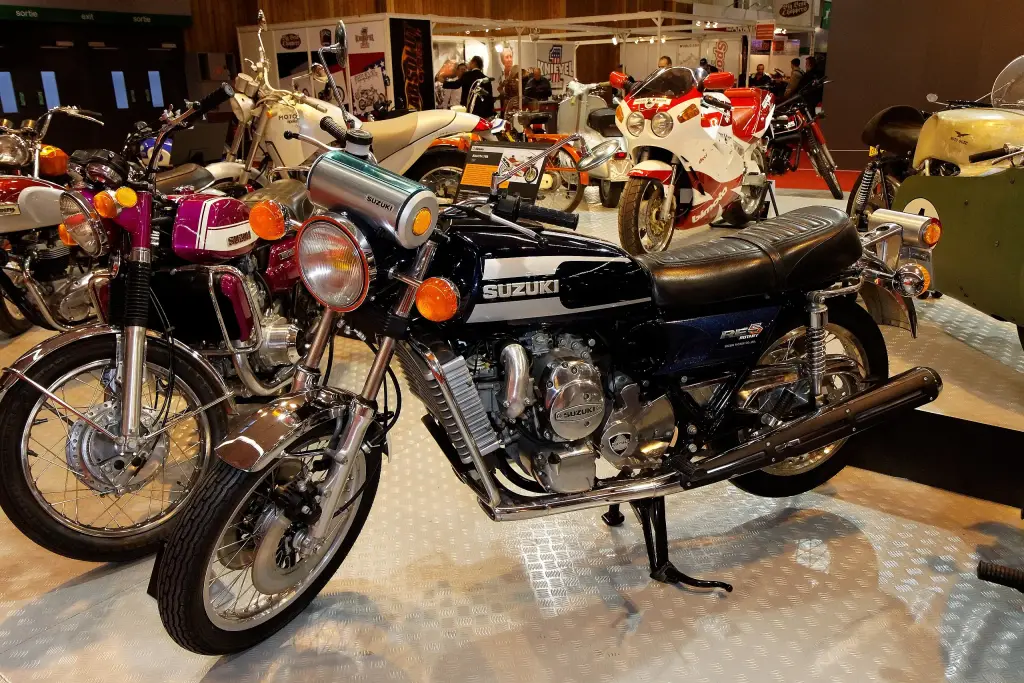
The Suzuki RE5 is a motorcycle with a liquid-cooled single-rotor Wankel engine, built from 1974 to 1976. Apart from the engine it is a fairly conventional roadster, though its styling by Giorgetto Giugiaro gave it a few very distinctive details.
Suzuki RE5 at a glance
| Production | 1974–1976 |
|---|---|
| Engine | 497 cc single-rotor Wankel, liquid-cooled |
| Licence | technical agreement with NSU, November 1970 |
| Styling | Giorgetto Giugiaro |
| Ignition | CDI with two sets of points and one NGK plug |
| Cooling | water and oil, with double-skinned exhaust pipes |
| Fuel consumption | 37 mpg imperial average |
| Models | 1975 M and 1976 A |
| Warranty | full engine replacement within 12 months or 12,000 miles |
| Built | about 6,000 |
History of the Suzuki RE5
Why a rotary
Compared with piston engines, Wankels are smooth, light and compact for their power, qualities that suit motorcycles. Several makers tried them — DKW, Norton, Van Veen and Hercules among them — and all four Japanese giants had plans, but only Suzuki put one into production. Project chief Shigeyasu Kamiya said Suzuki had considered a rotary motorcycle in the mid-1960s, and after development through the end of the decade the company signed a technical licence with NSU in November 1970, becoming the twentieth firm to do so.
The engineering
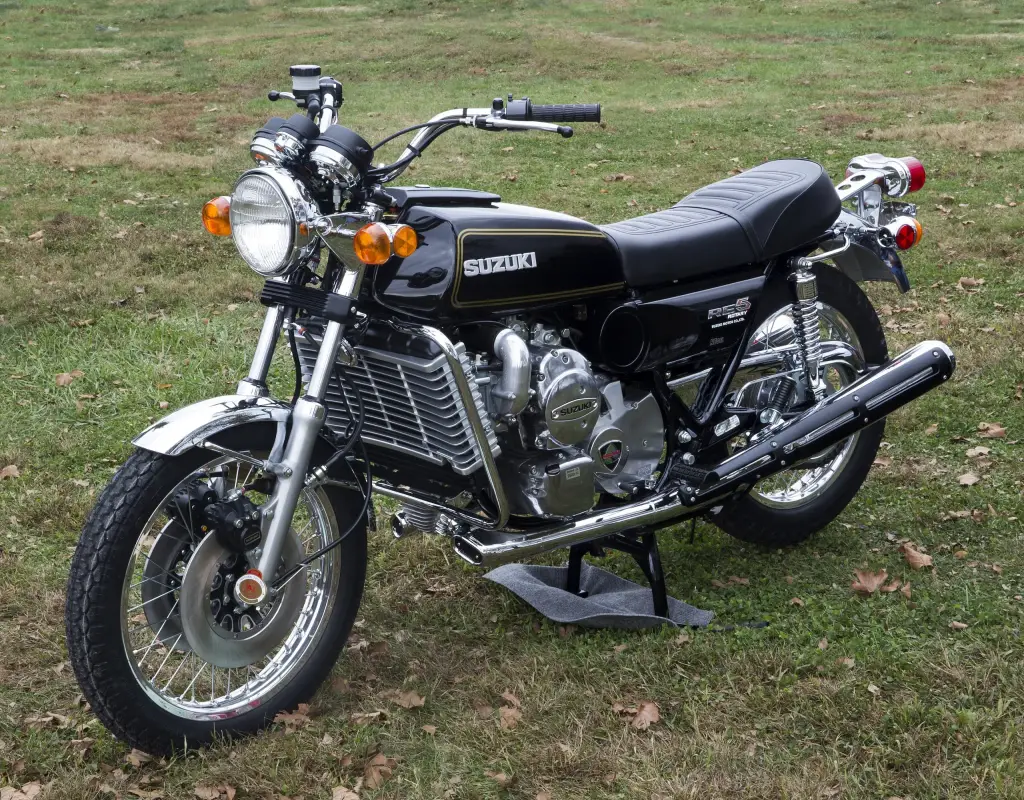
Suzuki designed and built much of its own rotary production machinery and holds twenty patents in plating, reflecting research into the composite electro-chemical materials used to coat the rotor housing. The resulting engine was mechanically complex and heavy. It needed water and oil cooling and double-skinned exhaust pipes to cope with rotary heat, CDI ignition with two sets of points driven by vacuum and rpm sensors to fire a single NGK plug, and three oil reservoirs for the sump, gearbox and total-loss tank, with separate pumps feeding the main bearings and the inlet tracts. The twist grip moved five cables, controlling the primary carburettor butterfly, a secondary port valve and the oil supply.
Giugiaro and the tin can
Suzuki commissioned Giorgetto Giugiaro to style the RE5. His instrument cluster was built into a tubular ‘tin can’ motif, repeated in the tail light, with spherical indicator lights completing the rotary theme. The gauge pack included a low-fuel light, a total-loss oil warning and a digital gear indicator. Options included a full touring kit with a large fairing, saddlebags, a rack and a lockable top box.
Two models and a short life
There were two production versions, the 1975 M and the 1976 A, which adopted more conventional styling, GT750-style instruments and lights, and lost the secondary overrun points and the chain oiler in favour of a sealed chain; many A models were converted M models. The warranty was unusually generous, offering a complete engine replacement for any problem in the first 12 months or 12,000 miles. About 6,000 were built. The RE5 was slower than the GT750 but torquey and smooth, though it grumbled at around 4,000 rpm and averaged 37 mpg. Reviewers praised its handling, and in 1985 Cycle World called it expensive, over-complicated, underpowered and hideous, naming it one of the ten worst motorcycles.
Design and features
- Wankel engine: a single-rotor rotary with water and oil cooling.
- Giugiaro details: the tin-can instrument pod and spherical indicators.
- Complex engineering: five throttle cables, three oil reservoirs and CDI ignition.
- Rare survivor: only about 6,000 built in two years.
Suzuki RE5 versions
- RE5 M (1975): the original model with rotary-themed instruments.
- RE5 A (1976): conventional styling, GT750 instruments and a sealed chain.
- Touring kit: fairing, saddlebags, rack and top box.
The RE5’s rotary engine was unique in Suzuki’s range, which otherwise relied on two-strokes such as the GT250 and four-strokes like the GS series. More Suzukis are in the Suzuki collection.
Video: Suzuki RE5
Video by Two Wheel Classics on YouTube.
Sources
- Suzuki RE5, English Wikipedia: engine, history, styling, reception