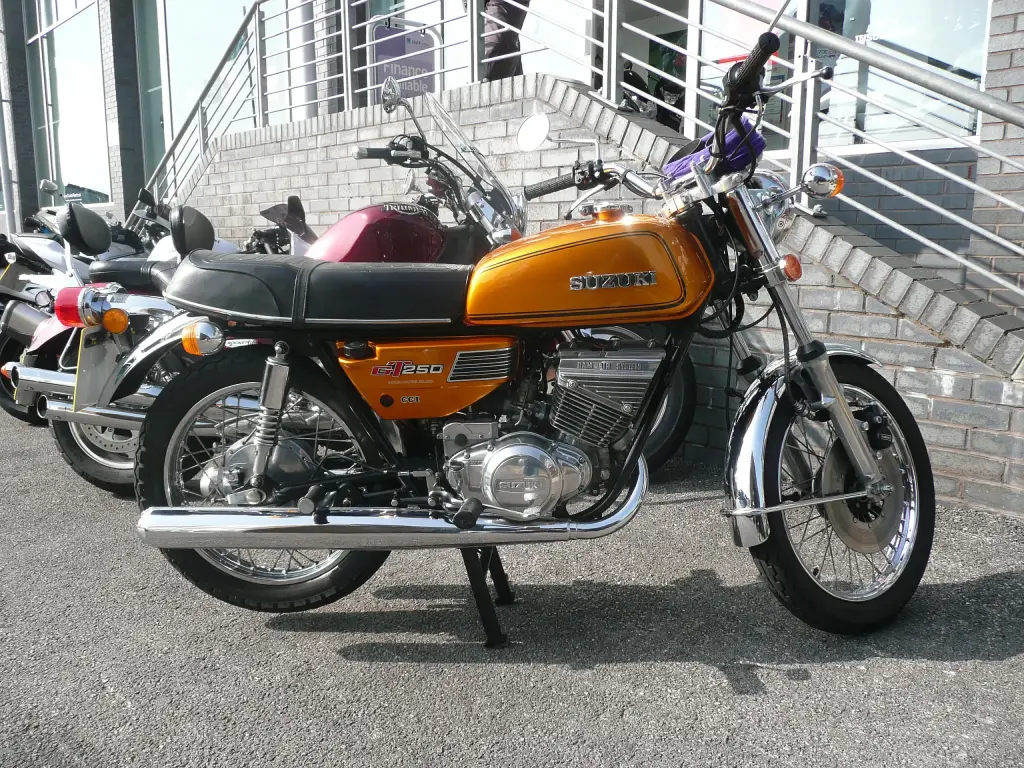
The Suzuki GT250, sold in the United States as the Hustler, is a 247 cc two-stroke twin that Suzuki built from 1971 to 1981. It grew out of the T250 and was for a time one of the best-selling motorcycles in its class.
Suzuki GT250 at a glance
| Production | 1971–1981 |
|---|---|
| American name | Suzuki Hustler |
| Developed from | Suzuki T250, engine from the T20 of 1966 |
| Engine | 247 cc two-stroke twin, 180-degree crank |
| Bore x stroke | 54 x 54 mm |
| Power | 31 bhp at 7,000 rpm; 32 bhp from 1976 |
| Carburettors | twin 26 mm Mikuni, 28 mm from 1975 |
| Gearbox | six-speed |
| Front brake | drum, then a single disc from 1972 |
| X7 | 1978, 18 kg lighter and good for 100 mph |
| End of production | 1981, replaced by four-strokes |
History of the Suzuki GT250
From T250 to GT250
The GT250’s engine was a development of the T250’s, itself descended from the T20 of 1966: a 180-degree piston-ported two-stroke twin with alloy head and barrels and cast-iron liners, 54 by 54 mm, giving 31 bhp at 7,000 rpm. The GT250 arrived in Japan in 1971, essentially a T250 with cosmetic changes. In 1972 it gained a front disc brake, fork gaiters and Suzuki’s Ram Air System, whose cooling ducts are still debated as much cosmetic as effective. The bike reached Europe and America in 1973 as the GT250K, with revised exhausts that met noise and emissions rules but cost some power.
Updates
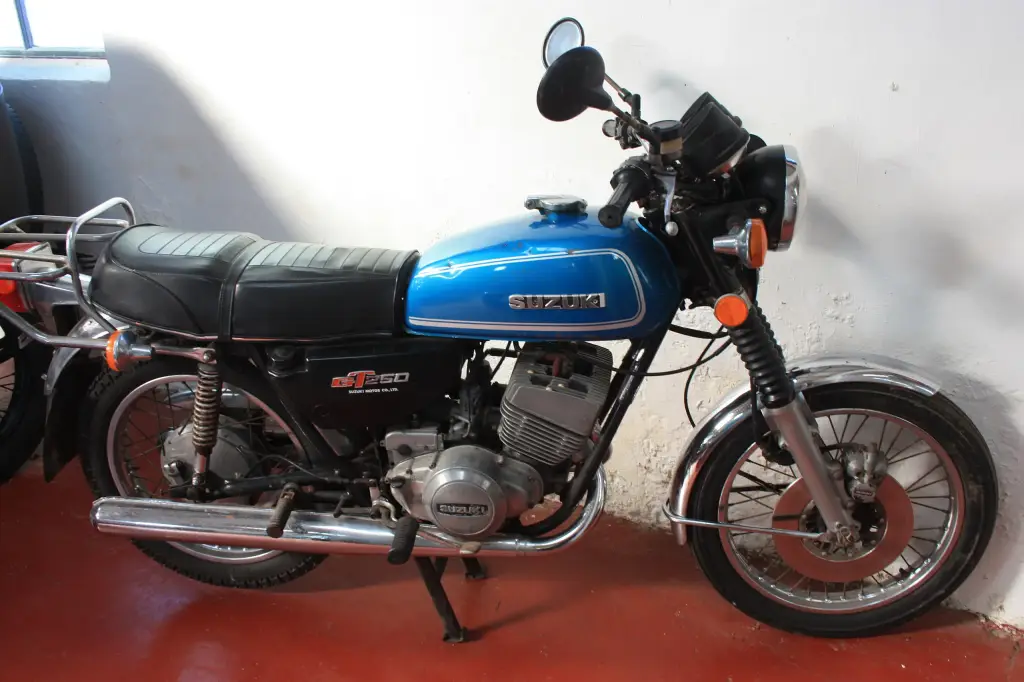
For 1976 the engine was revised with a four-bearing crankshaft instead of three, two extra transfer ports and larger carburettors, raising output to 32 bhp. The Ram Air System was deleted and the cylinder-head fins enlarged to compensate. The new version was faster but weak below 4,000 rpm, and in Britain it was advertised with 500 cc world champion Barry Sheene; it became the top-selling 250 in the learner class. The 1977 B and 1978 C models were cosmetically changed only.
The X7
For 1978 the bike was redesigned as the GT250 X7, sold as the X7E in Germany and the RG250 in Japan. A new single-downtube frame saved 1.5 kg, and the new engine, with Suzuki’s dual induction system using both piston porting and reed valves, was 7.8 kg lighter and more tractable although no more powerful. The X7 weighed 18 kg less than the GT250C and could reach 100 mph. It stayed in production until 1981 and formed the basis of the RG250 Gamma, the last of the line before Suzuki turned to four-strokes.
Design and features
- Two-stroke twin: 247 cc, 180-degree crank and CCI lubrication.
- Ram Air System: cooling ducts on the cylinder head from 1972.
- Six speeds: with revised second and third ratios from 1976.
- The X7: lighter, more compact and capable of 100 mph.
Suzuki GT250 versions
- T250: the 1970s predecessor with the same engine family.
- GT250 (1971): the Japanese-market original.
- GT250 II (1972): disc brake, gaiters and Ram Air.
- GT250K/L/M (1973–1975): the export models.
- GT250A/B/C (1976–1978): four-bearing crank and more power.
- GT250 X7 (1978–1981): the redesigned final version.
The GT250 developed into the RG500 line through the RG250 Gamma, and it shares its two-stroke twin layout with the T500. More Suzukis are in the Suzuki collection.
Video: suzuki t250 start up
Video by Ray Ellis on YouTube.
Sources
- Suzuki GT250, English Wikipedia: engine, model history, X7