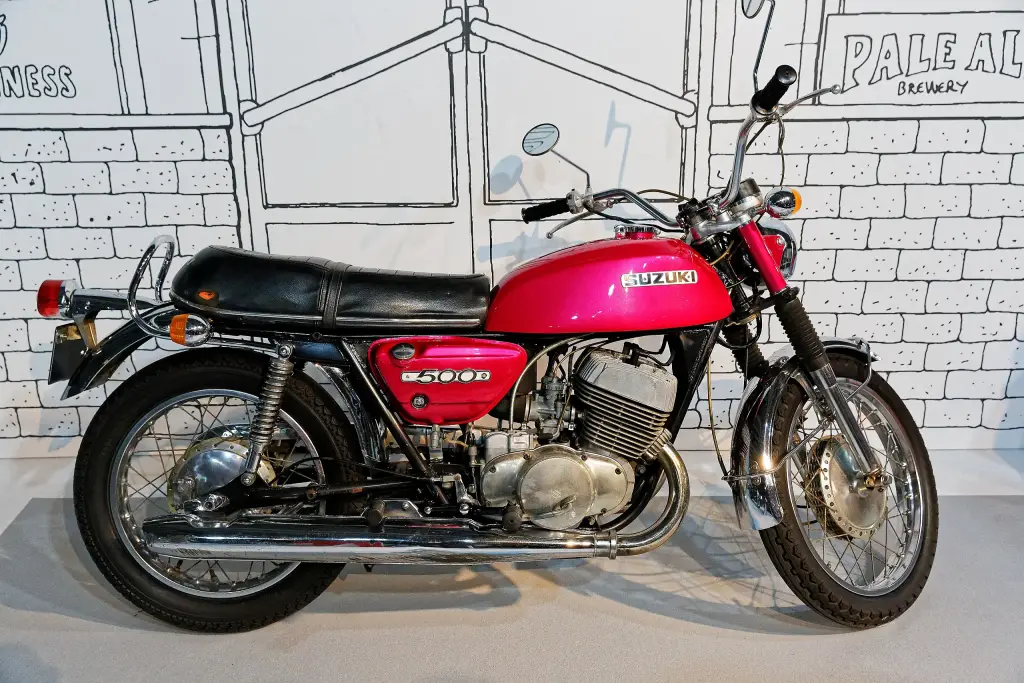
The Suzuki T500 is a 492 cc two-stroke twin sold from 1968 to 1975 under several names, including Titan, Charger and Cobra. It was built as a bigger T20 to take on British twins in America, and it became Suzuki’s largest-capacity machine of the time.
Suzuki T500 at a glance
| Production | 1968–1975; GT500 to 1978 |
|---|---|
| Engine | 492 cc two-stroke twin, 180-degree crank |
| Bore x stroke | 70 x 64 mm |
| Compression | 6.6:1 |
| Power | 47 bhp at 7,000 rpm |
| Top speed | 105 mph (169 km/h) |
| Carburettors | twin 34 mm Mikuni, 32 mm from 1969 |
| Lubrication | Suzuki Posi Force |
| Gearbox | five-speed |
| Frame | duplex cradle |
| Brakes | drums front and rear |
| Sold | over 100,000 |
History of the Suzuki T500
Defying the two-stroke rule
In the 1960s many believed an air-cooled two-stroke larger than 350 cc could not work: it would overheat, have too narrow a power band and drink fuel. Building on the T20, Suzuki made a 500 that disproved the theory, advertising the original T500/Five as the sports cycle that could not be made. It was Suzuki’s largest-displacement machine when it appeared in 1968.
Names and fixes
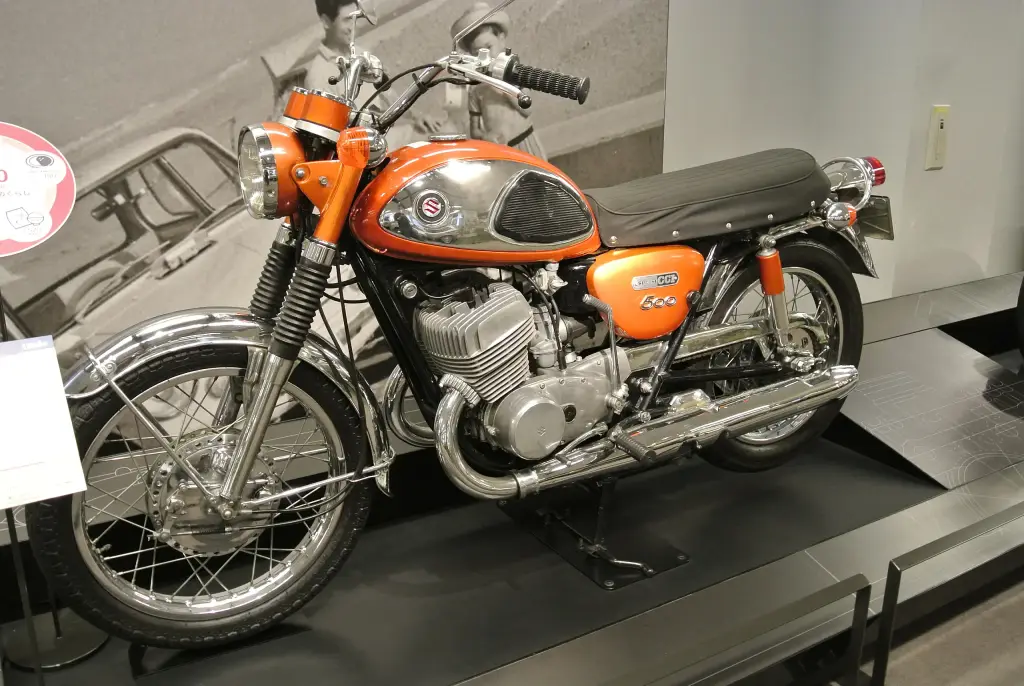
The first T500 had handling problems, so an updated Mk II lengthened the swingarm. Suzuki renamed it Cobra, which Ford objected to because of the Shelby Cobra, then Charger, which Dodge objected to, then Titan — except in Britain, where a dealer held the Titan trademark, so there it stayed the T500. For 1969 the bike was restyled, the carburettors shrank from 34 to 32 mm for better economy, the barrels were re-ported with 11 fins instead of 10, and stronger GT750-type pistons replaced ones that had failed. A Mk III in 1971 brought a revised tank with a luggage rack, gearbox updates and a longer swingarm for a 1,500 mm wheelbase. Gearbox oil capacity rose in 1973 after fourth and fifth gear failures, and the bottom end was strengthened.
GT500 and the end
For 1976 the bike was restyled as the GT500 to fit the range, by then seen as a tourer beside the GT380 and GT550. The porting and inlet tract were revised for torque, peak power fell to 44 bhp at 6,000 rpm, and it gained the GT750 tank, the 380/550 forks and front disc and an electronic PEI ignition. Tightening emissions rules, especially in America, made two-strokes hard to sell, and Suzuki dropped the GT500 in 1978 as it turned to four-strokes.
Racing
The T500 was popular in production racing, with Frank Whiteway winning the 1970 Isle of Man 500 cc Production TT and Stan Woods the 1972 race. A Grand Prix version, the TR500, did 135 mph in 1968 and 147 mph a year later; Jack Findlay gave Suzuki its first 500 cc Grand Prix win at the 1971 Ulster Grand Prix and won the 1973 Senior TT, and the water-cooled 1973 racer reached 160 mph.
Design and features
- Big two-stroke twin: 492 cc and 47 bhp in 1968.
- Bulletproof reputation: over-engineering made it famously reliable.
- Three names: Cobra, Charger and Titan, each blocked or changed for trademark reasons.
- Racing pedigree: the TR500 gave Suzuki its first 500 cc GP victory.
Suzuki T500 versions
- T500/Five (1968): the original model.
- Mk II: longer swingarm and the Cobra, Charger and Titan names.
- Mk III (1971): revised tank, gearbox and a longer wheelbase.
- T500K (1973): more gearbox oil and a stronger bottom end.
- GT500 (1976–1978): restyled tourer with a front disc.
- TR500: the Grand Prix racing version.
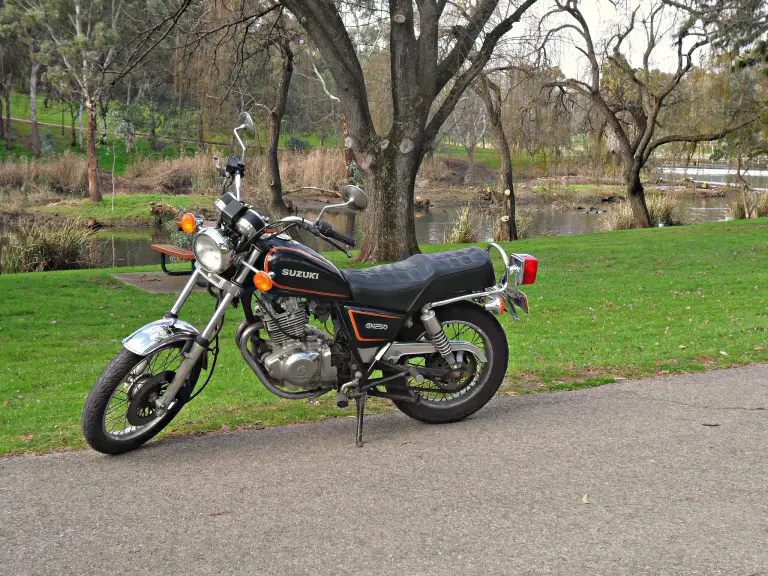
The T500’s engine grew out of the T20 and its two-stroke twin layout was shared with the later GT250. More Suzukis are in the Suzuki collection.
Video: Suzuki T500 Titan
Video by frankiebigtime on YouTube.
Sources
- Suzuki T500, English Wikipedia: history, engineering, racing, GT500