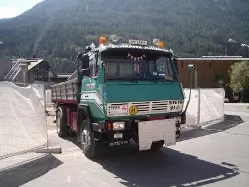
The Steyr 90 series was the cab-over lorry Steyr-Daimler-Puch introduced in 1968 to replace the bonneted 680–880 trucks. Its angular cabin with very large glass surfaces stayed in production through the 91 of 1978 and the 92 of 1986, and the same shape survived into the twenty-first century under the Chinese badge Sinotruk.
Steyr 90 series at a glance
| Maker | Steyr-Daimler-Puch AG, Steyr |
|---|---|
| Introduced | 1968 (90), 1978 (91), 1986 (92) |
| Layout | cab over engine, rear-wheel drive, all-wheel drive from 1969 |
| Cabin | angular Typ 160 design with an offset radiator opening |
| Engines | 6.0 and 8.1-litre sixes, 12-litre V8 |
| V8 introduced | 1971, the only 90 with a tilting cabin |
| Model range | from the 790 to the four-axle 1890 |
| 1890 four-axle | about 50 built for Switzerland |
| 91 engines | 6.6 and 9.7-litre sixes, 12-litre V8 |
| Military version | 91M from 1983, 1,200 sold to Canada |
| Built in China | 9,000 trucks in 1998 by CNHTC |
History of the Steyr 90 series
A truck developed alone
The 90 series came about after Steyr failed to link up with another European lorry maker and decided to go it alone. The new Typ 160 cabin replaced the outdated bonneted 680–880 range. It was angular, with very large glass surfaces, and the good visibility helped sales for construction and distribution work. Two details identify it: an asymmetric radiator opening, which lasted until the end of Steyr truck production, and a standard roof hatch. The 90 cabin did not tilt; instead it had a large front opening for maintenance. Buyers could order 6.0 or 8.1-litre six-cylinder diesels or a 12-litre V8, also turbocharged. The V8, first shown in 1971, was the only 90 with a tilting cabin, and the 6.6-litre WD 612 engine followed in 1976. A smaller 590/690 range with a modified Hanomag-Henschel cab joined the line in 1969 and lasted until 1982.
Names and numbers
Model names had three or four digits: the first one or two gave the payload in tonnes and the last two were always “90”. The range ran from the 790 to the four-axle 1890, of which only about 50 were built for Switzerland, where special rules limited the maximum weight per axle. Considering the comparatively low production numbers, an unusually wide choice of models and configurations was available; in 1980 about 35 per cent of the lorries on Austrian roads were made by Steyr.
The 91 and the 91M
The modernised Steyr 91 replaced the 90 from 1978. It had a tilt cab, though not in the lighter models, a plastic grille and front bumper, and a better insulated cabin. The four-axle models sold better than before because they were offered in several markets and for heavy construction work. Engines were the 6.6 and 9.7-litre sixes (WD 612 and WD 615) or the 12-litre V8, and the lighter 591 and 691 of 1982 used a detuned 6.6-litre six with an updated Hanomag body. A twelve-litre six was developed but never built because of the tooling cost. Steyr also changed its naming in the 1980s, so that the 1291.31 became the 19S31, with gross weight, an S for civilian and tens of horsepower. The militarised 91M of 1983 was a sales success: 1,200 vehicles went to Canada as the HLVW “Percheron”, assembled there by UTDC and in service from 1990, and others to Saudi Arabia and Greece, where Steyr had built the 680 series until the end of 1984.
Design and features
- Typ 160 cabin: angular, with very large glass surfaces and an asymmetric radiator opening.
- Wide range: from the 790 to the four-axle 1890, with all-wheel drive from 1969 and a sleeper cab later.
- Tilting cab on the 91: better insulated and quieter, with a plastic grille and bumper.
- Military 91M: the basis of the Canadian HLVW Percheron and the Greek army lorries.
Steyr 90 series versions
- Steyr 90 (1968–1978): fixed cabin, 6.0 and 8.1-litre sixes, 12-litre V8 from 1971.
- Steyr 590/690 (1969–1982): smaller range with a Hanomag-Henschel cab.
- Steyr 91 (from 1978): tilt cab, plastic front, heavier four-axle models.
- Steyr 591/691 (from 1982): light models with a detuned 6.6-litre six.
- Steyr 91M (1983): militarised all-wheel-drive version, 1,200 built for Canada alone.
- Steyr 92 (1986): the redesigned cab used by the lighter models.
The lorries that the 90 replaced were the bonneted types, among them the Steyr 380 and the Steyr 480. The company behind them is described with the Steyr-Daimler-Puch article. More vehicles are in the Steyr collection.
Sources
- Steyr 90 series, English Wikipedia: cabin design, engines, model range, 91 and 91M, Canadian order
- Steyr 91, German Wikipedia: model introduction dates, engine outputs, Greek production, China