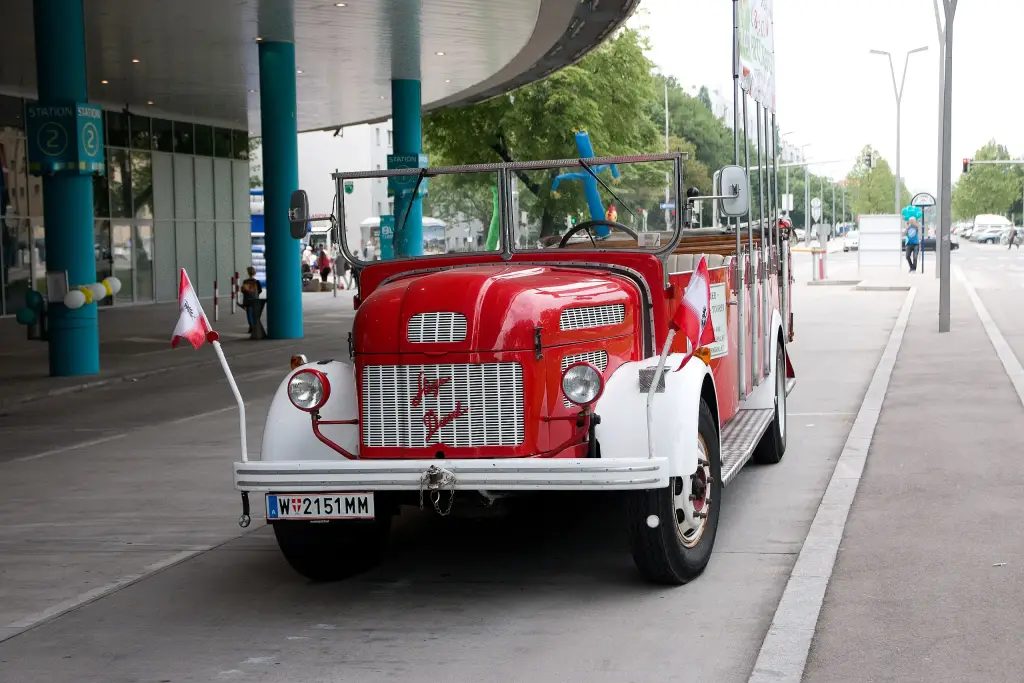
The Steyr 380 was the lorry with which Steyr-Daimler-Puch returned to commercial vehicle building after the Second World War. Introduced in 1948, it was the first post-war Steyr lorry offered with a diesel engine, it came in a very wide choice of bodies, and about 26,000 were built before the revised 380 II replaced it in 1953.
Steyr 380 at a glance
| Maker | Steyr-Daimler-Puch A.G., Steyr |
|---|---|
| Production | 1948–1953 |
| Class | 3.5 to 4-tonne lorry |
| Layout | two axles, bonneted cab, front engine, rear drive |
| Engine | WD 413 four-cylinder diesel, 5.3 litres |
| Power | 85 PS, later 90 PS (62.5 or 66 kW) |
| Gearbox | five-speed, not synchronised, plus reverse |
| Brakes | hydraulic drums with servo assistance |
| Wheelbases | 3,260, 3,710 and 4,200 mm |
| Built | about 26,000 |
| Successor | Steyr 380 II from 1953 |
based on one source: the German Wikipedia article on the Steyr 380.
History of the Steyr 380
Why Steyr built lorries
Before the war Steyr-Daimler-Puch had been above all a car maker. After 1945 the priority was transport and agriculture, cars counted as a luxury, and it was clear that Steyr would not become a major car manufacturer in Europe in the long run. The company therefore changed course: car production in Steyr gave way to tractors and lorries, while motorcycles were built in Graz. No diesel engine was available at first, so the earliest post-war products of 1946 had petrol engines while a modular diesel engine family was developed. It appeared in 1947 as a tractor engine and in 1948 as a lorry engine, and the first lorry of the programme was the Steyr 380 of 1948. In 1953 the technically revised Steyr 380 II took over, recognisable from outside by its changed radiator grille.
Chassis and engine
The 380 was a two-axle lorry in bonneted layout with a long-mounted front engine and rear-wheel drive. A ladder frame welded from steel sheet profiles carried the body, and for buses a low frame with a longer wheelbase and a lower top edge of the frame was offered. The rear axle was a pressed-steel rigid axle on longitudinal leaf springs, the front a drop-forged reverse Elliot axle on leaf springs with hydraulic shock absorbers. Steel disc wheels of 4⅓R–20 carried 7.5–20 tyres, doubled at the rear. Hydraulically operated drum brakes with servo assistance stopped the lorry and a cable-operated parking brake acted on the rear wheels, with worm-and-roller steering without assistance. The WD 413 engine had four cylinders in line, a side camshaft, overhead valves, a silumin crankcase, wet cast-iron liners and individually removable silumin cylinder heads; the five-bearing crankshaft was drop-forged, an in-line injection pump fed the prechambers and an electric starter turned the engine. A single dry clutch passed the drive to a five-speed gearbox that was not synchronised, with straight-cut teeth in the first two gears and helical teeth with dog clutches in the upper three, and a two-piece propeller shaft took it to a spiral-bevel differential that could be locked.
Bodies
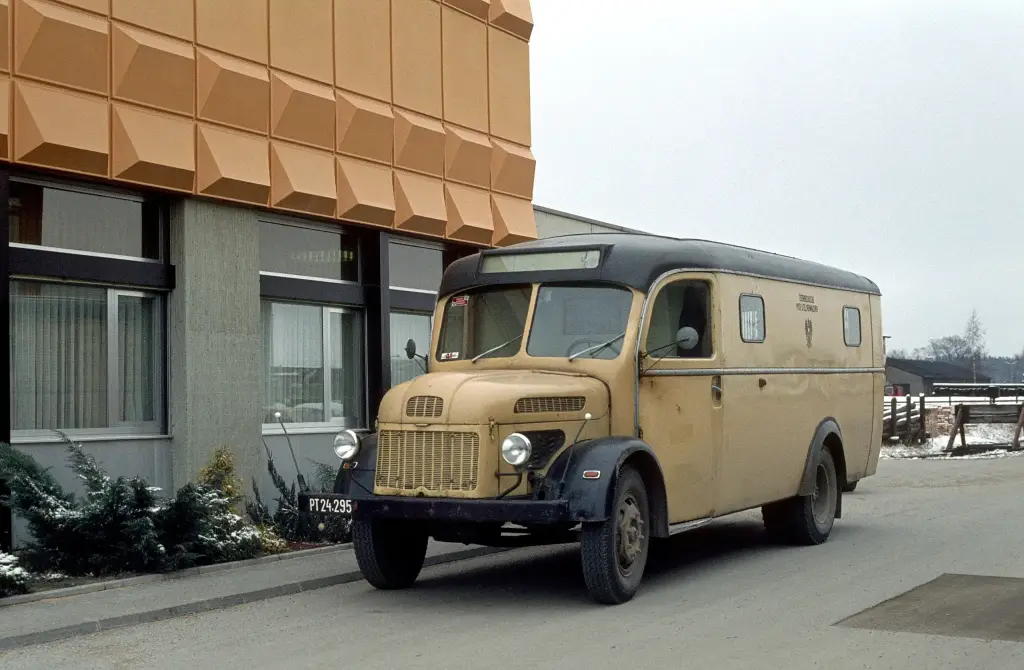
The cab of the platform lorry was insulated, seated three and had a split windscreen; the platform measured 8.2 m², and a hydraulically tipping platform of 6.7 m² was available. The range listed the 380 platform lorry, the 380a bus, the 380b bus with a low frame, the 380e and 380f chassis for large-capacity lorries, the 380k tipper, the 380g tractor unit, the 380q Postbus with the bonnet of the later 480 and the 386a van.
Design and features
- First post-war Steyr diesel lorry: the WD 413 engine of 5.3 litres gave 85, later 90 PS.
- Many bodies: platform, buses, chassis, tipper, tractor unit and Postbus on three wheelbases.
- Modular engine: the same diesel family served tractors as well as lorries.
- Heavy-duty chassis: welded ladder frame, rigid axles on leaf springs and a lockable differential.
Steyr 380 versions
- 380 platform lorry: the standard open lorry with an insulated three-seat cab.
- 380a and 380b buses: bus body and low-frame bus chassis.
- 380k tipper: three-way tipper body.
- 380g: tractor unit for semi-trailers.
- 380q Postbus: with the bonnet of the later 480.
- 386a: box van.
The bigger five-tonne development was the Steyr 480, and the later cab-over lorries are described with the Steyr 90 series. More vehicles are in the Steyr collection.
Sources
- Steyr 380, German Wikipedia: history, chassis, engine, gearbox, bodies, production total