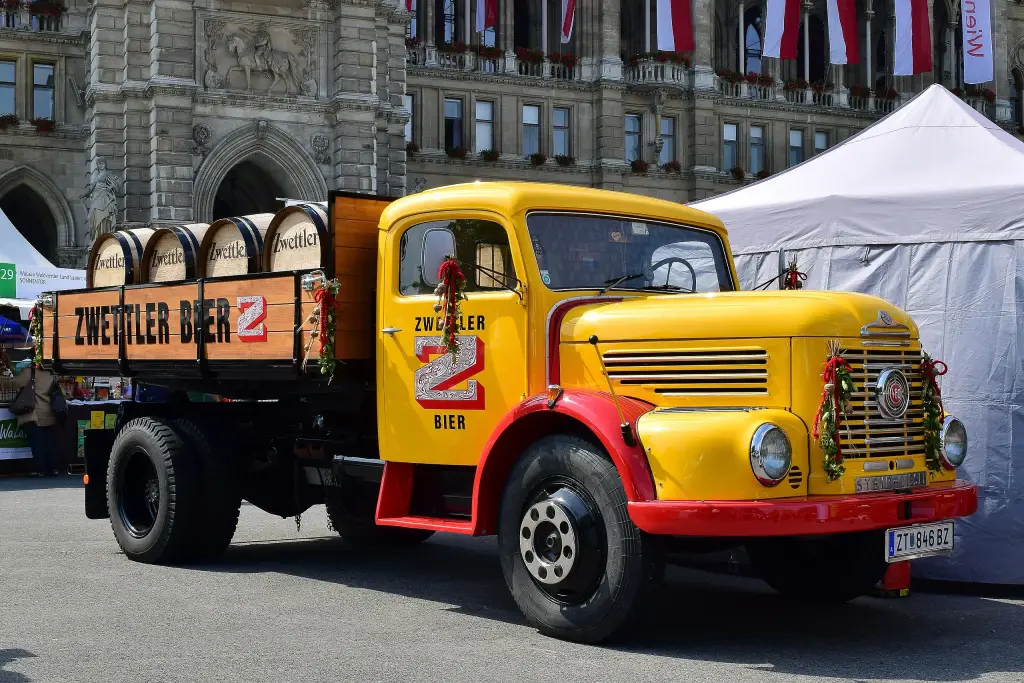
The Steyr 480 was the five-tonne lorry with which Steyr-Daimler-Puch enlarged its range in 1957. It was a strengthened Steyr 380 with a new cab and more chrome on the grille, and it proved so durable that it stayed in production unchanged until 1969.
Steyr 480 at a glance
| Maker | Steyr-Daimler-Puch AG, Steyr |
|---|---|
| Introduced | 1957 |
| Production | 1957–1969 |
| Class | five-tonne lorry |
| Developed from | Steyr 380 |
| Layout | two axles, bonneted cab, front engine, rear drive |
| Engine | WD 413c four-cylinder diesel, 5.3 litres |
| Power | 95 PS |
| Gearbox | five-speed with dog clutches |
| Front axle | rigid axle on leaf springs, ZF Gemmer steering |
| Versions | 480, 480f, 480k, 480g, 480u |
| From 1961 | 480z with six tonnes payload |
based on one source: the German Wikipedia article on the Steyr 480.
History of the Steyr 480
A stronger 380
The Steyr 480 appeared in 1957 as the reinforced version of the Steyr 380. Its cab was newly designed and carried more chrome decoration, especially on the radiator grille. The first 480 had already appeared in 1956 as a forward-control bus. The type became a popular vehicle, particularly as a fire engine and as a beer lorry, and it remained unchanged until production ended in 1969. The Austrian army also bought Steyr 480s. The range included the 480 in normal form, the 480f as a large-capacity lorry, the 480k tipper, the 480g tractor unit and the 480u with a long-wheelbase chassis; in 1961 the strengthened 480z with a payload of six tonnes joined them.
Technique
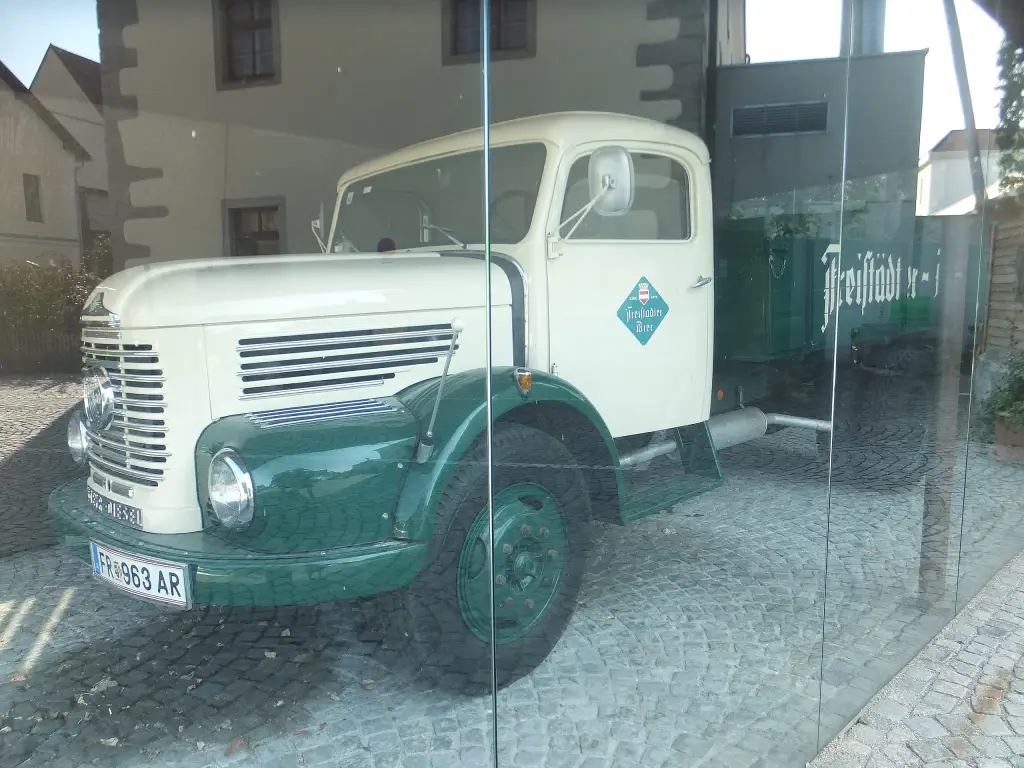
Technically the 480 largely matched the smaller 380: a two-axle bonneted lorry with a front engine and rear-wheel drive. The rear axle was a rigid axle on double leaf springs, the front a rigid reverse Elliot axle on leaf or semi-elliptic springs with Gemmer steering from ZF Friedrichshafen. The engine was the four-stroke naturally aspirated diesel WD 413c developed from the 380 unit, with four cylinders in line, 5.3 litres and 95 PS; its cylinders had wet liners and individually removable cylinder heads. A hydraulically operated single dry clutch passed the torque to a five-speed gearbox with dog engagement, and a two-piece propeller shaft, with an additional intermediate gearbox if ordered, took it to the rear axle. The cab was rubber-mounted and insulated, seated three people and had a one-piece windscreen with a defroster.
Design and features
- New cab: a redesigned cab with more chrome, especially on the grille.
- 95 PS diesel: the WD 413c, a development of the engine used in the 380.
- Long model life: unchanged from 1957 to 1969, a sign of how well the type suited its buyers.
- Many bodies: normal, large-capacity, tipper, tractor unit and long-wheelbase chassis.
Steyr 480 versions
- 480: the normal five-tonne lorry.
- 480f: large-capacity lorry.
- 480k: tipper.
- 480g: tractor unit.
- 480u: long-wheelbase chassis.
- 480z (from 1961): strengthened version with six tonnes payload.
The lorry it was developed from is the Steyr 380, and the cab-over types that followed are described with the Steyr 90 series. More vehicles are in the Steyr collection.
Sources
- Steyr 480, German Wikipedia: introduction, history, versions, engine and chassis