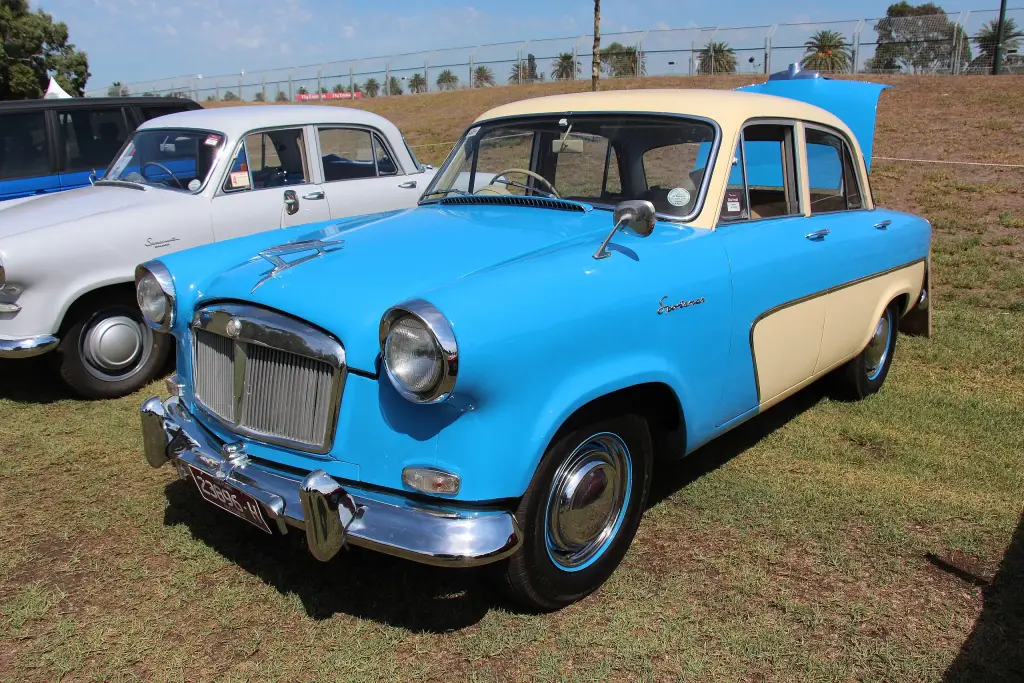
The Standard Sportsman, also called the Standard Vanguard Sportsman, was a sports saloon built by the British Standard Motor Company from 1956 to 1958. A more powerful and more expensive version of the Vanguard Phase III, it was a commercial failure, with fewer than a thousand cars built.
Standard Sportsman at a glance
| Maker | Standard Motor Company, Coventry |
|---|---|
| Production | 1956–1958 |
| Basis | Standard Vanguard Phase III |
| Body | four-door saloon, unitary construction |
| Engine | 2,088 cc four-cylinder |
| Bore and stroke | 85 mm × 92 mm |
| Carburettors | two SU |
| Compression | 8:1 |
| Power | 90 bhp (67 kW) |
| Gearbox | three-speed with overdrive, column shift |
| Top speed | 146 km/h (90 mph) |
| 0–97 km/h | 19.2 seconds |
| Price at launch | £1,230 |
| Sold by 1958 | 901 |
There is no English Wikipedia article on the Standard Sportsman; this page is based on the German article. Only one free photograph of the model was available.
History of the Standard Sportsman
Plans under the Triumph name
The Standard Vanguard had represented Standard in the middle class since 1948, and from autumn 1955 the third generation, the Phase III, was on sale. Unlike the Phase I and II, which had each been a single model, the Phase III was soon split into several versions. The first step was a more powerful and more expensive variant aimed at sporting drivers, followed later by a deliberately simple version called the Ensign. At first Standard planned to sell the sporting saloon under the Triumph name, which had belonged to the group since 1939 and was then building the TR3 roadster; the model name Renown, unused by Triumph since 1954, was intended. Shortly before production began, after Triumph badges had already been ordered and delivered, the decision was taken for reasons unknown to sell the car as a Standard, and the name Sportsman was chosen on the spur of the moment.
Design and engineering
The Sportsman was available only as a four-door saloon. Its unitary body followed the Vanguard Phase III’s Ponton shape, with a stepped rear and a trapezoidal passenger cell, and the design went back to the American designer Carl Otto, who borrowed features from contemporary Chrysler, Ford and Studebaker models. Only the front was unique: instead of the Vanguard’s full-width radiator opening, the Sportsman had a rectangular, broadly framed chrome grille with many vertical bars, which some writers compared with the MGA’s. The headlamps had chrome rather than body-coloured rings, and two-tone paint was a particular feature, the side crease forming the boundary between the colours and emphasised by a chrome strip. Leather seats were available. The chassis had independent front suspension with coil springs on a subframe and a live rear axle on semi-elliptic leaf springs, with Lockheed drum brakes of a larger diameter than the Vanguard’s.
Performance and sales
The engine was largely the Vanguard Phase III four, also used in modified form in the Ferguson TE20 tractor. For the Sportsman it received two SU carburettors instead of one, a raised compression ratio of 8:1 and a different inlet manifold, lifting output to 90 bhp. A three-speed manual gearbox with overdrive, operated by a column shift, drove the rear wheels. A 1956 test by The Motor recorded a top speed of 146 km/h and 0–97 km/h in 19.2 seconds; critics argued that the transmission, carried over from the Vanguard III, worked against the car’s claimed sportiness. At its launch in 1956 the Sportsman cost £1,230, about £200 more than a Vanguard Phase III and £180 more than a Wolseley 6/90, but £300 less than the considerably more powerful Jaguar Mark I. It sold unexpectedly badly: by 1958 Standard had disposed of only 901 cars. Some sources report that further Sportsmans, including a few estates, were built to special order until 1960 from unused stocks of engines, but the size of this post-production batch is unclear.
Design and features
- Sports engine: 2,088 cc with twin SU carburettors and 8:1 compression for 90 bhp.
- Two-tone paint: the side crease separated the colours, with a chrome strip along it.
- Distinctive grille: a rectangular chrome mask with vertical bars, unlike the Vanguard’s.
- Overdrive: a three-speed gearbox with overdrive and column shift.
Standard Sportsman versions
- Sportsman saloon (1956–1958): the only catalogued version, a four-door saloon.
- Special-order cars (to 1960): a small, undocumented number built from remaining engine stocks, including some estates.
The Sportsman was a sporting version of the Standard Vanguard, and its simpler stablemate was the Ensign. The small-car line is represented by the Standard Ten; more cars are in the Standard collection.
Sources
- Standard Sportsman, German Wikipedia: development, design, engine, performance, prices, production