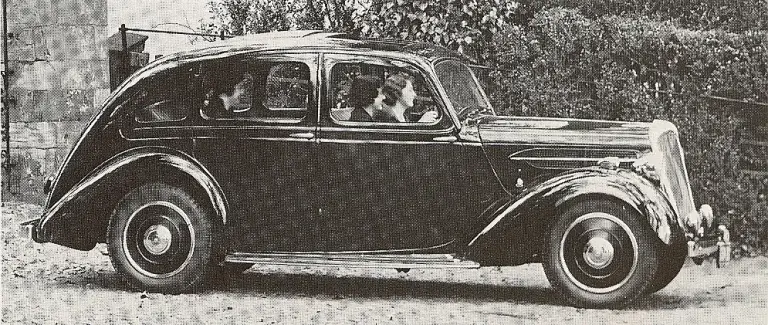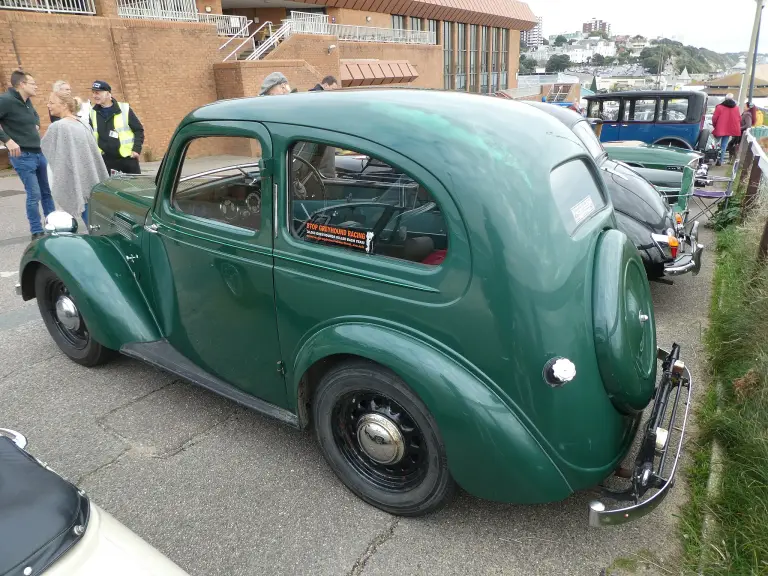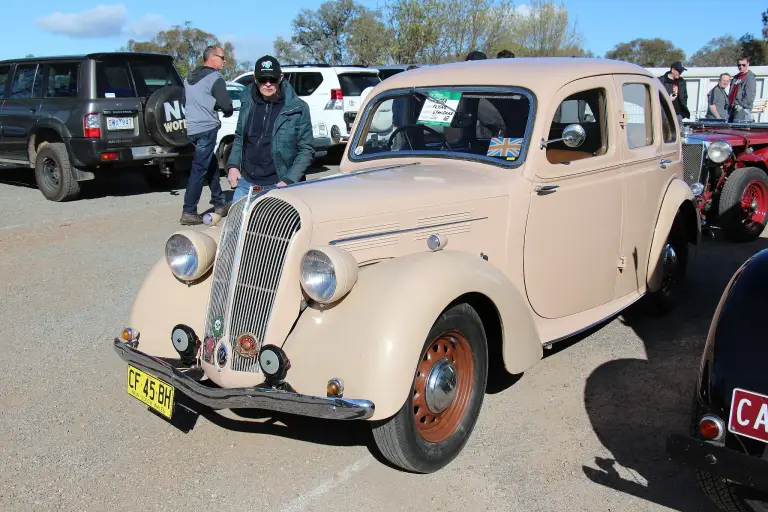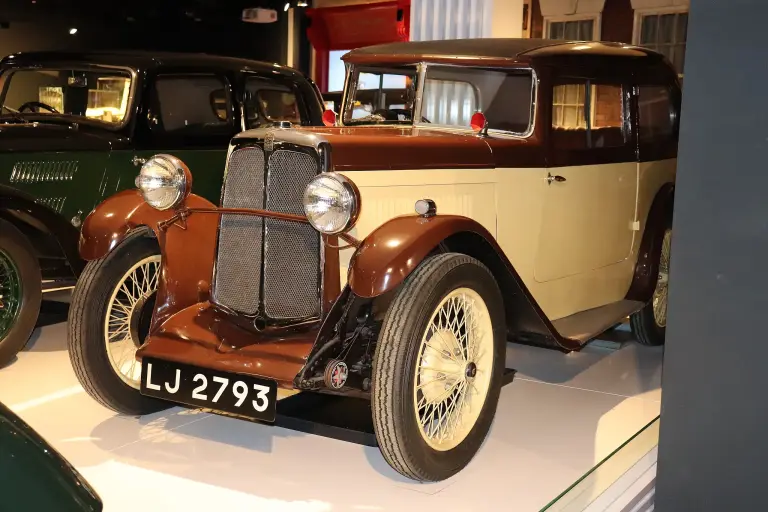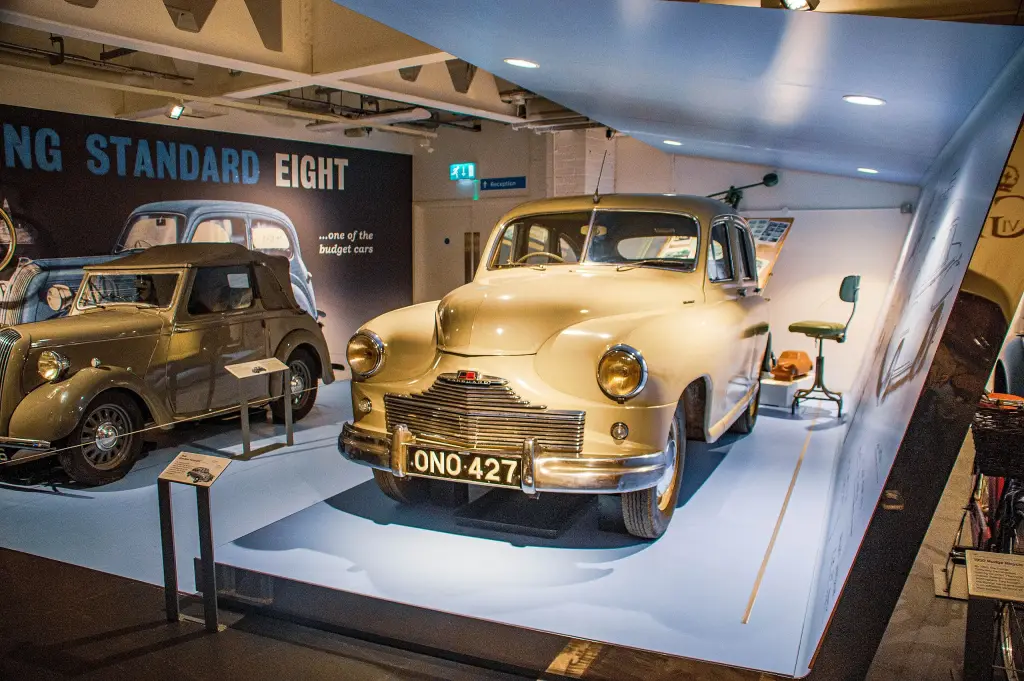
The Standard Vanguard was produced by the Standard Motor Company in Coventry from 1947 until 1963. Announced in July 1947 and designed in 1945, it was Standard’s first post-war car, intended for export around the world, and the first model to carry the new Standard badge with a stylised griffin’s wings.
Standard Vanguard at a glance
| Maker | Standard Motor Company, Coventry |
|---|---|
| Production | 1947–1963 |
| Announced | July 1947 |
| Engine | 2,088 cc overhead-valve four, wet liners |
| Bore and stroke | 85 mm × 92 mm |
| Power | 68 bhp |
| Gearbox | three-speed, column change |
| Overdrive | Laycock de Normanville, from 1950 |
| Suspension | independent front with coil springs, live rear axle |
| Brakes | hydraulic, 9-inch drums |
| Test (1949) | 78.7 mph, 0–60 mph in 21.5 seconds, £671 |
| Bodies | saloon, estate, pickup, 12 cwt van |
Based on one source, the English Wikipedia article on the Standard Vanguard. The Phase III is mentioned only briefly in the available text.
History of the Standard Vanguard
A new car for export
The Vanguard was announced in July 1947 and was completely new, with no resemblance to previous models. It was shown to the public at the Brussels Motor Show in February 1948 and began coming off the assembly lines in the middle of 1948, when all production was allotted to the export trade. The name recalled HMS Vanguard, the last Royal Navy battleship, launched in 1944, and permission to use it involved extensive negotiations with senior naval personnel. An estate car and a utility pickup were announced in September, followed by a 12 cwt delivery van, and aprons were fitted over the rear wheels from September 1949.
Chassis and running gear
The car used a conventional chassis with pressed-steel channel sections welded into a box frame with cruciform bracing, under a slab-sided body. Suspension was independent at the front with coil springs and a live axle on leaf springs at the rear, with anti-roll bars front and rear. The brakes were hydraulic with 9-inch drums all round, and a column gear change was used to make the most of the interior space. The engine was an overhead-valve unit of 85 mm bore and 92 mm stroke with wet cylinder liners, a single Solex downdraught carburettor and a compression ratio of 6.7:1, giving 68 bhp. It was essentially the same engine Standard made for the Ferguson TE20 tractor, with changes for car use. The three-speed gearbox had synchromesh on all forward ratios. The Laycock de Normanville overdrive was announced at the end of 1949 and became available in June 1950 at slightly under £45 including purchase tax; it operated on the second and third gears, in effect creating a five-speed gearbox. Overdrives were cable-operated on top gear until 1954, when an electric solenoid was added and the overdrive worked on the top two gears.
Phases and bodies
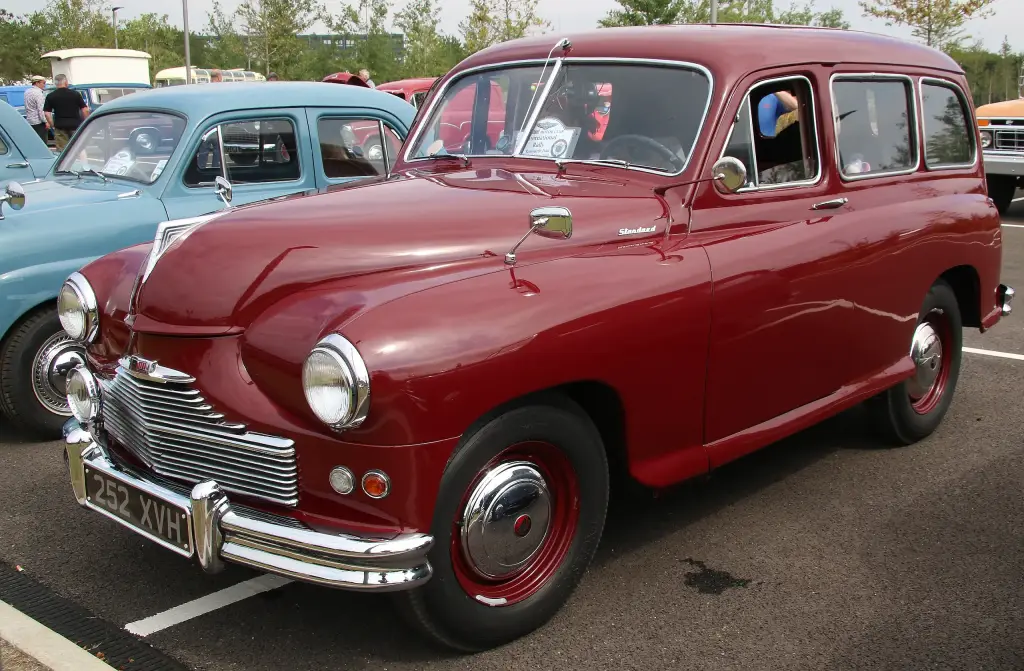
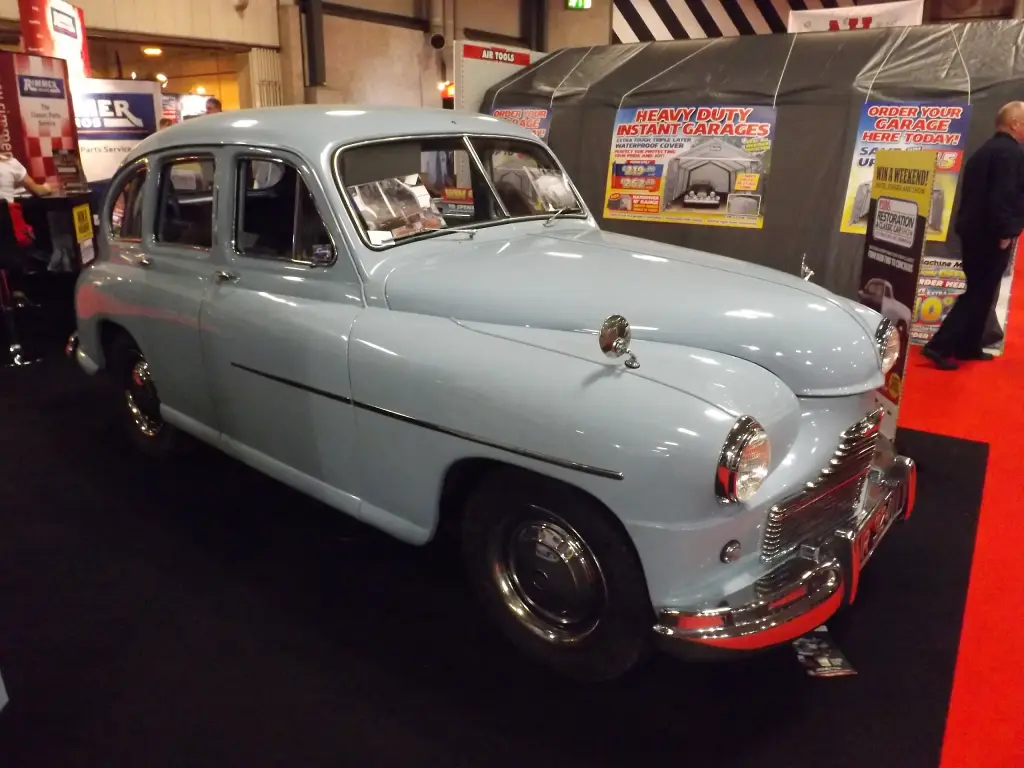
An estate car joined the range in 1950, and there were also a panel van with a 12 long cwt payload and a pickup; all three were used extensively by the RAF, the 12 cwt van being the most common. For Belgium only, some convertibles were made by the Impéria coachbuilding company. A car tested by The Motor in 1949 reached 78.7 mph and accelerated from 0 to 60 mph in 21.5 seconds, returning 22.9 mpg; it cost £671 including taxes. Virtually all output was exported for the first two years, and only in 1950 did significant home-market deliveries begin; in West Germany the Vanguard recorded 405 sales in 1950, more than 70 per cent of British cars sold there that year. The body was updated in 1952 with a lowered bonnet line, a wider rear window and a new grille with a wide horizontal chrome bar, becoming known as the Phase 1A. At the Geneva Motor Show in March 1953 an extensive redesign was unveiled as the Phase II, a pontoon three-box saloon with a boot 50 per cent larger than the Phase I’s and a further enlarged rear window, while mechanically there were few changes: a hydraulic clutch, a compression ratio raised to 7.2:1, no anti-roll bar and wider 6.00×16 tyres. A third generation, the Phase III, arrived in the autumn of 1955 and the Vanguard remained in production until 1963.
Design and features
- First post-war Standard: a completely new design of 1947, aimed at export markets.
- Wet-liner engine: 2,088 cc and 68 bhp, closely related to the Ferguson TE20 tractor unit.
- Early overdrive: the Vanguard and Triumph Renown were the first cars with Laycock de Normanville overdrive in 1950.
- Many bodies: saloon, estate, pickup and 12 cwt van, the last widely used by the RAF.
- Three phases: Phase I, the 1952 Phase 1A facelift and the 1953 Phase II redesign.
Standard Vanguard versions
- Phase I (1947–1952): the original slab-sided saloon.
- Phase 1A (1952): lowered bonnet, wider rear window and a new grille.
- Phase II (1953): pontoon three-box body with a 50 per cent larger boot.
- Estate (from 1950): load-carrying version of the saloon.
- Pickup and 12 cwt van: commercial versions, the van widely used by the RAF.
- Belgian convertibles: built by Impéria for the Belgian market.
The Vanguard replaced the Standard Fourteen and was joined by the sporting Standard Sportsman. More cars are in the Standard collection.
Video: Restoration of a 1949 Standard Vanguard
Video on YouTube.
Sources
- Standard Vanguard, English Wikipedia: Phase I, chassis, engine, overdrive, bodies, Phase 1A and Phase II