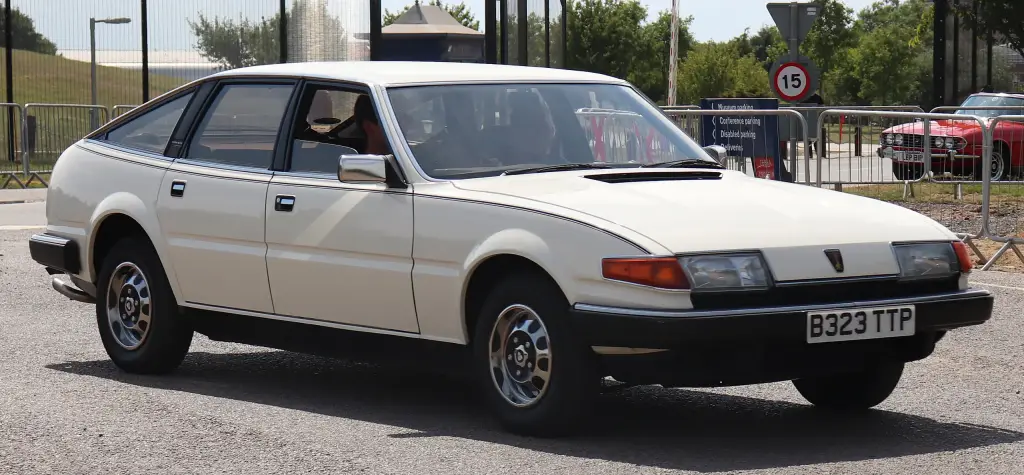
The Standard 2000 was the last passenger car of Standard Motor Products of India, built in Madras from 1985 to 1988. It was a Rover SD1 assembled under licence with an old 2-litre Standard four-cylinder engine, because the company could not obtain a licence for the Rover’s modern units.
Standard 2000 at a glance
| Maker | Standard Motor Products of India, Madras |
|---|---|
| Production | 1985–1988 |
| Basis | Rover SD1 |
| Engine | 2,061 cc four-cylinder, derived from the Standard Vanguard |
| Power | 83 hp (62 kW) at 4,250 rpm |
| Gearbox | four-speed manual, from the Standard 20 |
| Kerb weight | 1,335 kg |
| Top speed | 145 km/h |
| Ground clearance | raised for the Indian market |
| Capacity | 4,000 cars a year, never reached |
Based on one source, the English Wikipedia article on Standard (Indian automobile), which describes the 2000 in a section. No free photographs of the Standard 2000 were found, so the article uses the existing cover image of the record.
History of the Standard 2000
An Indian Standard
Standard Motor Products of India Limited was incorporated in 1948 by Union Company (Motors) and the British Standard Motor Company, and its first locally built Vanguard was finished in 1951 at Vandalur, a suburb of Madras. From 1955 the factory made versions of the Standard Eight and Ten with increasing local content, the Pennant followed in 1959 and the Triumph Herald, sold as the Standard Herald, in 1961. The Herald was redesigned in India as the Gazel in 1972 and remained in production until 1979, with a handful of cars built in the early 1980s.
The SD1 with an old engine
In 1985 the company introduced the Standard 2000, a version of the Rover SD1 powered by a 2,061 cc Standard four-cylinder engine borrowed from an old Standard Vanguard, the same unit used in the Standard 20 commercial vehicle. It produced only 83 hp at 4,250 rpm. The four-speed manual gearbox also came from the Standard 20. With a kerb weight of 1,335 kg, the top speed was 145 km/h. Standard had not been able to acquire a licence for the Rover’s more modern engines and so relied on its existing technology. The car had higher ground clearance for Indian conditions.
A short life
Hopes were high: the Ministry of Industry claimed the 2000 would be successful enough to bring down the black-market price of imported luxury cars. Production capacity was set at 4,000 cars a year, but this was never realised. Low quality, a high price and low performance combined to end the model after only about three years. Passenger-car output had already collapsed in the 1970s, when the annual figure fell from about 3,000 in the early part of the decade to 161 cars in 1976 and six in 1980; in later years the company reportedly built single cars only to keep its licence active. Standard Motor Products was dissolved in 2006 and the old plant was torn down.
Design and features
- Rover SD1 body: the British executive hatchback, assembled in Madras under licence.
- Standard engine: an elderly 2,061 cc four of 83 hp, the only unit Standard could licence.
- Commercial-vehicle gearbox: the four-speed manual was shared with the Standard 20 van.
- Raised ride height: extra ground clearance for Indian roads.
Standard 2000 versions
- Standard 2000 (1985–1988): the only version, a four-door SD1-derived saloon.
The 2000 followed the Indian Standard Herald and the Gazel, and its engine came from the Standard Vanguard. More cars are in the Standard collection.
Sources
- Standard (Indian automobile), English Wikipedia: history of the company, engine, performance, production