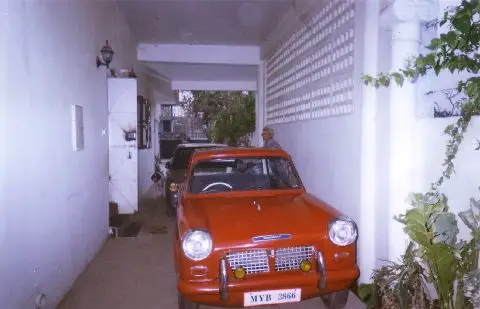
The Standard Herald was the Indian-built version of the Triumph Herald, produced by Standard Motor Products of India in Madras from 1961. It was progressively localised, gained a four-door body designed in India and was replaced by the Standard Gazel in 1972.
Standard Herald at a glance
| Maker | Standard Motor Products of India, Madras |
|---|---|
| Production | from 1961; Gazel successor from 1972 |
| Basis | Triumph Herald |
| Engine | 948 cc Standard-Triumph four |
| Local content | engines, gearboxes and axles made in India by 1965 |
| Mk II | 1966, Vitesse bonnet and front end |
| Mk III | 1968–1971, four-door body developed in India |
| Top speed (Mk III) | 109–112 km/h |
| Companion | 1969–1970 five-door estate, fibreglass roof and tailgate |
| Replaced by | Standard Gazel (1972) |
The Indian Standard Herald is described in a section of the English Wikipedia article on Standard (Indian automobile); background on the British Triumph Herald comes from its own article. No free photographs of the Indian-built model were found, so the article keeps the existing cover image of the record.
History of the Standard Herald
A British design for India
Standard Motor Products of India Limited was formed in 1948 and began building Standard vehicles in Madras in 1951. Its first product was the Standard Vanguard, and from 1955 it made versions of the Standard Eight and Ten with increasing local content; the Pennant joined in 1959. The Tens and the later Heralds and Gazels all used versions of the 948 cc Standard-Triumph four-cylinder engine. Production of the Triumph Herald, known in India as the Standard Herald, began in 1961.
Localisation and the Mk II
Badged as the Standard Herald, the car was at first heavily dependent on British parts, but these were gradually replaced by Indian items as local content increased. By 1965 engines, gearboxes and axles were all made in India. In 1966 the Standard Herald Mk II was introduced with the bonnet and front end of the Triumph Vitesse, but with the outer pair of headlights blocked off and the parking lights and side indicators incorporated there instead. Very late Mk IIs received modified rear bodywork in anticipation of the Mk III, with a different roofline and a bootlid without a recess.
The four-door Mk III and the Gazel
The Standard Herald Mk III, made from 1968 to 1971, received a unique four-door body developed in India to meet the demands of Indian buyers with large families and to compete with the Ambassador and Fiat 1100, both four-door cars. The engine remained the same, with a claimed top speed of 109–112 km/h. In 1969–1970 a very few Herald Mk III Companions were built, five-door estates with fibreglass roofs and tailgates; the Companion name recalled the Standard Ten-based Companion of 1955. In 1972 the Herald was redesigned with a new body, suspension and differential as the Standard Gazel, the first car redesigned and re-engineered in India. The Gazel’s front recalled the Triumph Herald 13/60, its rear lost the Herald’s tail fins and it used a live rear axle on two leaf springs.
Design and features
- Indian production: the Triumph Herald built in Madras from 1961, with local engines by 1965.
- Mk II front end: Vitesse bonnet and wings, with the outer headlights blanked off.
- Four-door Mk III: a body developed in India for local family buyers.
- Companion estate: a small batch of five-door estates with fibreglass roofs and tailgates.
Standard Herald versions
- Standard Herald (from 1961): the original Indian-built Herald.
- Mk II (1966): Vitesse-type bonnet and front end, with side indicators in the blanked headlight recesses.
- Mk III (1968–1971): four-door body, 109–112 km/h.
- Mk III Companion (1969–1970): five-door estate, built in very small numbers.
The Herald was followed by the Standard 2000, and its engine family also powered the Standard Ten. More cars are in the Standard collection.
Sources
- Standard (Indian automobile), English Wikipedia: Indian production, Mk II, Mk III, Companion, Gazel
- Triumph Herald, English Wikipedia: origin of the Herald, 948 cc engine