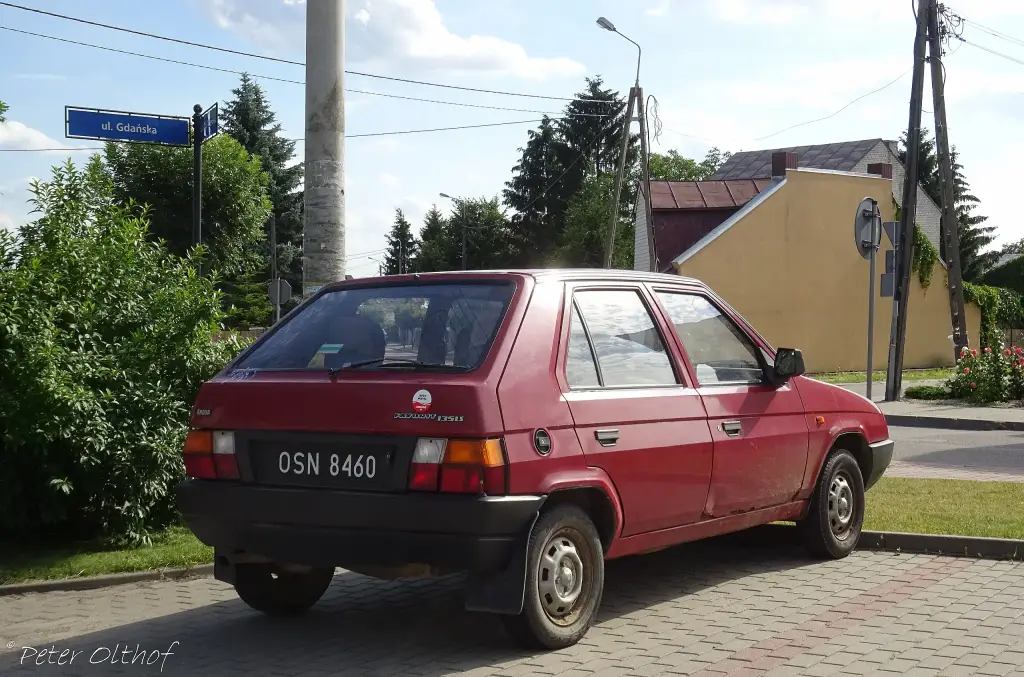
The Škoda Favorit was a small family car built by AZNP, later Škoda Auto, from 1987 to 1995. It was the company’s first car with a transverse front engine and front-wheel drive, its body was designed by Bertone, and with the Forman estate and the Pick-up it gave Škoda a range that could compete with Western European cars for the first time in decades.
Škoda Favorit at a glance
| Maker | AZNP / Škoda Auto, Mladá Boleslav |
|---|---|
| Production | 1987–1995 |
| Factory type | 781 (Forman 785, Pick-up 787) |
| Body | five-door hatchback; estate; two-seat pick-up |
| Layout | front engine, transverse, front-wheel drive |
| Engine | 1,289 cc four-cylinder OHV |
| Power | 46 kW (63 PS) at first |
| Gearbox | five-speed manual |
| Body design | Bertone, Turin |
| Luggage | 251 litres, 1,038 with the rear seat folded |
| Replaced by | Škoda Felicia in 1994 |
History of the Škoda Favorit
A car designed against the clock
The Favorit began as the Type 780 and then 781 project, developed at a time when European makers were moving to front-wheel drive with a transverse engine for smaller, lighter and more economical cars. Talks with Wartburg and Trabant about a joint project went nowhere, so Škoda developed its own. The government approved the new front-wheel-drive car in 1982, work on it began in 1983 and the design was finished only in mid-1985, full production starting in 1987; the car was shown publicly in July 1987 at the Brno engineering fair. Because no Czechoslovak studio could design a complete body for export markets in the time allowed, Škoda signed a contract with Bertone on 1 June 1983 for five body variants for 28 million Kčs. Bertone designed the exterior and the interior; the engineering was Škoda’s own. A four-door saloon and a two-door coupé were designed too but never built.
Bodies and engines
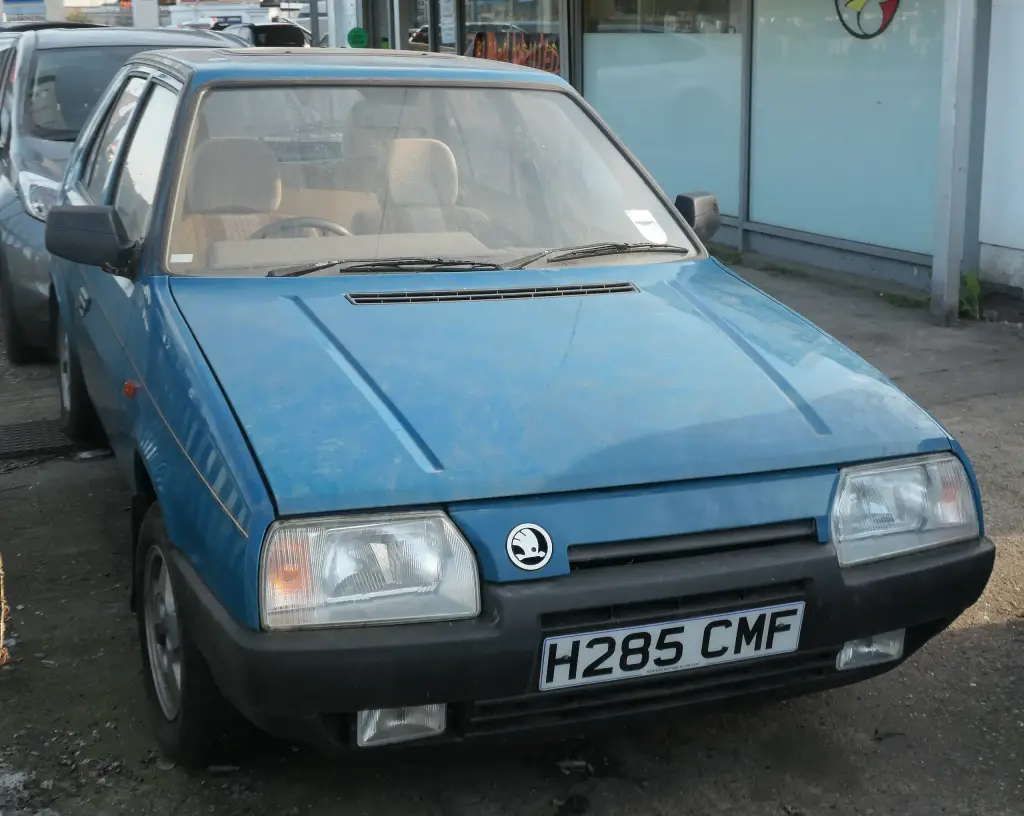
All versions used the same 1,289 cc overhead-valve four, at first with 46 kW at 5,000 rpm and a five-speed gearbox. The five-door hatchback was the original; the Forman estate, Type 785, appeared in 1990 and was known in Britain as the Favorit Estate, its name coming from the Czech word for a waggoner and not from the film director Miloš Forman; the Pick-up, Type 787, followed in 1991 as a two-seat utility with a redesigned rear axle. After Volkswagen took over in 1991, the Favorit received fuel-injected catalytic converter versions badged Li, GLi and GLXi, better door hinges, Volkswagen seats, dashboards and instruments, stronger door beams and a redesigned front. A further round of changes in 1993 brought engine and electrical upgrades and bigger bumpers. Special editions included the Black Line, the Silver Line and the rare Solitaire, and Metalex built the MTX Roadster; Škoda also built the Eltra 151 electric cars on Favorit mechanicals.
What it meant for Škoda
The Favorit was the second car in the Eastern bloc, after the Lada Samara, to be a front-wheel-drive design of its own rather than a foreign licence, and it could be compared with Western cars on handling and practicality. That reputation was one of the decisive factors in the privatisation of the company in 1991, when Volkswagen became the owner. It was replaced in 1994 by the Felicia, which was developed with Volkswagen and kept the Favorit’s core structure. In Britain about 50,000 were sold between 1989 and 1995, though only 232 were still on the road in December 2016.
Design and features
- Front-wheel drive at last: Škoda’s first transverse-engined, front-driven car and the end of the rear-engined era.
- Bertone body: exterior and interior styling from the Turin studio, with engineering done in Mladá Boleslav.
- Practical hatchback: 251 litres of luggage, 1,038 with the rear seat folded, and the seat could be removed entirely.
- Easy to mend: a large engine bay and simple mechanicals made home repairs possible.
Škoda Favorit versions
- Favorit hatchback (1987–1995): the original five-door.
- Forman estate (1990–1995): Type 785 five-door estate.
- Pick-up (1991–1995): Type 787 two-seat utility.
- Li, GLi and GLXi: fuel-injected versions after the Volkswagen takeover.
- Black Line, Silver Line, Solitaire: limited editions with extra equipment.
- MTX Roadster and Eltra 151: external convertible and electric conversions.
The Favorit was replaced by the Škoda Felicia and succeeded the rear-engined Škoda 105/120. More cars are in the Škoda collection.
Sources
- Škoda Favorit, English Wikipedia: development, body styles, engines, special editions, UK sales
- Škoda Favorit, Czech Wikipedia: Bertone contract, prototypes, variants, significance