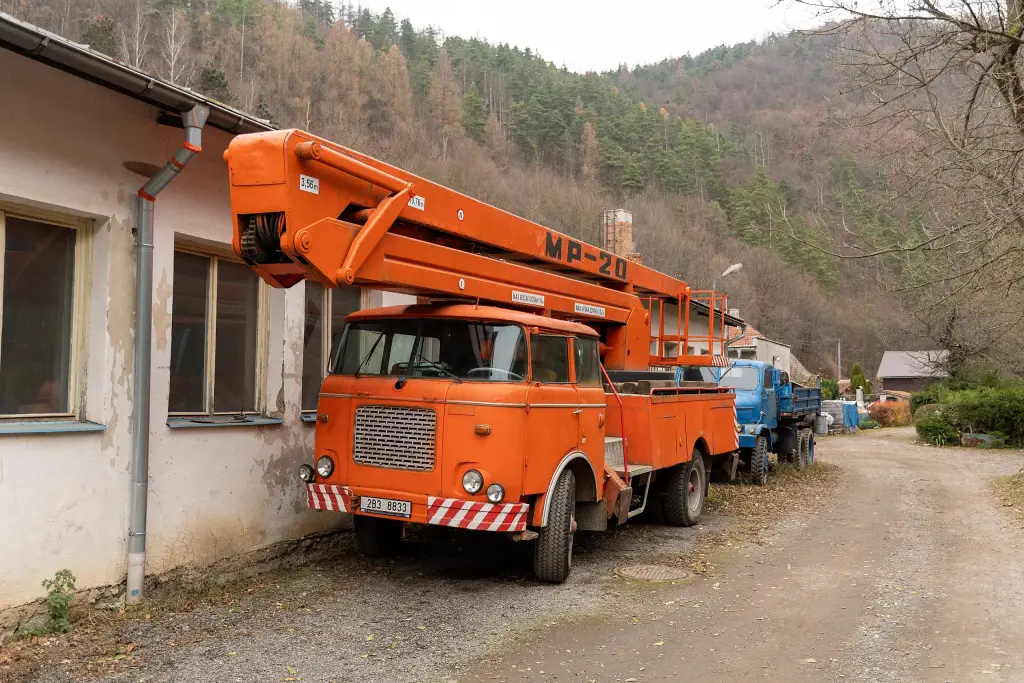
The Škoda 706 was a range of heavy commercial vehicles developed by ASAP in Mladá Boleslav at the end of the 1930s. Its name described it: a seven-tonne lorry with a six-cylinder engine. After the war production moved to Letňany and then to northern Bohemia, where it grew into the LIAZ works, and the last vehicles of the line were built half a century after the first.
Škoda 706 at a glance
| Maker | ASAP, later AZNP, Avia, LIAZ |
|---|---|
| Introduced | end of the 1930s |
| End of the line | last 706 MT built by LIAZ in Jablonec nad Nisou |
| Payload | seven tonnes |
| Engine | six-cylinder diesel |
| Chassis | ladder frame with two rigid axles |
| Suspension | semi-elliptic leaf springs |
| Main bodies | flat-bed lorry, chassis for bodybuilders, bus chassis |
| Chassis variants | 706 N and ND (low frame), 706 D (long frame) |
| Postwar production | 7,877 Škoda 706 R at Letňany |
| Successor works | LIAZ, Liberec region |
There is no English Wikipedia article on the Škoda 706; this page is based on one source, the Czech Wikipedia article.
History of the Škoda 706
The original lorry
The first Škoda 706 was a lorry with a ladder frame, a six-cylinder diesel engine and two rigid axles, only the rear of which was driven, sprung on a pair of semi-elliptic leaf springs. It was normally supplied as a flat-bed lorry, but it was equally common for the factory to deliver only a chassis with engine and cab, leaving the body to a specialist coachbuilder. The 706 replaced the smaller Škoda 606 of 1930–1940 and the more powerful 806 of 1935–1936, and its career was cut short by the Second World War: the last lorries were requisitioned by the Wehrmacht and there was neither material nor capacity for more, because the factory had been turned over largely to armaments.
Bus chassis and the wartime years
For the Protectorate railways and private hauliers Škoda built diesel buses on the low-frame 706 N and 706 ND chassis, and later a wood-gas version, the 706 NG. The bodies came from outside firms such as Sodomka. For the Českomoravské dráhy railway the 706 N was supplied with longitudinal benches for 26 seated and 35 standing passengers, or with transverse seats for 35; the 706 ND took 33 seated and 35 standing, and the gas-engined 706 NG 23 seated and 33 standing. The Brno transport undertaking used 706 NG buses on city routes. During the war a reworked engine was developed in secret, mainly to raise its output.
Bombing, Letňany and Liberec
The 706 R was ready just as the war ended, but on 9 May 1945 the last air raid destroyed most of the Mladá Boleslav works, including the stores and the halls with special machine tools. Only a few, largely incomplete 706 R lorries were assembled from salvaged parts. The political decision that followed left only car production in Mladá Boleslav and moved everything else to the Avia aircraft works in Letňany, which had escaped the bombing; until 1947 most mechanical assemblies still came from Mladá Boleslav. In the following years 7,877 Škoda 706 R lorries were built in Letňany, along with several thousand chassis and complete 706 RO buses. At the start of the 1950s the government ordered Avia back to aircraft work and moved lorry production to the Liberec region, where vacuum cleaner and hat factories were converted into engine, axle and assembly plants in a matter of months. Components began to be made there in October 1951, the first 706 RO bus left the Rýnovice works on 2 January 1952, and by 1954 output had reached 4,120 chassis and lorries in a year. The works became the independent LIAZ company, and the last vehicles of the 706 MT line were built by LIAZ in Jablonec nad Nisou, closing a history of about fifty years.
Design and features
- Seven-tonne six: the model number encoded payload in hundreds of kilos and the number of cylinders.
- Chassis for coachbuilders: many 706s left the factory as bare chassis for buses and specialist bodies.
- Low and long frames: the N, ND and D variants served bus bodywork and larger flat-beds.
- Industrial migration: production moved from Mladá Boleslav to Letňany and then to the Liberec region.
Škoda 706 versions
- 706: the basic flat-bed lorry or chassis.
- 706 N: low frame for bus bodies.
- 706 D: long frame with a 1,000 mm longer wheelbase.
- 706 ND: low and long frame for larger buses.
- 706 R: the postwar reworked lorry, built at Letňany.
- LIAZ 706 RT and MT: later trambus-cab lorries of the same line.
The chassis also carried the Škoda 706 RTO bus, and Škoda’s lighter lorry of the period was the Škoda 150. More vehicles are in the Škoda collection.
Sources
- Škoda 706, Czech Wikipedia: designations, chassis variants, war, Letňany, move to LIAZ