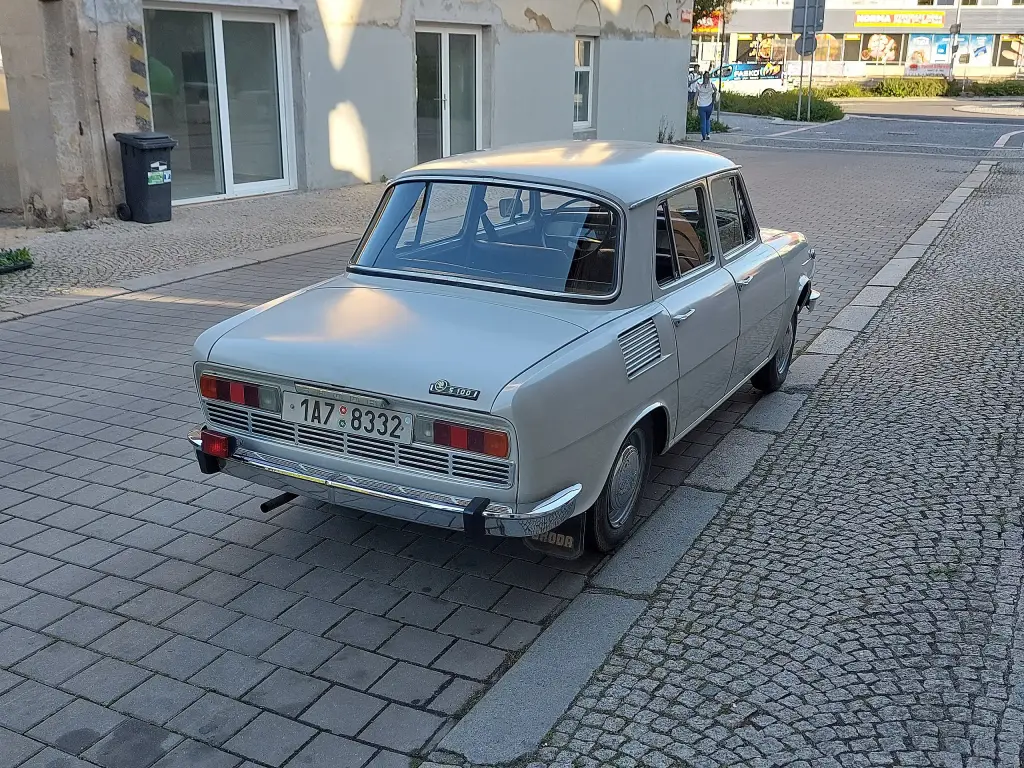
The Škoda 100 and Škoda 110 were two versions of the same rear-engined, rear-wheel-drive compact saloon built by AZNP in Mladá Boleslav from 1969 to 1977. They replaced the 1000 MB and 1100 MB with a squarer body and stronger equipment, and they were the first Škoda cars to exceed a million in production.
Škoda 100 at a glance
| Maker | AZNP, Mladá Boleslav (now Škoda Auto) |
|---|---|
| Production | 1969–1977 (110 R coupé to 1980) |
| Predecessors | Škoda 1000 MB and 1100 MB |
| Layout | rear engine, rear-wheel drive |
| Engine, 100 | 988 cc four-cylinder OHV, 35 kW |
| Engine, 110 L | 1,107 cc four-cylinder OHV, 39 kW |
| Engine, 110 LS | 1,107 cc, 45.6 kW, from the 110 R |
| Top speed | 125 km/h (100), 135 km/h (110 L), over 140 km/h (110 LS) |
| Gearbox | four-speed manual |
| Front brakes | Dunlop disc brakes under licence |
| Built | 1,079,798 of all versions |
| Replaced by | Škoda 105/120 in 1976 |
History of the Škoda 100
A new body on the old bones
Work on the replacement for the 1000 MB began in 1968, when the Mladá Boleslav plant was being rebuilt and a facelift of the ageing car was prepared at the same time. A rough prototype of 1965 already had the same roof and pillars as the 1000 MB but squarer wings and ends. Series production of the new car started on 25 August 1969 under the internal type number 722. The body was more modern and much stiffer, the boot larger, and the rear panel carried wide horizontal lamp clusters that made the car look broader than it was. Inside there was a new steering column and a more carefully styled dashboard, and the front wheels received Dunlop disc brakes built under licence; on the front axle the number of lubrication points fell from eleven to four.
Three engines, three levels of trim
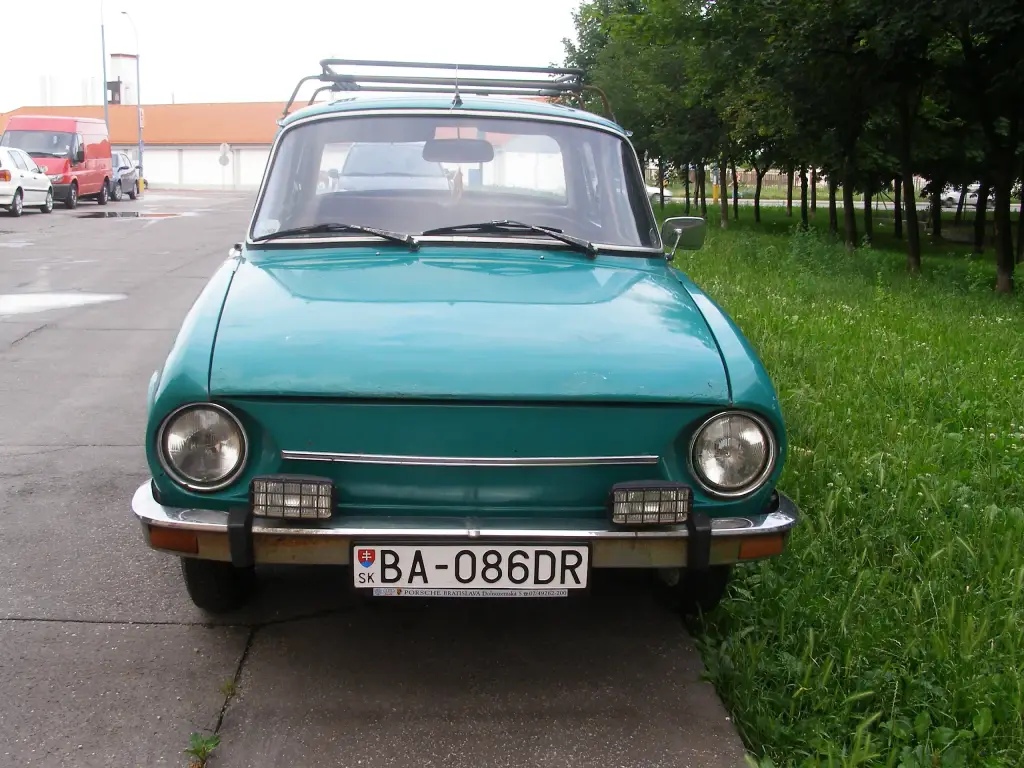
The 100 kept the 988 cc engine of the 1000 MB and was sold as Standard or de Luxe with 35 kW and a claimed 125 km/h. The 110 L used a 1,107 cc engine of 39 kW for 135 km/h, and from 1971 the 110 LS took the 45.6 kW engine of the 110 R coupé with an oil cooler, a modified head and different valve timing, which pushed the saloon past 140 km/h. The L and LS cars were the well-equipped ones, with reclining seats that folded into a bed in the de Luxe models. Between them the 110 L and 110 LS accounted for 259,921 cars.
Updates and the end of the line
The cars were revised in 1972, when draught-free ventilation arrived, the rear quarter windows disappeared and the door mirror moved far forward onto the front wing; a manual choke had been added in the middle of 1970. In 1973 the dynamo gave way to a 12 V 35 A alternator and the recessed Bomoro door handles appeared, and export cars could be ordered with headlamp washers and wipers. From 1970 to 1976 the factory also built rally and circuit versions in groups A1 and A2, split into classes up to 1,000, 1,150, 1,200 and 1,300 cc. Saloon production ended in 1977; the related 110 R coupé lasted until the end of 1980.
Design and features
- Rear-engine layout: engine, gearbox and final drive sit behind the rear axle, with a luggage boot over the front axle.
- Stiffer, roomier body: the 1969 shell was stronger than the 1000 MB’s and offered a larger boot.
- Disc brakes: licence-built Dunlop discs on the front wheels were new for the model.
- Choice of power: from the 35 kW 100 to the 45.6 kW 110 LS with the coupé’s engine.
Škoda 100 versions
- 100 Standard and 100 de Luxe: 988 cc, 35 kW, single headlamps.
- 110 L: 1,107 cc, 39 kW, the volume version.
- 110 LS: from 1971, 45.6 kW engine from the 110 R, four headlamps after the 1973 model year.
- Racing cars: group A1 and A2 rally and circuit versions built from 1970 to 1976.
- 110 R coupé: the two-door derivative, built in Kvasiny until 1980.
The car the 100 replaced was the Škoda 1000 MB, and its two-door relative was the Škoda 110 R. More cars are in the Škoda collection.
Sources
- Škoda 100, English Wikipedia: production years, engines, totals, cultural references
- Škoda 100, Czech Wikipedia: launch date, body changes, brakes, updates, racing versions