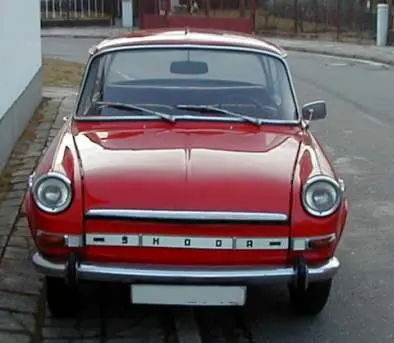
The Škoda 1000 MB and 1100 MB were rear-engined, rear-wheel-drive small family cars built by AZNP in Mladá Boleslav between 1964 and 1969. The letters MB stood for Mladá Boleslav. The 1000 MB was the first series-produced Škoda with a monocoque body and the first with the engine behind the rear axle, and it set the pattern the company followed for the next quarter of a century.
Škoda 1000 MB at a glance
| Maker | AZNP, Mladá Boleslav (now Škoda Auto) |
|---|---|
| Production | 1964–1969 |
| Layout | rear engine, rear-wheel drive |
| Body | four-door saloon; two-door coupés as 1000 MBX and 1100 MBX |
| Engine | 988 cc four-cylinder OHV, water-cooled |
| Power | 44 bhp (33 kW) at first; 48 and 52 bhp later |
| Gearbox | four-speed manual, all-synchromesh |
| Suspension | all-round independent, swing axle at the rear |
| Brakes | drums on all wheels |
| Top speed | 120 km/h (75 mph) |
| Acceleration | 0–100 km/h in 27 seconds |
| Built | 443,141 ‘MBs; 2,517 MBX coupés |
History of the Škoda 1000 MB
A new factory for a new car
Škoda began planning a 1960s car in 1955, the year the 440/445 appeared. The brief asked for a light, economical four-door saloon of no more than 700 kg using 6–7 litres per 100 km, and for the first time the company chose a monocoque shell instead of a separate chassis. Front-wheel drive was studied and rejected as too costly, and the rear-engined layout was adopted, as it had been by Renault, Volkswagen, NSU, Fiat and Hillman for their small cars. The decision meant a completely new plant next to the old one in Mladá Boleslav, covering more than 80 hectares and equipped in 1960–1965 for 400–500 cars a day. Several prototypes were built in 1957, including a front-wheel-drive car and a classic front-engine design, and the rear-engined one won on cost and on export arguments. A fleet of fifty near-production cars was then tested from Scandinavia to Siberia and Tunisia in 1961, and the finished car was presented in April 1964 as the successor to the Octavia.
Engineering and equipment
The engine was a 988 cc overhead-valve four with an aluminium cylinder block and a cast-iron head, mounted behind the rear axle with its radiator and engine-driven fan; slats cut into the rear wings and panel fed air to it. The gearbox was a four-speed all-synchromesh unit and the suspension was independent all round, with a swing axle at the rear and drum brakes on every wheel. The body measured 13 feet 8 inches long and 5 feet 4 inches wide on a wheelbase of 7 feet 10 inches, with a steeply sloping nose and rounded front wings. In Britain the car arrived early in 1965 at £579, cheaper than a Ford Cortina 1200 at £592 or a Hillman Minx Deluxe at £636, and it came with reclining front seats, a heater and demister, a full tool kit, a large boot in front and storage behind the split-folding rear seat.
The MB family grows and goes
The range was steadily extended: a 1000 MB de Luxe with 48 bhp in 1966, then the 1000 MBG and the 1000 MBX coupé with a twin-carburettor 52 bhp engine, and in 1967 the 1100 MB de Luxe and 1100 MBX with the larger 1.1-litre unit. The two-door MBX cars, with their unusual tudor body, sold in very small numbers and are now extremely rare. By the time the Škoda 100 and 110 arrived in August 1969, 443,141 of the ‘MB series had been built. Owners nicknamed the car ‘embéčko’, and early cars, which were troublesome, earned it the joke expansion ‘a thousand small pains’.
Design and features
- Monocoque body: the first series-produced Škoda shell welded from steel pressings rather than built on a frame.
- Rear engine and radiator: cooling air reached the back through slats in the rear wings and panel.
- Light and economical: around 120 km/h and roughly 7 litres per 100 km from a one-litre engine.
- Aluminium engine block: pressure die-cast, a process Renault later licensed from Škoda.
Škoda 1000 MB versions
- 1000 MB (1964): Type 990 saloon, 42 bhp.
- 1000 MB de Luxe (1966): Type 721, 48 bhp and better trim.
- 1000 MBG de Luxe (1966): Type 710 with a twin-carburettor 52 bhp engine.
- 1000 MBX and 1100 MBX: two-door coupés, 2,517 built in total.
- 1100 MB de Luxe (1967): the 1.1-litre engine in the saloon body.
The 1000 MB replaced the Škoda Octavia and was itself replaced by the Škoda 100 and 110. More cars are in the Škoda collection.
Sources
- Škoda 1000 MB, English Wikipedia: development, engineering, British price, production figures, timeline
- Škoda 1000 MB, Czech Wikipedia: prototypes, new plant, design, nicknames