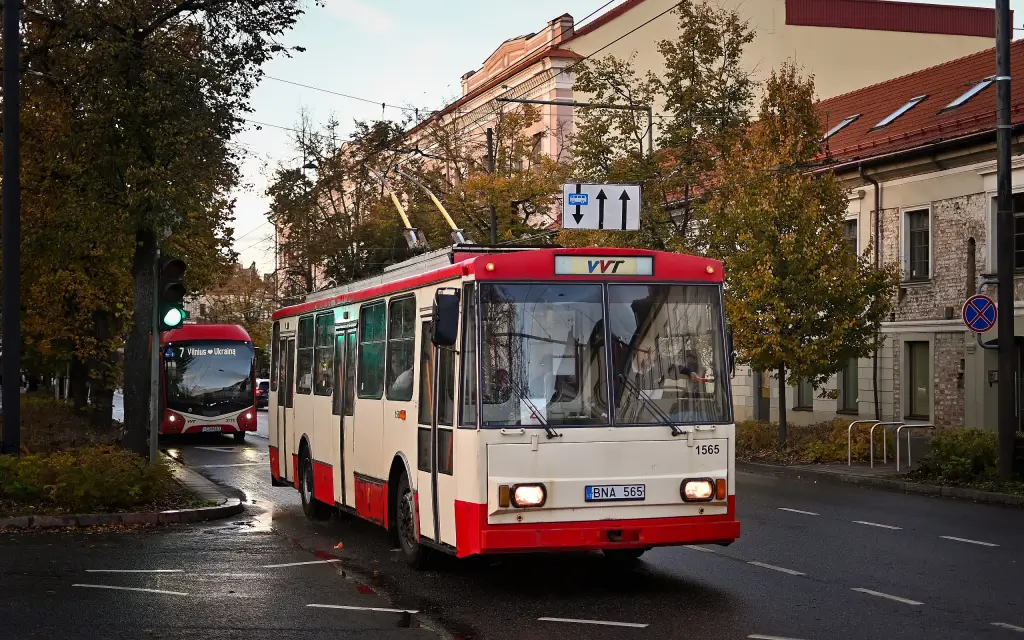
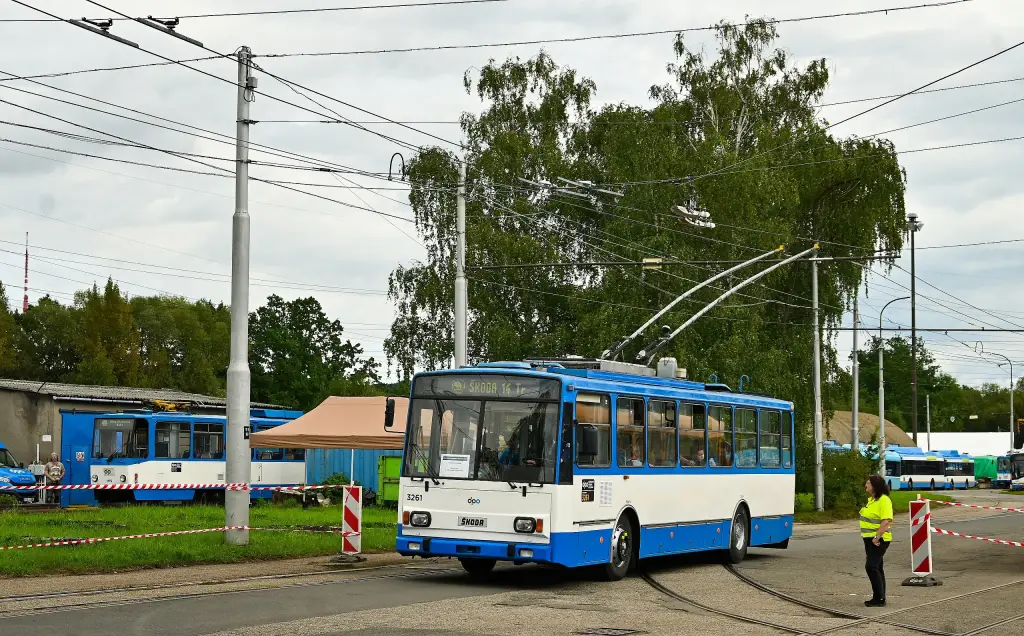
The Škoda 14Tr is a two-axle trolleybus produced by Škoda Ostrov from 1981 to 1998, after prototypes built in 1972 and 1974. It combined the body know-how of the 9Tr with thyristor control, and it became the standard trolleybus of the late Soviet era, with more than three thousand built and delivered across Eastern Europe and the USSR.
Škoda 14Tr at a glance
| Maker | Škoda Ostrov |
|---|---|
| Production | 1981–1998; prototypes in 1972 and 1974 |
| Predecessor | Škoda 9Tr |
| Layout | two axles, unibody, rear-mounted traction motor |
| Body | welded steel frame, steel skin, three twin-leaf doors for home cars |
| Control | thyristor pulse control (TISU) or rheostat-contactor control (RCSU) |
| Interior | transverse leatherette seats, plastic panelling |
| Built | 3,263, plus two bodies for the TV-14Tr trolley train |
| Most delivered | 354 to Kyiv |
| US assembly | 297 as 14TrE, 14TrE2 and 14TrSF, 1994–2004 |
History of the Škoda 14Tr
A design held up by politics
The 14Tr grew out of two failures: an attempt to share a body between the Karosa ŠM 11 bus and the Škoda T 11 trolleybus, and the abandoned Škoda 13Tr project. Škoda drew a new trolleybus in the early 1970s and called it the 14Tr, but work stopped when the authorities planned to replace trolleybus networks with diesel buses. The oil crisis of 1973 changed that calculation and the project was revived. The first prototype, with different front and rear ends from the production cars, was finished in 1972 and sold to Mariánské Lázně in 1974 as car 22, where it ran until 1981; the second went to the same town as car 23 and was scrapped in 1984. Five more prototypes were built in 1980, close to production form, and series production began in 1981. Two 14Tr0 cars, 001 and 002, went to Kyiv for trials that year, one with rheostat-contactor control and one with the new thyristor-pulse system.
Construction
The 14Tr is a two-axle trolleybus with a unibody: frame, side walls, roof and ends are welded from steel sections and pressings and covered with steel skin, and the section below the windows is insulated against heat, noise and vibration. Home-market cars have three twin-leaf folding doors on the right, export cars only two, and the transverse seats are trimmed in leatherette. The electrical equipment uses thyristor pulse control carried over from the last series of the 9Tr. The first series suffered from weak bodies: the 14Tr0 cars were withdrawn early, while the 14Tr01 batch was reinforced after the fact, and later series had thicker pillars and a stronger floor frame from the start.
Where they went
Between 1972 and 1998, 3,263 trolleybuses were built, plus two bodies that formed the single TV-14Tr trolley train of 1985. The largest single order went to Kyiv, which took 354 cars, because Czechoslovakia itself had few large trolleybus systems and Soviet-built vehicles dominated there. A 750-volt prototype was built in 1988 and entered service in Banská Bystrica in 1989. From 1994 to 2004 Electric Transit, a joint venture of Škoda and AAI Corporation, assembled 297 trolleybuses for Dayton, Ohio and San Francisco: shells were built in the Czech Republic and shipped to Hunt Valley, Maryland for initial fitting out to satisfy Buy America rules, with final assembly in the customer cities. The modernised 14TrM was produced from 1995 to 2002.
Design and features
- Unibody construction: a welded steel shell rather than a separate chassis, insulated below the window line.
- Thyristor control: smooth starting and regenerative braking that returned power to the network.
- Two door layouts: three doors at home, two on export cars.
- Export success: the standard trolleybus for cities from Vilnius and Riga to Kyiv and Simferopol.
Škoda 14Tr versions
- 14Tr0: the 1981 verification series, with a weaker body.
- 14Tr01: first production series, reinforced after early problems.
- 14TrM: modernised version built from 1995 to 2002.
- 14TrE and 14TrE2: US-market cars assembled by Electric Transit.
- 14TrSF: San Francisco version, in service until 2016.
- TV-14Tr: a single articulated trolley train of two coupled cars.
The 14Tr was the basis of the articulated Škoda 15Tr. More vehicles are in the Škoda collection.
Video: Skoda 14 tr in Pazardjik
Video by Krassen Panev on YouTube.
Sources
- Škoda 14Tr, English Wikipedia: development, construction, production totals, US assembly
- Škoda 14Tr, Czech Wikipedia: prototypes, body problems, TV-14Tr train, deliveries