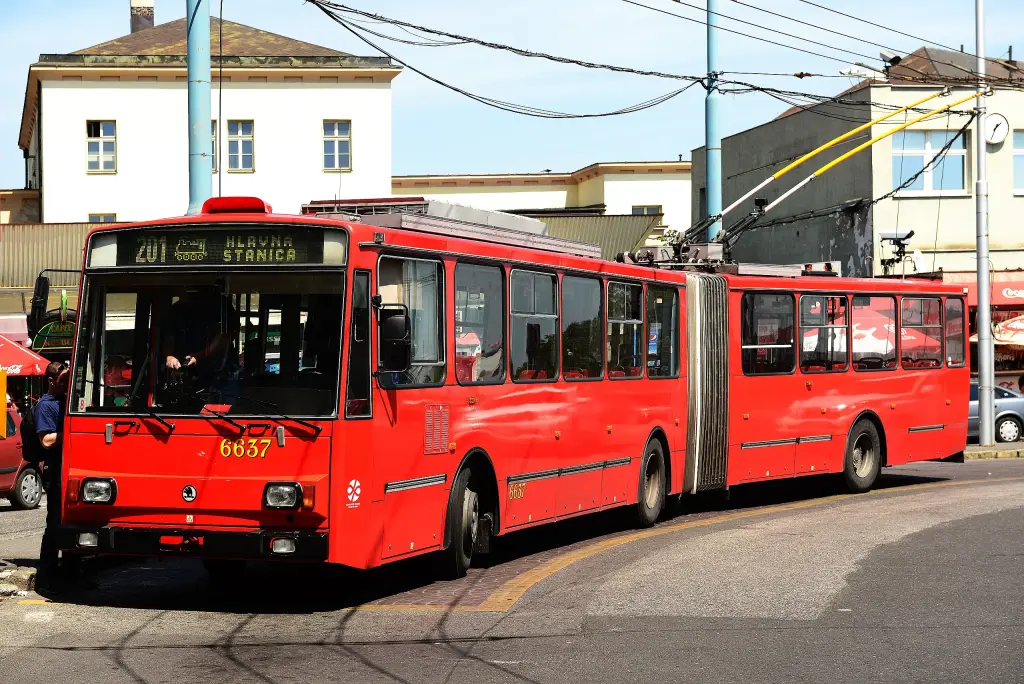
The Škoda 15Tr is an articulated trolleybus built by Škoda Ostrov from 1988 to 2004, with prototypes already in the first half of the 1980s. It was the first articulated trolleybus designed entirely in Czechoslovakia, it shared its parts with the two-axle 14Tr, and from 1995 it was produced in a modernised 15TrM form.
Škoda 15Tr at a glance
| Maker | Škoda Ostrov |
|---|---|
| Production | 1988–2004; prototypes from 1983 |
| Basis | Škoda 14Tr, mechanically and electrically |
| Layout | three axles, articulated, two traction motors |
| Powered axles | middle and rear |
| Body | steel frame with a self-supporting shell, bellows joint |
| Doors | four twin-leaf folding doors on the right |
| Seats | transverse, leatherette upholstery; fluorescent interior lighting |
| Built | 469 as 15Tr, plus 121 of the 15TrM |
| Export | Czechia, Slovakia, Estonia, Hungary, Iran, Latvia, Lithuania, Ukraine |
History of the Škoda 15Tr
Why an articulated trolleybus
The 15Tr was developed in the first half of the 1980s as Czechoslovakia’s first articulated trolleybus of its own design: an earlier 10Tr project was never built and the Škoda-Sanos S 200 was a joint Czechoslovak-Yugoslav venture. It was based on the standard 14Tr in both its mechanical and electrical parts, and it was assembled from identical or modified 14Tr components, which made maintenance and spares much easier for operators. The design was needed for heavily used lines, above all on hilly routes, where a single two-axle trolleybus could not carry the load.
Construction
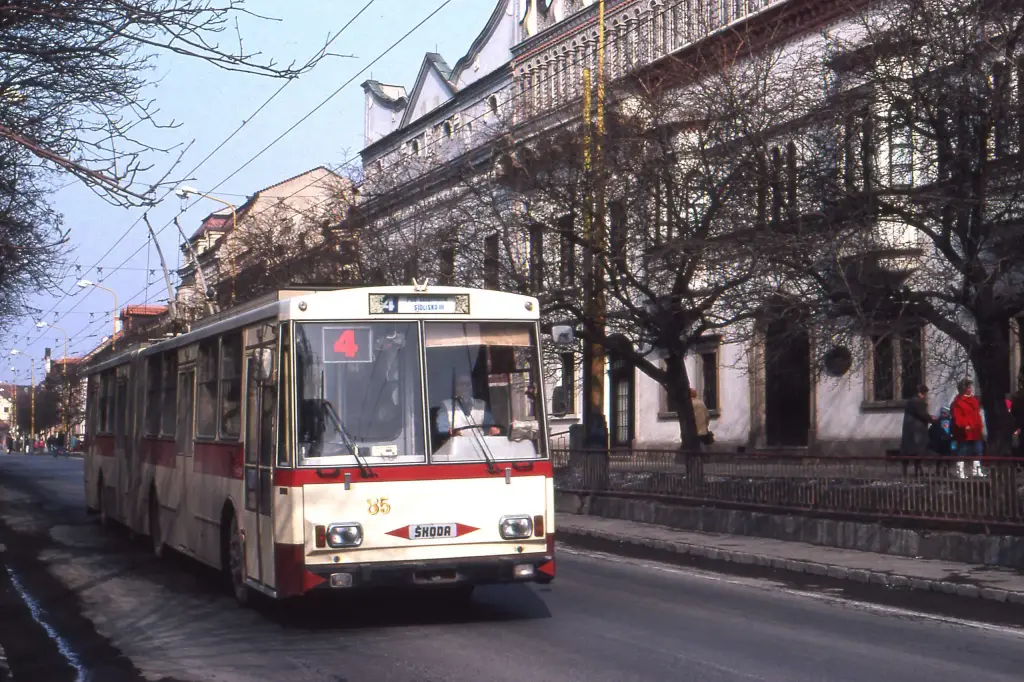
The vehicle is a three-axle trolleybus in two sections, joined by an articulation in the chassis with a bellows around it. A steel frame carries the self-supporting body, and four twin-leaf folding doors open on the right-hand side. The interior is fitted with transverse leatherette seats and fluorescent lighting. The trolleybus has two traction motors, one on the middle axle and one on the rear, of the same type used in the 14Tr; with two driven axles it coped well with difficult terrain. The first delivery series had split windscreens, later cars had one-piece glass, and early vehicles were painted in the standard red and cream of Czechoslovak public transport.
Prototypes and production
The first two prototypes were built in 1983 with partly different electrical equipment. After factory tests the first one ran in Plzeň in 1984 and 1985 as car 500, and part of its front section was later sold to Brno for spares; the second was tested at the works and scrapped in the second half of the 1980s. Three more prototypes followed in 1987 and 1988 and did carry passengers. Series production ran from 1988 to 1995 in the original form, and 469 cars were built and delivered to operators in the Czech Republic, Slovakia, Estonia, Hungary, Iran, Latvia, Lithuania and Ukraine. From 1995 the modernised 15TrM was built until 2005, with 121 cars for Czech, Latvian and Slovak operators, and a 15TrSF version served San Francisco until 2016. A single chassis was also sold to a company in São José dos Campos in Brazil.
Design and features
- Two driven axles: motors on the middle and rear axles gave traction on hills.
- Parts commonality: built from 14Tr components, which simplified maintenance.
- Articulated body: a chassis joint under a bellows allows a much longer vehicle.
- Four doors: faster boarding on busy city routes.
Škoda 15Tr versions
- 15Tr (1988–1995): the original series, split windscreens at first.
- 15TrM (1995–2005): modernised version with updated equipment.
- 15TrSF: San Francisco cars built by Electric Transit.
- 15TrR: factory rebuilds of older bodies with modern equipment.
The 15Tr was developed from the two-axle Škoda 14Tr. More vehicles are in the Škoda collection.
Video: Skoda 15TR-422, Tallinn
Video by Renno Jeerland on YouTube.
Sources
- Škoda 15Tr, English Wikipedia: production, construction, exports, 15TrM and San Francisco cars
- Škoda 15Tr, Czech Wikipedia: development, prototypes, body details, production totals