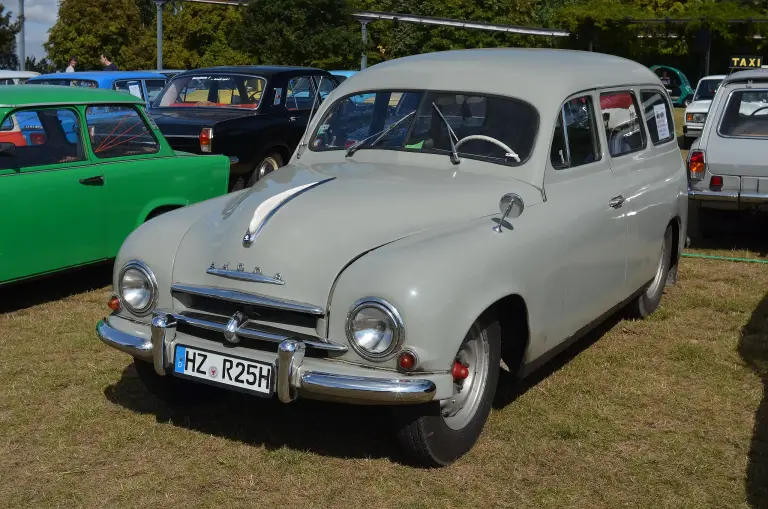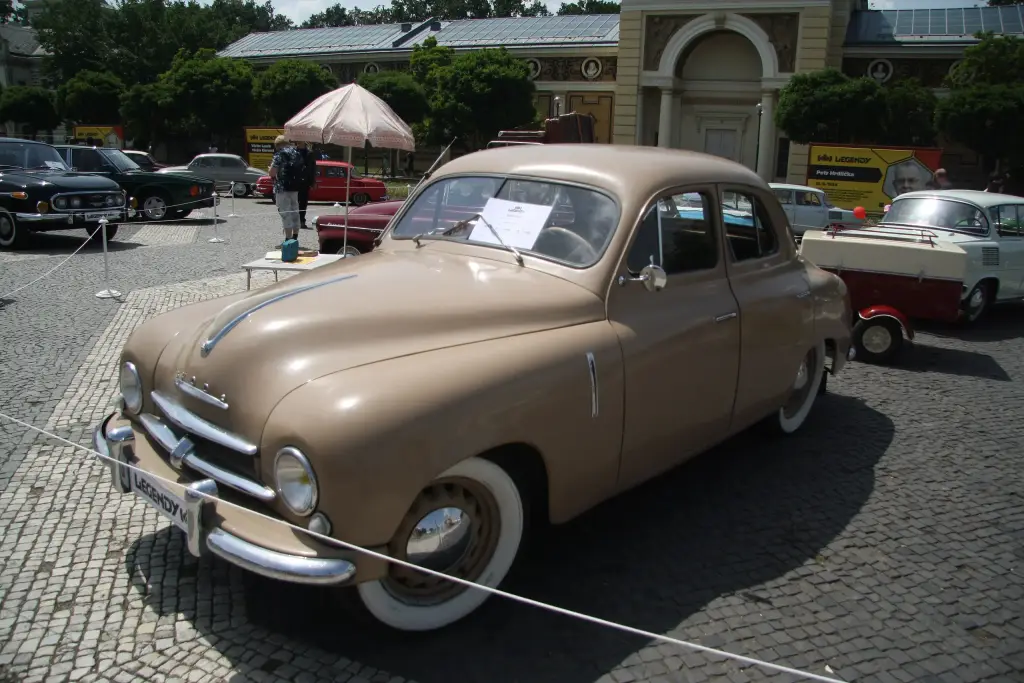
The Škoda 1200 was a family car built by AZNP in Mladá Boleslav from 1952 to 1956. It succeeded the 1101, and it was the first mass-produced Škoda to use a steel ponton body instead of the old mixed frame-and-panels construction. Saloons, estates, vans and about two thousand ambulances were made before the 1201 took over.
Škoda 1200 at a glance
| Maker | AZNP, Mladá Boleslav, Kvasiny and Vrchlabí |
|---|---|
| Production | 1952–1956 |
| Factory type | 955 |
| Predecessor | Škoda 1101/1102 |
| Body | all-steel ponton, welded from pressings |
| Bodies | four-door saloon, three-door van, five-door estate, ambulance |
| Engine | 1,213 cc four-cylinder OHV, water-cooled |
| Power | 36 PS (26 kW) at 4,200 rpm |
| Gearbox | four-speed manual, synchromesh on the top three ratios |
| Wheelbase | 2,685 mm |
| Top speed | 105 km/h |
| Built | more than 67,000 of all body styles |
History of the Škoda 1200
A new body on familiar mechanicals
After the war and above all after February 1948 the Czechoslovak industry was in flux, and Mladá Boleslav needed a modern car that could earn hard currency in the West. The 1101 and 1102 still used a wooden-framed body with a steel skin, which was slow and expensive to build by hand and unsuited to mass production. The new car therefore received a welded all-steel shell, but to save time and money its chassis was based on the 1102: a September 1949 prototype, type 955, shared about 80 per cent of its mechanical parts with that car. The wheelbase was first kept at 2,485 mm and then lengthened to 2,685 mm for every version, which improved space and gave the saloon better proportions.
Engineering and production
The body was designed by Josef Velebný and his team, and for the first time Škoda used a wind tunnel for a production car: tests on 1:5 models cut the drag coefficient by 6 per cent even though the car was 180 mm wider than the Tudor. It was also the first Škoda with a 12-volt electrical system and with a hot-water heater as standard, and it introduced baked synthetic paint in place of nitrocellulose. The engine was the familiar four-cylinder unit bored out to 1,213 cc for 36 PS, enough for 105 km/h but not much more, and utility versions in particular were underpowered. Production was nearly cancelled in December 1950, when the government ordered the Tatra 600 Tatraplan to be moved into the Mladá Boleslav plant and the 1200 project to be stopped; the tooling was nominally scrapped, the company was compensated for more of it than it actually destroyed, and the car survived.
Versions and the end
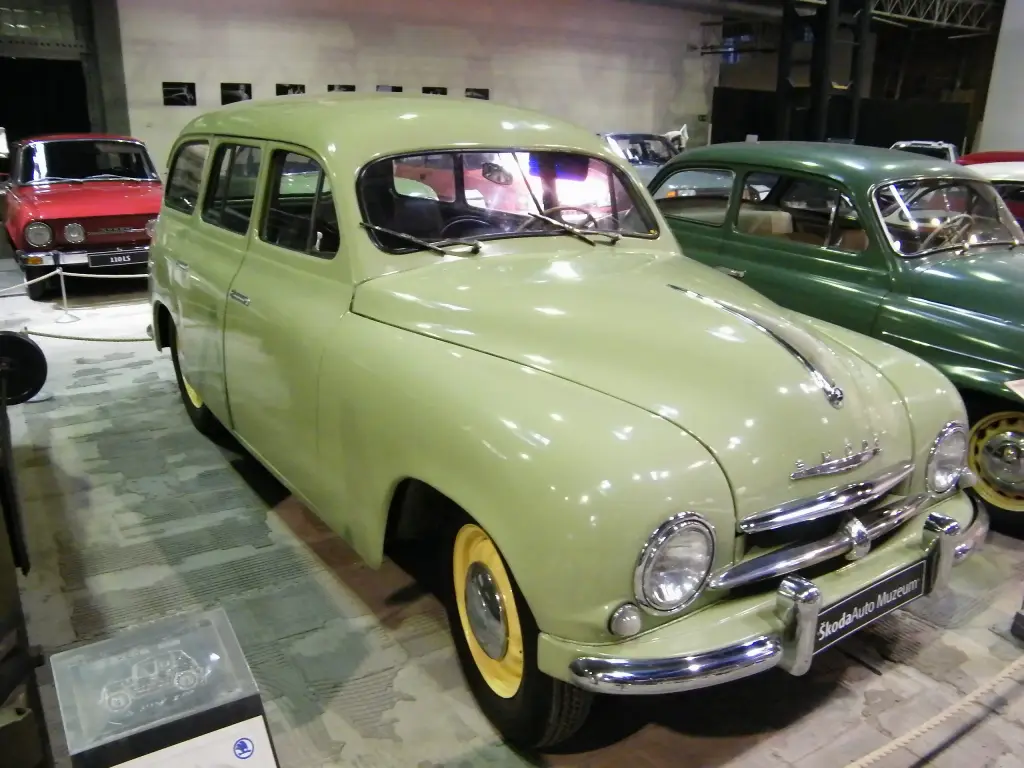
The 1200 was sold as a four-door saloon, a three-door van, a five-door estate and an ambulance, and pick-ups followed. It was known popularly as the Sedan, a name that stuck to the whole family. Most cars were exported, chiefly to Western markets. In 1956 the stronger 1201 replaced it, and the utility versions were eventually taken over by the 1202 built in Vrchlabí.
Design and features
- All-steel ponton body: the first mass-produced Škoda shell welded from steel pressings, suited to automated welding.
- Wind-tunnel development: the first Škoda production car shaped with aerodynamic testing.
- Modern electrics and heating: 12-volt equipment and a hot-water heater as standard.
- Shared mechanicals: about 80 per cent of parts carried over from the 1102, which kept the car cheap to build.
Škoda 1200 versions
- 1200 saloon: the four-door family car, the main version.
- 1200 STW estate: five-door station wagon.
- 1200 van: three-door light delivery vehicle.
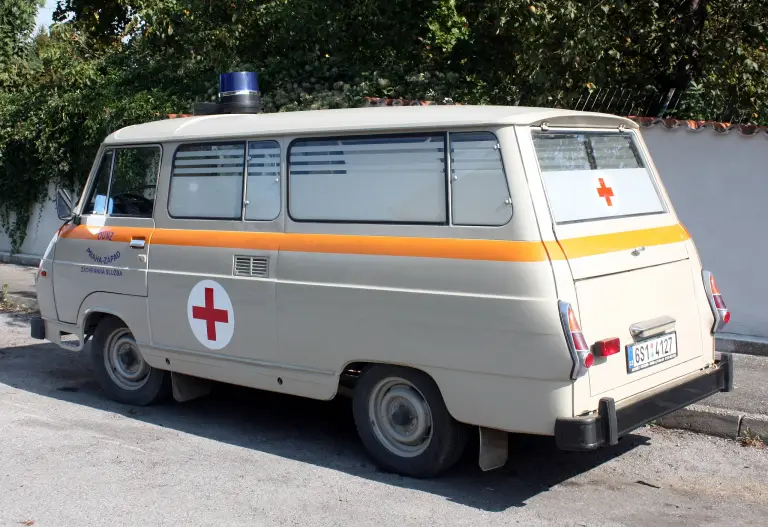
- 1200 ambulance: about 2,000 built on the longer wheelbase.
- 1201 (1956): the more powerful successor with flashing indicators.
The 1200 replaced the Škoda 1101 and 1102 and was followed by the Škoda 1201. More cars are in the Škoda collection.
Video: Škoda 1200 – Retro (1/3)
Video by gokralik on YouTube.
Sources
- Škoda 1200, English Wikipedia: production years, engine, bodies, performance
- Škoda 1200/1201, Czech Wikipedia: type number, design, wind tunnel, wheelbase, production figures, Tatraplan episode