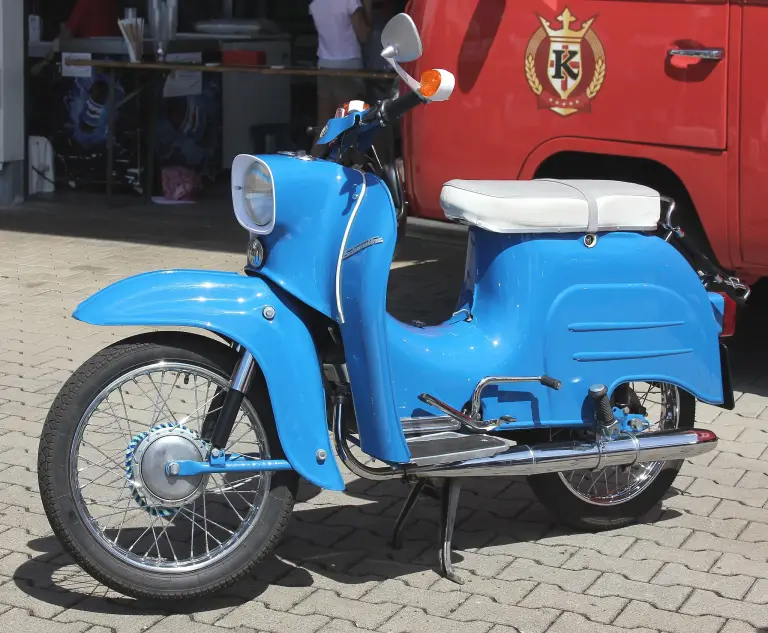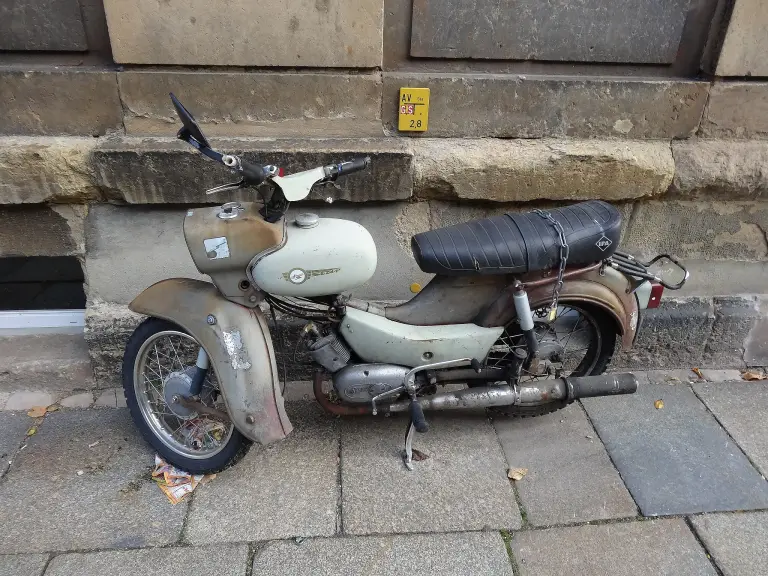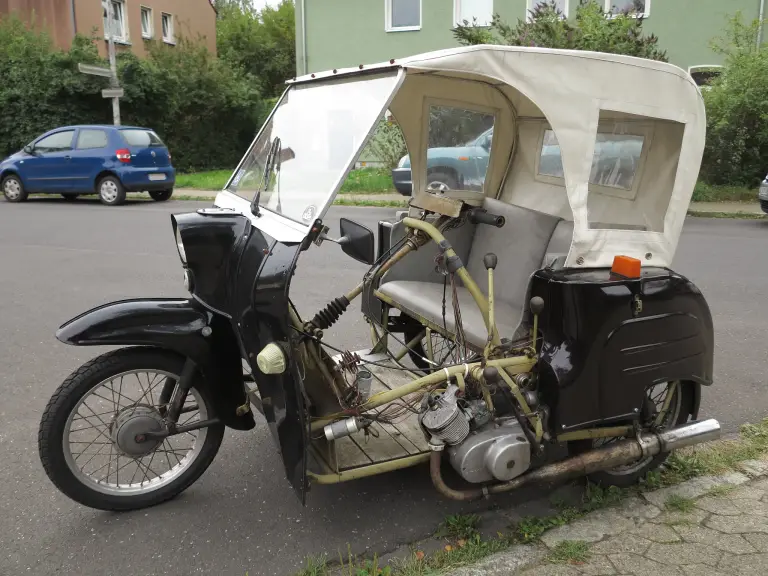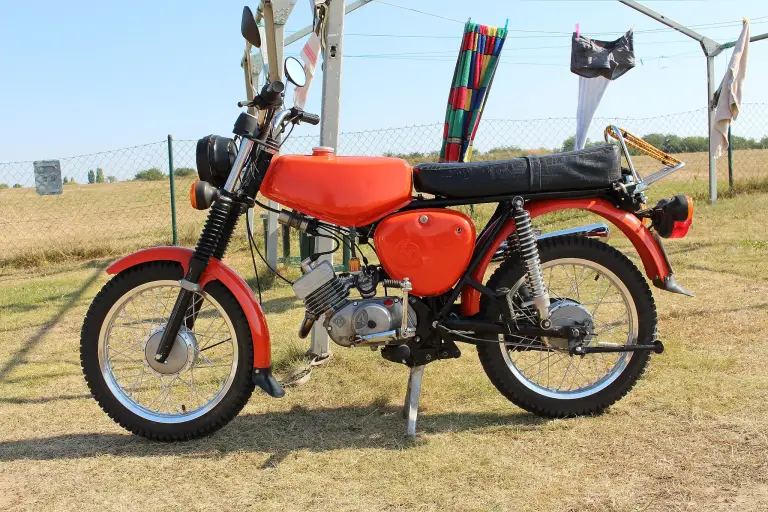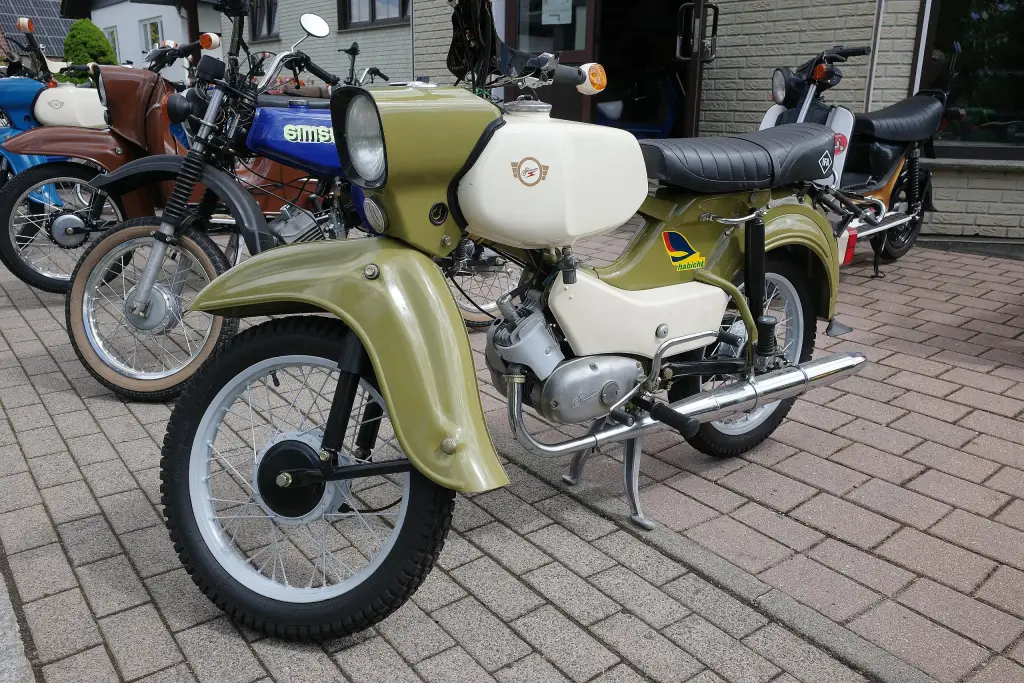
The Habicht, type SR 4-4, was the last model of Simson’s Vogelserie. Shown at the Leipzig autumn fair in 1971 and built from 1972, it combined the body and four-speed gearbox of the Sperber with the simpler, fan-cooled 3.4 PS engine of the Star, producing a comfortable 60 km/h moped that was not restricted by a motorcycle licence.
Simson Habicht at a glance
| Maker | VEB Fahrzeug- und Jagdwaffenwerk „Ernst Thälmann“, Suhl |
|---|---|
| Type | SR 4-4, two-seat moped |
| Production | 1972–1975 |
| Engine | 49 cc fan-cooled two-stroke, 3.4 PS (M 54/11 KFL) |
| Gearbox | four-speed, claw shift |
| Top speed | 60 km/h |
| Price when new | 1430 Mark |
| Built | about 77,200 |
| Fuel consumption | 3.0 l/100 km in the KFT test |
| Colours | olive green with alabaster-white side panels and tank |
Based on one source, the German Wikipedia article on the Habicht.
History of the Simson Habicht
At the end of the 1960s there was strong demand in East Germany for the 60 km/h Simson mopeds Schwalbe and Star. At the same time Simson built the Sperber, a better-equipped machine whose 75 km/h made it legally a motorcycle and therefore less popular. To meet demand, the Sperber’s production capacity was to be used for a new 60 km/h moped with the Sperber’s higher equipment. The result, the SR 4-4, was first shown to the public at the Leipzig autumn fair in 1971. It was called Star de luxe at first, but that name was used only for export models; at home the machine was named Habicht.
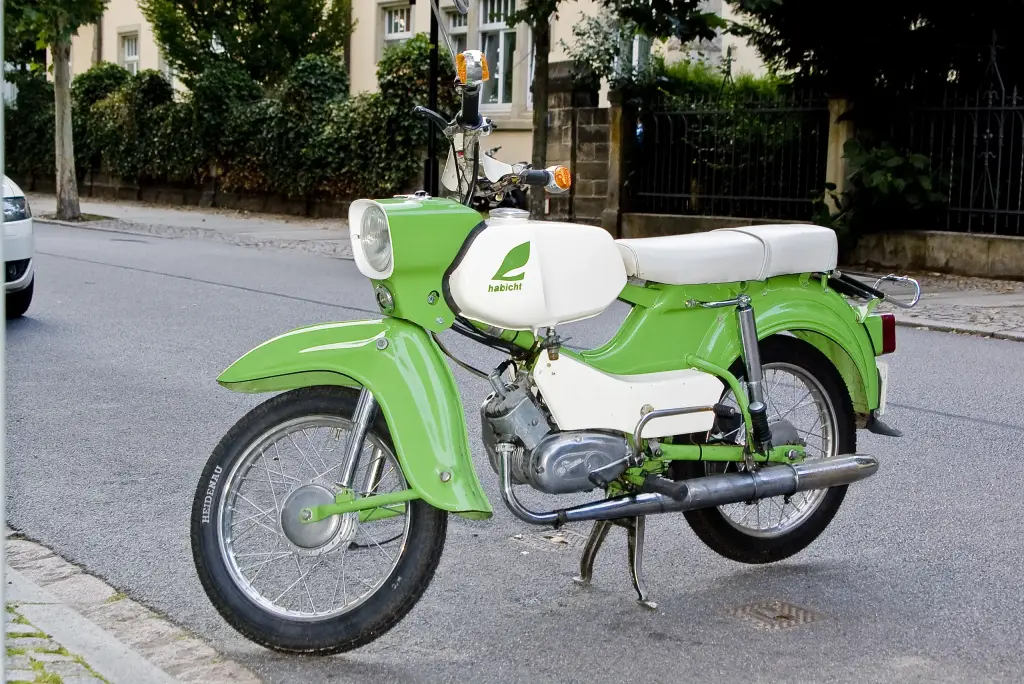
The Habicht pushed Simson’s parts-sharing system to its limit. Technically and visually it matched the Sperber, and the only major difference was the fan-cooled 3.4 PS engine from the Star, type M 54/11 KFL. The Sperber’s four-speed claw gearbox, its external ignition coil and its 25/25 W headlamp were retained. The result was a moped with the comfort and sporting look of the Sperber: a stiffer frame with an extra strut, a tank that allowed the knees to grip, a 625 mm seat, hydraulically damped suspension units and pillion footrests fixed to the frame.
The Habicht was painted olive green, a colour that stood for higher equipment at Simson and was also used on the top Schwalbe; the side panels, handlebar shell and tank were light beige, officially alabaster white. Another identifying feature was the smaller filler neck of the 9.5-litre tank. Production of the Habicht, like that of the Star, ended in 1975 in favour of the S 50 models; only in 1980 did a four-speed model return to the Simson range with the S 51 B 1-4. About 77,200 Habichte were built. Spare frames were made after 1975, so a type plate can show a later year.
Design and features
- Star engine, Sperber chassis: the reliable 3.4 PS fan-cooled unit in the stronger Sperber frame.
- Four-speed gearbox: rare in a 60 km/h moped of the period, and a large part of the Habicht’s appeal.
- Comfort equipment: long seat, hydraulic dampers, pillion footrests and the larger 9.5-litre tank.
- Olive green paint: the Habicht’s most obvious visual mark, with alabaster-white panels.
Simson Habicht versions
- Habicht (1972–1975): the standard home-market model in olive green.
- Star de luxe (export): the same machine sold abroad under the earlier name.
- Late spare-frame cars: replacement frames made after 1975 can carry a later type-plate year.
The Habicht shared its body with the Simson Sperber and its engine with the Simson Star. Its place at the top of the Vogelserie was taken by the Simson S51. More vehicles are in the Simson collection.
Video: Simson Habicht
Video by MadeinF on YouTube.
Sources
- Simson Habicht, German Wikipedia: history, equipment, price, production