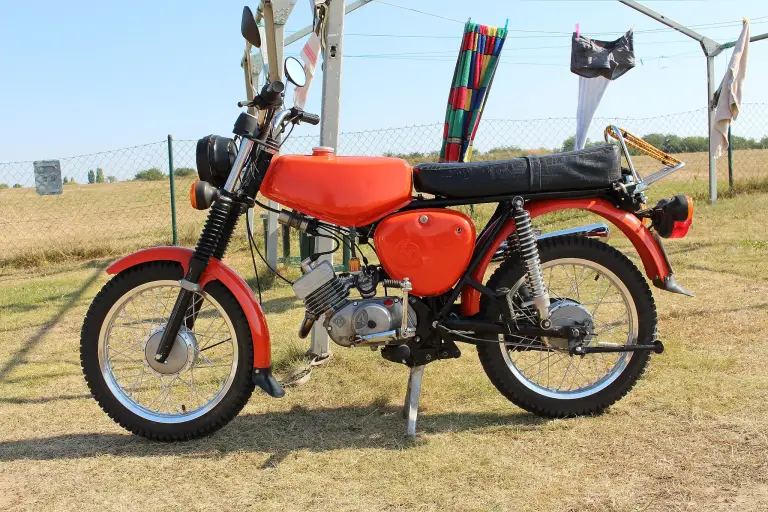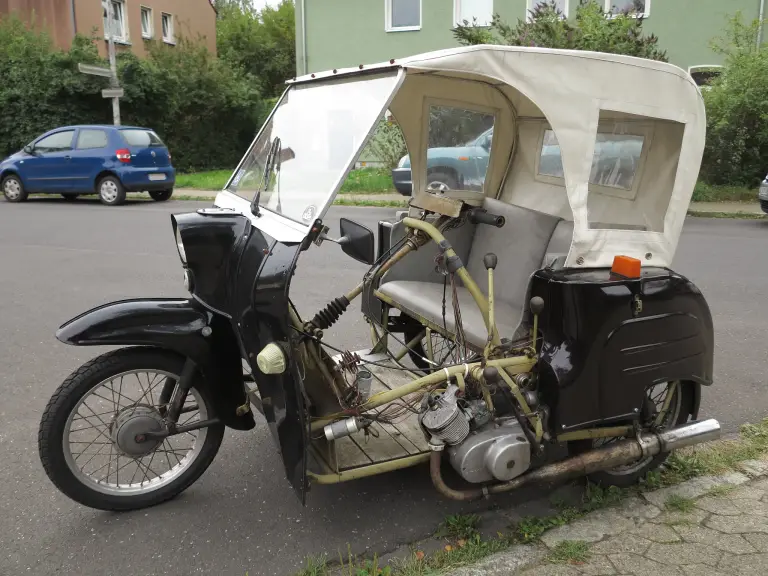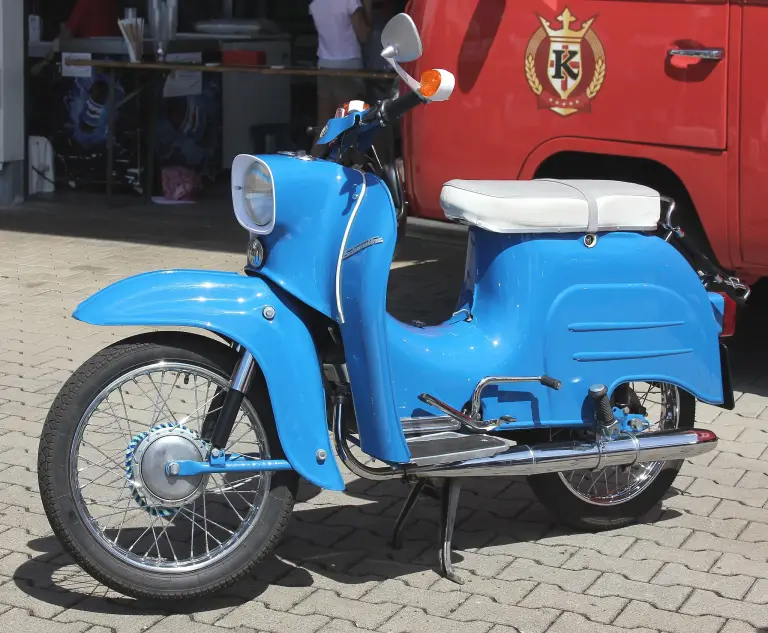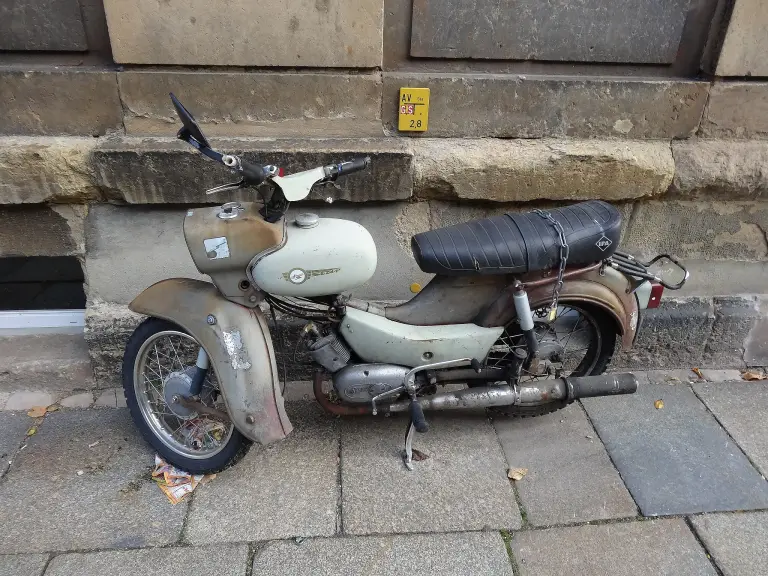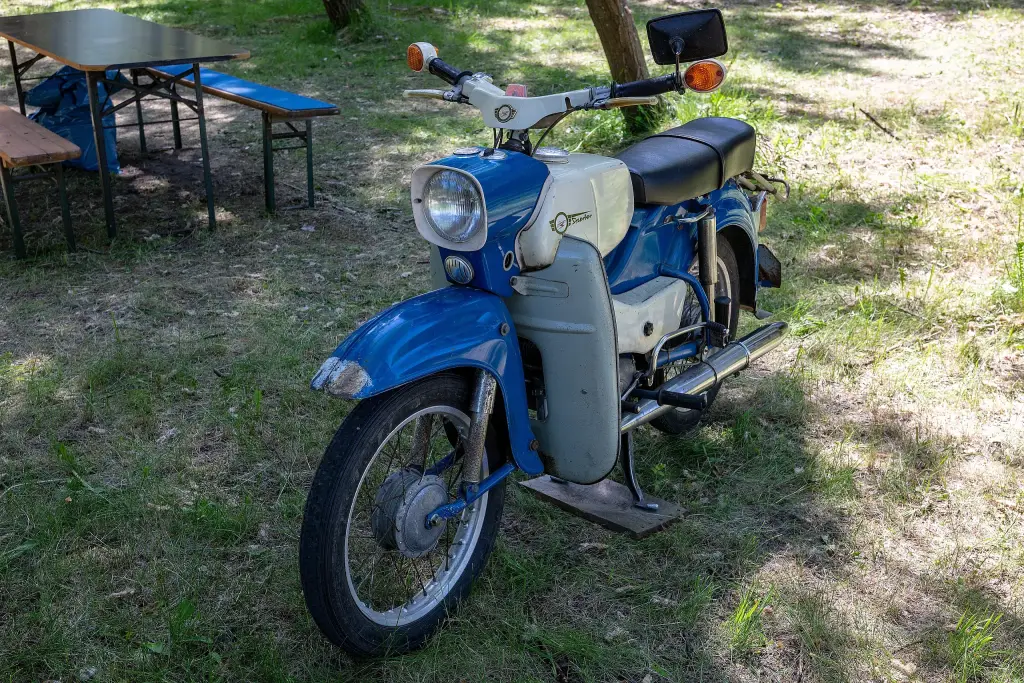
The Simson Sperber, type SR4-3, was a two-seat light motorcycle from the VEB Fahrzeug- und Jagdwaffenwerk Simson in Suhl and the most powerful model of the Vogelserie. Built from 1966 to 1972, its 4.6 PS 50 cc two-stroke and four-speed gearbox gave about 75 km/h, which placed it in the motorcycle class and made it less popular in East Germany than the 60 km/h mopeds.
Simson Sperber at a glance
| Maker | VEB Fahrzeug- und Jagdwaffenwerk Simson, Suhl |
|---|---|
| Type | SR4-3 |
| Production | 1966–1972 |
| Engine | 49 cc air-cooled two-stroke, 4.6 PS |
| Gearbox | four-speed, foot shift |
| Top speed | about 75 km/h |
| Licence | motorcycle class A, A2 or A1 |
| Price when new | 1550 Mark |
| Built | about 80,000 |
| Fuel consumption | 2.9 l/100 km in the KFT test |
Based on one source, the German Wikipedia article on the Sperber.
History of the Simson Sperber
The SR4-3 Sperber was styled by Karl Clauss Dietel and built from 1966 to 1972, with about 80,000 made. Its air-cooled 50 cc two-stroke developed 4.6 PS thanks to a high-revving design with altered timing and a very generously sized intake system with a dry air filter that filled the space under the tank and seat. With a foot-shifted four-speed gearbox it reached about 75 km/h on level ground. Because of that speed it was classified as a light motorcycle, then called Mokrad, despite its 50 cc engine, and could be ridden only with a motorcycle licence.
In its basic chassis and equipment the Sperber largely matched the Star, but it had a larger 9.5-litre tank, a form later used on the MZ ETS 125/150 models, and a strengthening frame strut beneath it. Hydraulic shock absorbers front and rear and a longer 60 cm seat improved comfort, and the pillion footrests were fixed to side lugs on the frame. The electrics ran on 6 volts, but a new flywheel magneto raised headlamp output to 25/25 watts. The clutch used four cork plates in an oil bath with reinforced steel plates to handle the torque. Apart from a few very early examples delivered in red and white, the Sperber was always painted olympia blue and alabaster white; in 1966 and 1967 it had a red artificial-leather seat.
The price was always 1550 Mark, considerably less than the MZ ES 150 of the time, yet demand at home and in export stayed below expectations. Because East German buyers wanted mopeds that needed no licence, Simson decided to end Sperber production in favour of the Habicht. The journal KFT regretted the decision, since Simson was evidently withdrawing from a class with great export potential, and suggested reconsidering the East German 60 km/h rule. The rule did not change. Simson returned to light motorcycles in the 1980s with the S 70 and SR80 of 70 cc, though these also sold in small numbers, and further attempts after 1990 failed.
Design and features
- 4.6 PS from 50 cc: the most powerful engine of the Vogelserie, with altered timing and a large intake system.
- Four-speed gearbox: necessary to use the high-revving engine’s narrow power band.
- 9.5-litre tank and frame strut: touring range and extra stiffness compared with the Star.
- Comfort equipment: hydraulic dampers, a 60 cm seat and frame-mounted pillion footrests.
Simson Sperber versions
- Sperber SR4-3 (1966–1972): the standard model in olympia blue and alabaster white.
- Early red and white cars (1966–1967): a small batch with a red seat.
- Later spare engines: replacement M54 KF engines from motor number 2081449 can be set up for 1:50 mixture.
The Sperber shared its chassis with the Simson Star and was replaced in production by the Simson Habicht, which used its body with the Star’s engine. Its place in the sporting range was later taken by the Simson S51. More vehicles are in the Simson collection.
Video: Simson Sperber – eine ewige Baustelle
Video by Axel on YouTube.
Sources
- Simson Sperber, German Wikipedia: history, engineering, production, road tests