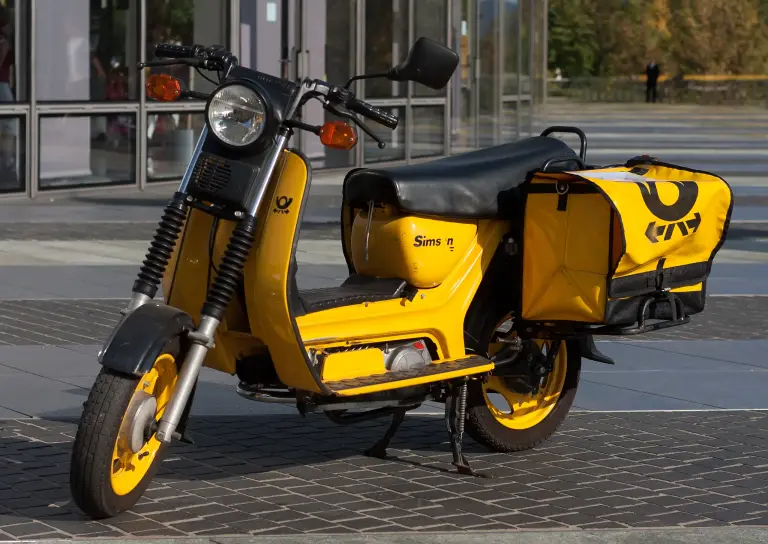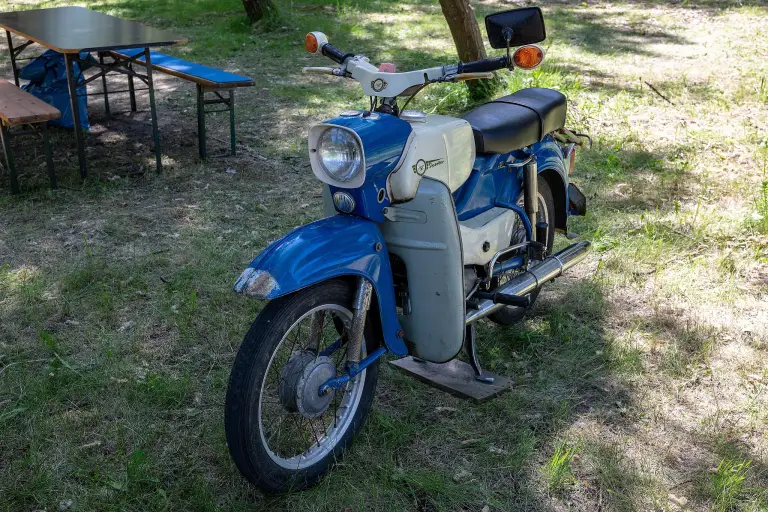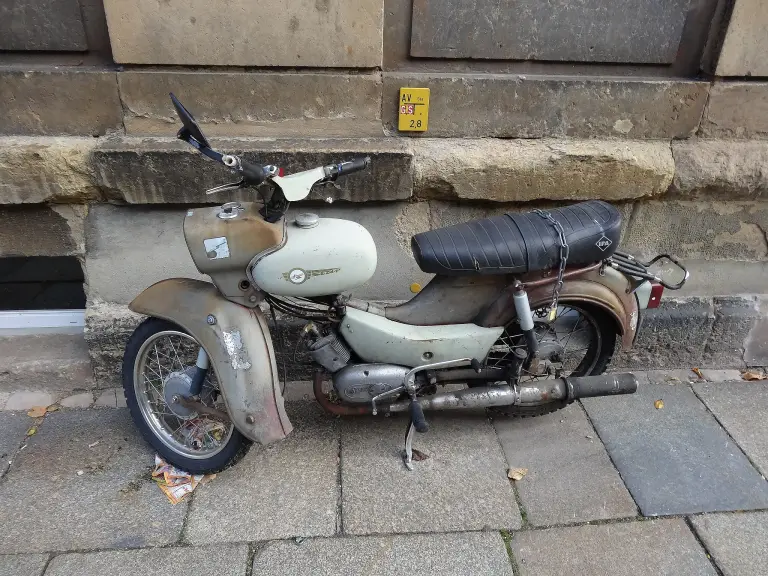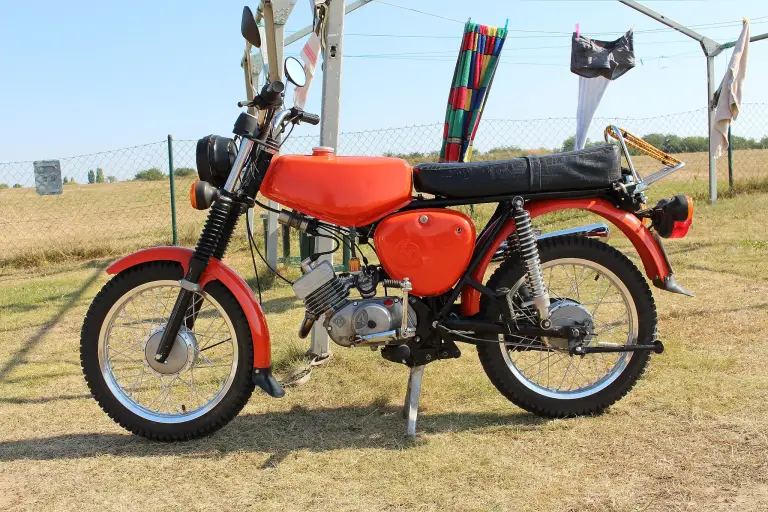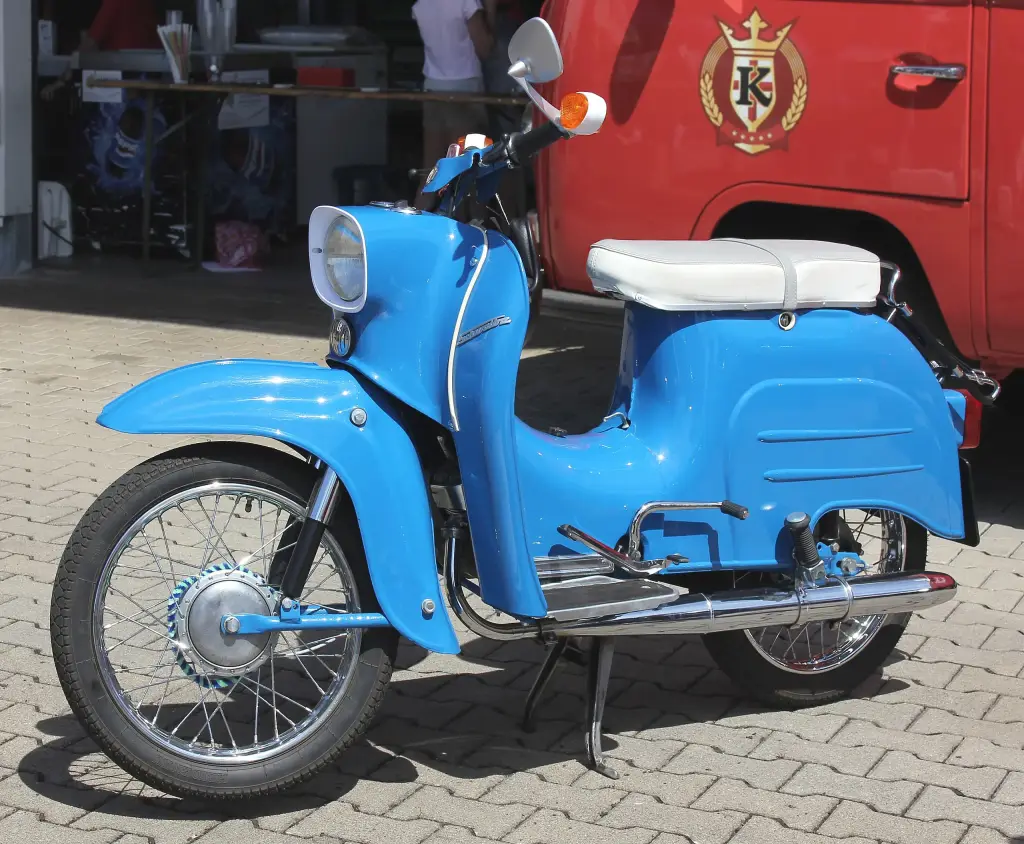
The Simson Schwalbe was a moped-scooter built in Suhl from 1964 and the first model of Simson’s Vogelserie. Its first series designation was KR 51, in which KR stands for Kleinroller, 5 for the 50 cm³ engine and 1 for the difference from its predecessor, the KR 50. With more than a million examples built, it was extraordinarily common in East Germany and was replaced in 1986 by the SR 50.
Simson Schwalbe at a glance
| Maker | VEB Simson, Suhl |
|---|---|
| Type | KR 51, two-seat moped-scooter |
| Production | 1964–1986 |
| Series | three, with nine models in all |
| Engine | 49 cc fan-cooled two-stroke, 3.4 to 3.7 PS |
| Gearbox | three-speed |
| Top speed | 60 km/h |
| Wheels | 16-inch aluminium rims |
| Brakes | 125 mm drum brakes |
| Built | more than 1 million |
Based on one source, the German Wikipedia article on the Schwalbe.
History of the Simson Schwalbe
Work on a two-seat successor to the KR 50 began in 1958, following an international trend. The chief designer was Erhard Werner, at Simson since 1949, working with Karl-Heinz Walther and Georg Schübel. It soon became clear that two-up riding needed a much stronger engine, and in 1960 testing began with four prototypes, some painted in two colours. The 1962 specification set the KR 51 as a moped without a speed limit, designed for 68 km/h, to match Western machines. After negotiations with the ministries the speed was limited to 60 km/h in 1963 by changing the third-gear ratio. Twenty pre-series machines were built in 1963; series production started officially in February 1964, though supplies became regular only from April 1964. A carburettor suited to the new engine was available only in 1965; until then the Schwalbe used the NKJ-135-5, a modified carburettor from the KR 50.
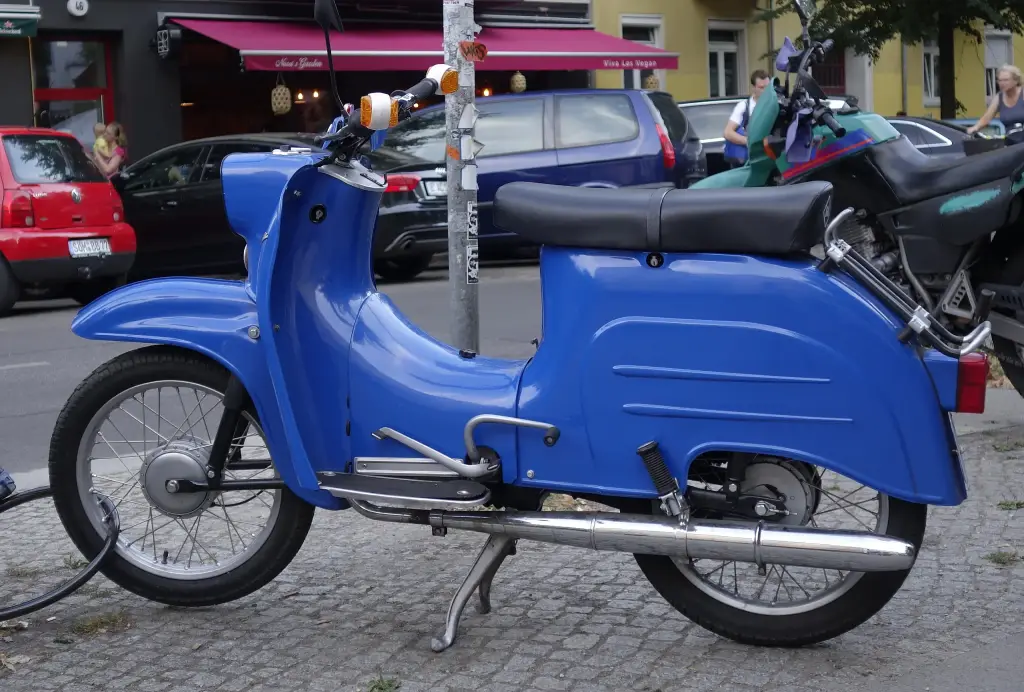
The Schwalbe was designed as a scooter with good weather protection, but its engine position, construction and handling show that it was less a scooter than a moped with pressed-steel bodywork. Compared with the KR 50, the styling was developed inconsistently, because the expensive deep-drawing tools had to be kept. The designer Karl-Heinz Walther said that anyone with a feeling for aesthetics could hardly call the Schwalbe beautiful; the journal KFT judged in 1964 that Simson had nevertheless turned the KR 50, considered unsuccessful especially at the rear, into an attractive vehicle, praising above all the front mudguard.
The fan-cooled three-speed engine M53 KHL was a new design, already tested in the GS 50 off-road machine. Unlike the previous engine it was to be built at Simson rather than in Sömmerda, which delayed the Schwalbe because a production line first had to be installed in Suhl. Prototypes were tested until the basic structure lasted more than 40,000 km. The frame was a double-tube design as on the KR 50, with a full swing-arm chassis; the front swing arm was hidden inside the mudguard, travel was 105 mm at the front and 85 mm at the rear, and the aluminium rims were 16 inches, large for a small scooter. The drum brakes grew to 125 mm and gave a deceleration of 7 m/s². Both wheels were identical and easy to remove, the rear drive stayed on the swing arm, and the chain was fully enclosed under an MZ patent.
Design and features
- Pressed-steel body: weather protection and a step-through layout unusual for a moped of its class.
- 16-inch wheels: large rims for a small scooter, with 125 mm drum brakes.
- Hidden front swing arm: the suspension sat inside the front mudguard, a distinctive technical solution.
- Enclosed chain: the fully covered chain drive followed an MZ patent and cut maintenance.
- Full electrics: battery, indicators, brake light, flasher and parking light were part of the specification.
Simson Schwalbe versions
- KR 51 (1964–1968): the original series with a three-speed hand-shift engine.
- KR 51/1 (1968–1975): the second series, with detail improvements and higher output.
- KR 51/2 (1975–1986): the final series, which in its last form used an S51-type engine.
- E-Schwalbe (from 2010): a modern electric scooter that borrowed the name and luggage-carrier concept but little of the engineering.
The Schwalbe’s three-speed engine and body parts were used in the three-wheeled Duo, and its place was taken by the Simson SR50. The sporting Star and Sperber shared its chassis principles. More vehicles are in the Simson collection.
Video: GoPro Simson Schwalbe Racing Weekend
Video by Sellemann1987 on YouTube.
Sources
- Simson Schwalbe, German Wikipedia: development, construction, production