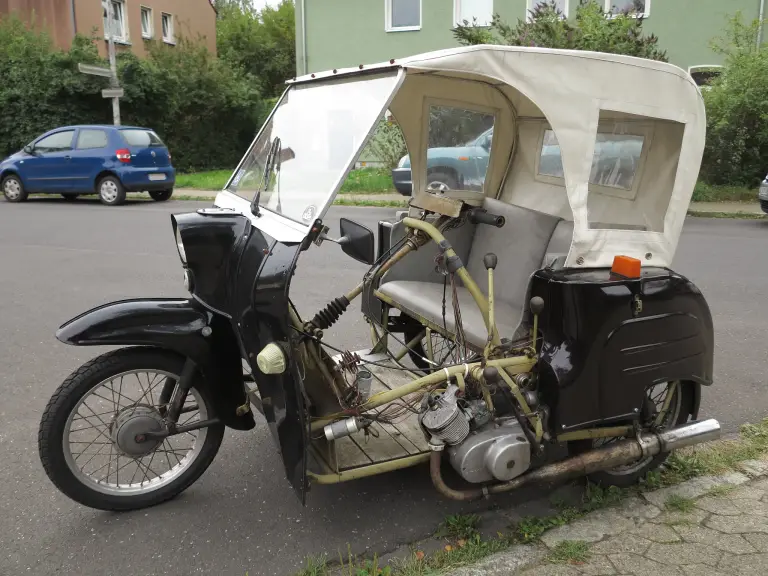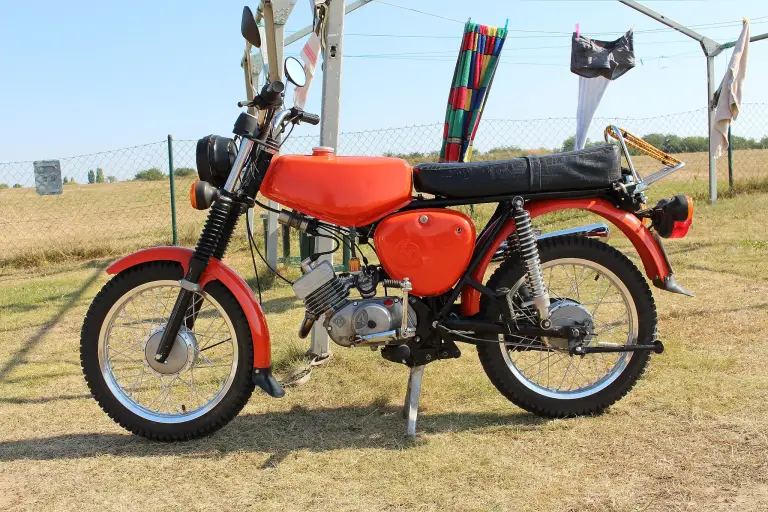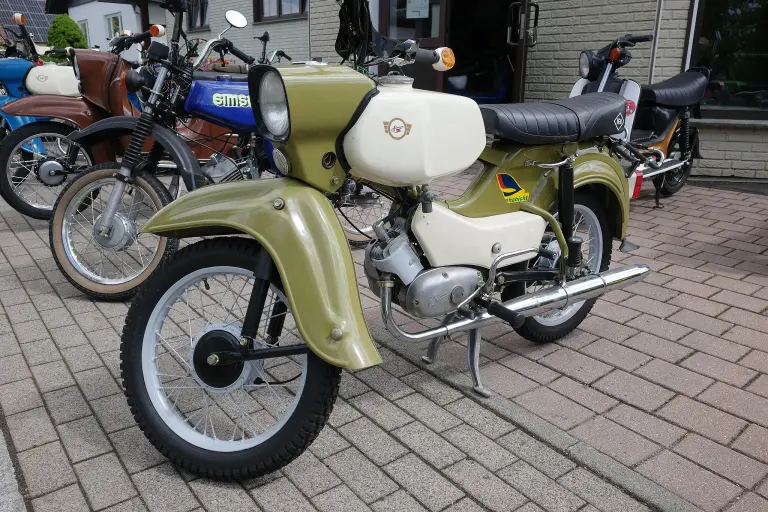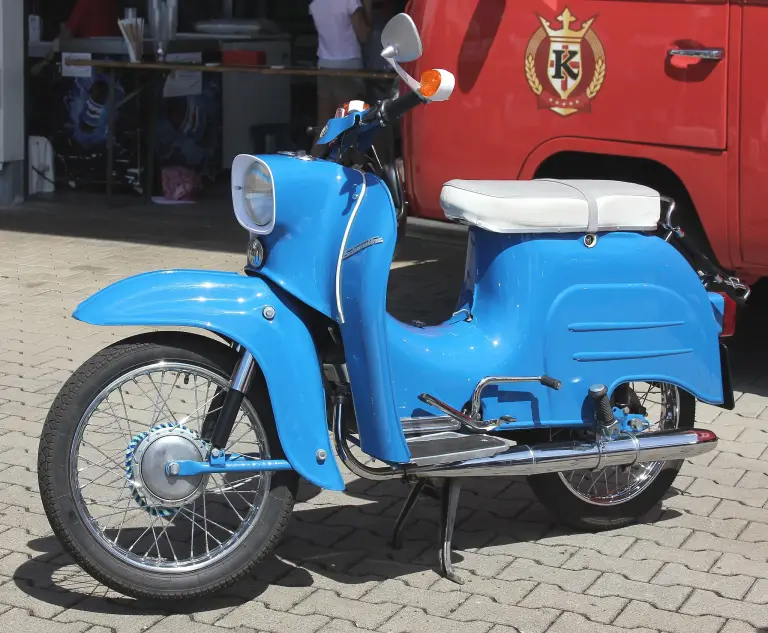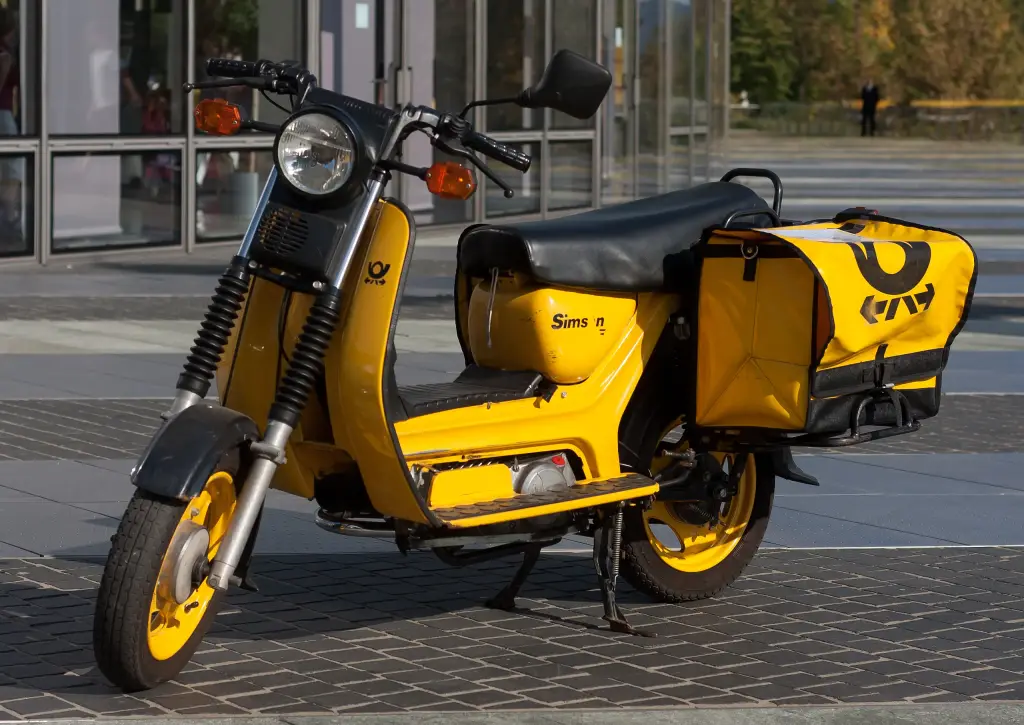
The SR 50 and SR 80 were scooters from the VEB Fahrzeug- und Jagdwaffenwerk „Ernst Thälmann“ in Suhl and its successor companies in reunited Germany; SR stands for Stadt Roller, town scooter. The SR 50 replaced the Schwalbe in April 1986, but its new design means it cannot really be considered the Schwalbe’s successor. Production continued after the fall of the Berlin Wall until Simson’s insolvency in 2002.
Simson SR50 at a glance
| Maker | VEB Simson, Suhl; later Simson successor companies |
|---|---|
| Type | SR 50 and SR 80 scooter |
| Production | 1986–2002 |
| Engine | 49 cc (SR 50) or 70 cc (SR 80), derived from the S 51 |
| Power | 5.6 PS in the SR 80 |
| Gearbox | three- or four-speed |
| Top speed | 60 km/h; 75 km/h for the SR 80 |
| Wheels | 12-inch |
| Front suspension | telescopic fork |
| Built | over 200,000 SR 50 and SR 80 by 1990 |
Based on one source, the German Wikipedia article on the SR 50. The original record’s video is no longer available, so this article has no video.
History of the Simson SR50
The SR 50 replaced the popular but conceptually outdated KR51/2 Schwalbe in April 1986. Its frame and styling were awarded at the Leipzig autumn fair in 1985, and the form came from Karl Clauss Dietel and Lutz Rudolph. New were a telescopic fork and 12-inch wheels, unusually large for a scooter. The well-developed and torquey M541/M531 engine, exhaust and carburettor system were taken almost unchanged from the Simson S 51. As a result the engine’s installation angle in the SR 50 is rather unfavourable, causing a “slanted” oil level and more vibration. The S51 engine also brought a special feature: the foot gearshift was moved forward by a linkage and rotated 90 degrees, so first gear is engaged forward instead of down, and the other gears by pressing back with the sole of the boot. The KFT noted that the SR 80’s 70 cc engine was the better engineering solution, giving more power with less fuel; the 50 cc version existed only because of the moped regulations.
More than 200,000 SR 50 and SR 80 machines were built by 1990. Typical East German accessories were a knee cover, a child seat and a trailer coupling, and a matching trailer with 12-inch wheels was developed. After 1990 a windscreen, topcase and panniers were offered. The SR 50 came in an unusually wide range of equipment levels for East Germany. The basic N version had no indicators, lead-acid battery or ignition lock; it cost 1880 Mark and ended in 1987 when the law required indicators on mopeds. The B3 added a battery, indicators, ignition lock and a side luggage rack for 2190 Mark, usually in wine red and dark brown. The most popular version was the B4 with a combined instrument and four-speed gearbox, typically beige and dark brown, at 2365 Mark. The C had five-way adjustable suspension, electronic ignition, 12-volt electrics, a 35-watt headlamp, two large mirrors and a structured seat, and the CE added an electric starter for 2885 Mark. The SR80 CE was already a light motorcycle, with a 70 cc engine of 5.6 PS, 75 km/h and a price of 2995 Mark in 1987; because it needed a licence plate, sales were limited.
From January 1989 all models received improved electrics: 12 volts, a 35/35-watt Bilux lamp and a 21/5-watt brake and tail light, a 12 V/5.5 Ah battery, a structured seat as standard and better corrosion protection through powder coating. The basic model became the SR 50/1 B, and the C gained an HS1 halogen lamp and a voltage regulator for a steadier electrical supply. After a break in 1991 and 1992 production resumed; together with the S 53 the SR 50 accounted for 95 percent of Simson’s post-reunification output. The SRA 50 Star intended as its successor was not a success. The SR 50 is still used on East German roads today, though it lacks the cult status of the Schwalbe. Spare parts remain available: since 2009 the Simson successor MZA Meyer-Zweiradtechnik has built the old four-speed M541 engine in its Suhl branch.
Design and features
- S51 engine: a proven, torquey two-stroke, though its installation in the scooter is not ideal.
- 12-inch wheels and telescopic fork: a modern chassis compared with the Schwalbe’s 16-inch wheels and hidden swing arm.
- Wide equipment range: from the spartan N to the C and CE with electronic ignition, halogen light and electric starter.
- Long production: built from 1986 to 2002, with the SR 80 as a 75 km/h light motorcycle.
Simson SR50 versions
- SR 50 N (1986–1987): minimal equipment without indicators, battery or ignition lock; 1880 Mark.
- SR 50 B3 (1986–1988): battery, indicators, ignition lock and side luggage rack; 2190 Mark.
- SR 50 B4 (1986–1988): the most popular version, with combined instrument and four-speed gearbox; 2365 Mark.
- SR 50 C and CE (1986–1988): electronic ignition, 12-volt electrics, 35-watt lamp and, on the CE, an electric starter; 2885 Mark.
- SR 80 and SR80 CE: 70 cc, 5.6 PS and 75 km/h, classed as a light motorcycle; 2995 Mark in 1987.
- SR 50/1 (from 1989): 12-volt electrics, Bilux or HS1 halogen lighting and powder-coated finish.
The SR 50 replaced the Simson Schwalbe and used the engine of the Simson S51; a three-wheeled derivative was the SD 50. The sporting Sperber had shown earlier how Simson approached faster machines. More vehicles are in the Simson collection.
Sources
- Simson SR 50, German Wikipedia: history, models, equipment, production