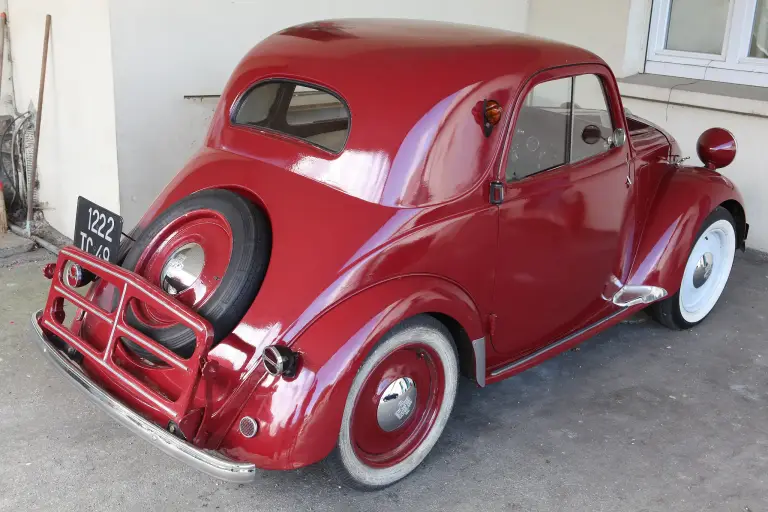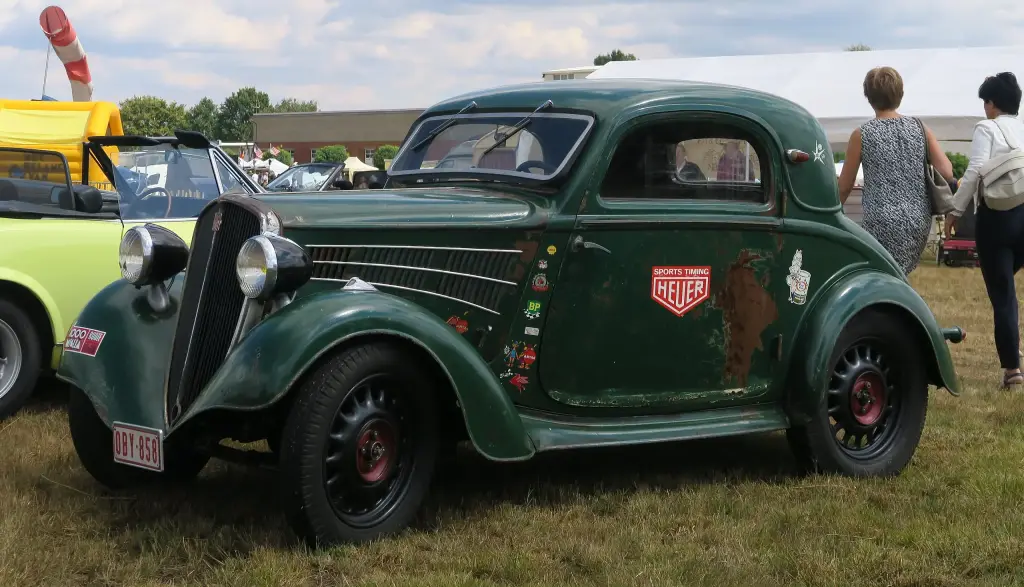
The Simca-Fiat 6 CV was a French car built under Fiat licence from 1932, first by SAFAF and from July 1935 by Simca, the company Fiat had founded. Derived from the Fiat 508 Balilla, it brought motoring to the French middle classes and 26,472 were built in France up to 1937.
Simca-Fiat 6 CV at a glance
| Production | 1932–1937 |
|---|---|
| Makers | SAFAF, then Simca from July 1935 |
| Based on | Fiat 508 Balilla |
| Plants | Levallois, then Nanterre from 1935 |
| Engine, first series | 995 cc four, 20 hp at 3,400 rpm |
| Engine, second series | 24 hp |
| Gearbox | three speeds in the first series, four in the second |
| Brakes | hydraulic drums on all four wheels |
| Top speed | over 80 km/h |
| Tax class | 6 CV |
| Van payload | 300 kg, listed at 16,850 francs in October 1936 |
| Built in France | 26,472 |
This article is based on one source, the French Wikipedia article on the Simca-Fiat 6 CV.
History of the Simca-Fiat 6 CV
Pigozzi and the French Fiats
The founder of the marque, Henri Théodore Pigozzi, was born in Turin in 1898 and settled in France in the early 1920s. He represented motorcycle makers, then traded coal, and in 1926 became the general distributor of Fiat cars in France. From 1928, with no real factory, he had bodies built by the coachbuilder Chaize near the boulevard Kellermann in Paris and assembled parts from Turin on a line at Suresnes barely thirty metres long. Even so he managed to build 29,000 Fiats, mostly four-cylinder 8/9 CV type 514 cars but also six-cylinder types 522 and 524.
The Balilla project
The future 6 CV was the work of Fiat engineers including Nebbia, Fessia, Dante Giacosa and Zerbi, who created a car of quality at reasonable cost. The Balilla project was led by Tranquillo Zerbi, head of Fiat’s technical office; Antonio Fessia had worked on the first drafts from 1929, and the young Dante Giacosa, then 27, took part before his long career at Fiat. The new model was shown at the Milan Fair on 12 April 1932 during the motor show.
Production in France
Building began at the Levallois works on 18 September 1932 under the name Fiat française 6 CV F, the F standing for française, and the model was approved by the Mines on 20 September 1932. The commercial launch of the “100 per cent French” 6 CV came at the Paris Salon in October 1932 in two forms: a two-door four-seat berline without a boot and a two-seat roadster with a folding windscreen. Like the Fiat 508 Balilla, the first version had a three-speed gearbox. It used the Fiat type 108 engine, a 995 cc four mounted at the front and giving 20 hp at 3,400 rpm, and it had hydraulic drum brakes on all four wheels — still rare on a French car of the period — and a top speed above 80 km/h. The second series was assembled in the new Simca factory at Nanterre from July 1935 and sold under the Simca-Fiat name; it had a four-speed gearbox, 24 hp and a more aerodynamic body with two or four doors.
The range
The two series produced a wide choice of bodies: berline, spider, torpédo, colonial military, sport spider and berlinette Mille Miglia. Many coachbuilders clothed bare chassis, as was the fashion, among them the Parisian Kelsch, who reworked the French 6 CV body several times from 1933, and foreign houses including Garavini, Savio, Balbo, Bertone, Casaro and Ghia. From 1 July 1935, when car production moved to Nanterre, the 6 CV range was widened with a camionnette and a fourgonnette offering 300 kg of payload, the latter still listed in October 1936 at 16,850 francs. Production in France between 1932 and 1937 reached 26,472 cars, a real achievement for the period.
Design and features
- Fiat pedigree: a direct licence version of the Fiat 508 Balilla, one of Europe’s best small cars of the 1930s.
- Hydraulic brakes: on all four wheels, still rare on French cars in this class in 1932.
- Two series: three gears and 20 hp at first, four gears and 24 hp from 1935.
- Many bodies: from the standard berline to spiders and Mille Miglia berlinettes by outside coachbuilders.
Simca-Fiat 6 CV versions
- First series (1932–1935): three-speed gearbox, 995 cc and 20 hp, built at Levallois.
- Second series (1935–1937): four-speed gearbox, 24 hp, more aerodynamic body, built at Nanterre.
- Roadster and spider: two-seat open versions, the roadster with a folding windscreen.
- Camionnette and fourgonnette (1935): 300 kg payload commercial versions.
- Coachbuilt cars: bodies by Kelsch, Garavini, Savio, Balbo, Bertone, Casaro and Ghia.
The 6 CV was replaced in the Simca range by the Simca 8, and the small car below it was the Simca 5. More cars are in the Simca collection.
Sources
- Simca-Fiat 6 CV, French Wikipedia: history, Pigozzi, engines, series, bodies, production