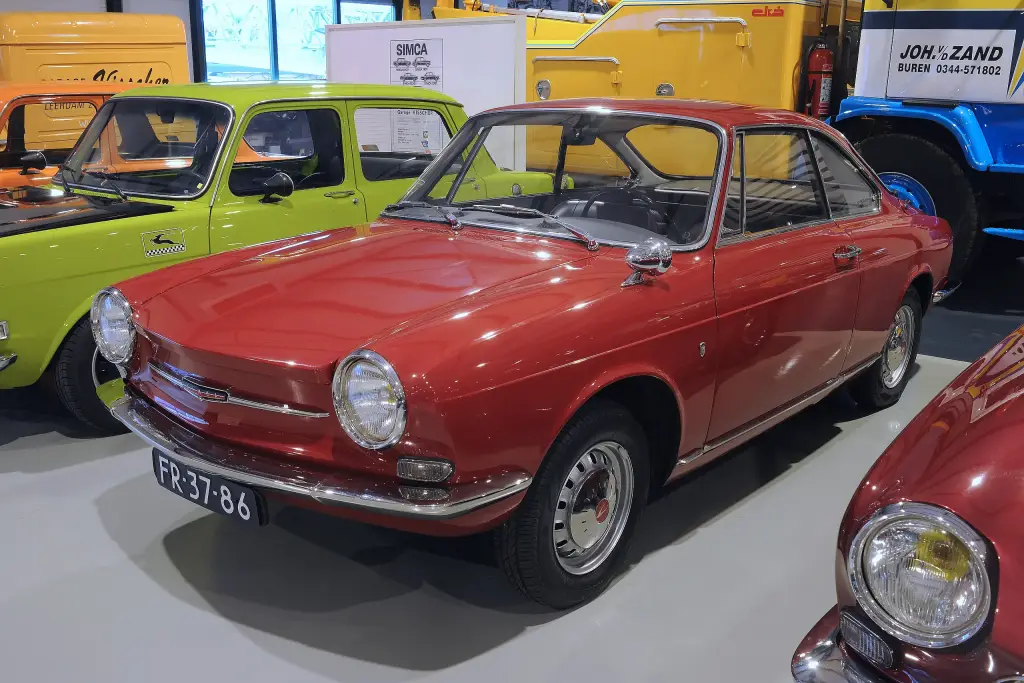
The Simca 1000 Coupé was a small rear-engined two-door with a body built by Bertone in Turin and styled by the young Giorgetto Giugiaro. Launched in 1962, it was upgraded in 1967 into the Simca 1200S, which stayed in production until 1971.
Simca 1000 Coupé at a glance
| Production | 1962–1971 |
|---|---|
| Bodies | Bertone, Turin; final assembly at Poissy, 1200S also at Rotterdam |
| Designer | Giorgetto Giugiaro for Bertone |
| Coupé 1000 engine | 944 cc, 52 hp (38 kW) |
| Coupé 1000 top speed | 140 km/h |
| 1200S engine | 1,204 cc, 80 hp (59 kW), 85 hp from 1968 |
| 1200S top speed | 175 km/h, 179 km/h from 1968 |
| Brakes | discs on all four wheels |
| Coupé 1000 built | about 10,600 |
| 1200S bodies | about 25,000, of which 3,114 assembled in Rotterdam |
| Replacement | none directly; Matra Bagheera of 1973 was a belated one |
This article is based on one source, the English Wikipedia article on the Simca 1000 Coupé.
History of the Simca 1000 Coupé
From Facel to Bertone
The Simca 1000 saloon was launched in October 1961 and sold well in France but less so abroad, and Simca wanted a car that would raise its profile internationally. The company first discussed a joint project with Facel, but Henri Pigozzi judged Facel’s proposal lacking in style, and there were also worries about Facel’s finances. Simca then turned to Bertone, which gave the work to a recently recruited young designer, Giorgetto Giugiaro. The coupé was shown at the Geneva Motor Show in early 1962, French homologation followed in November 1962 and customer deliveries began in 1963.
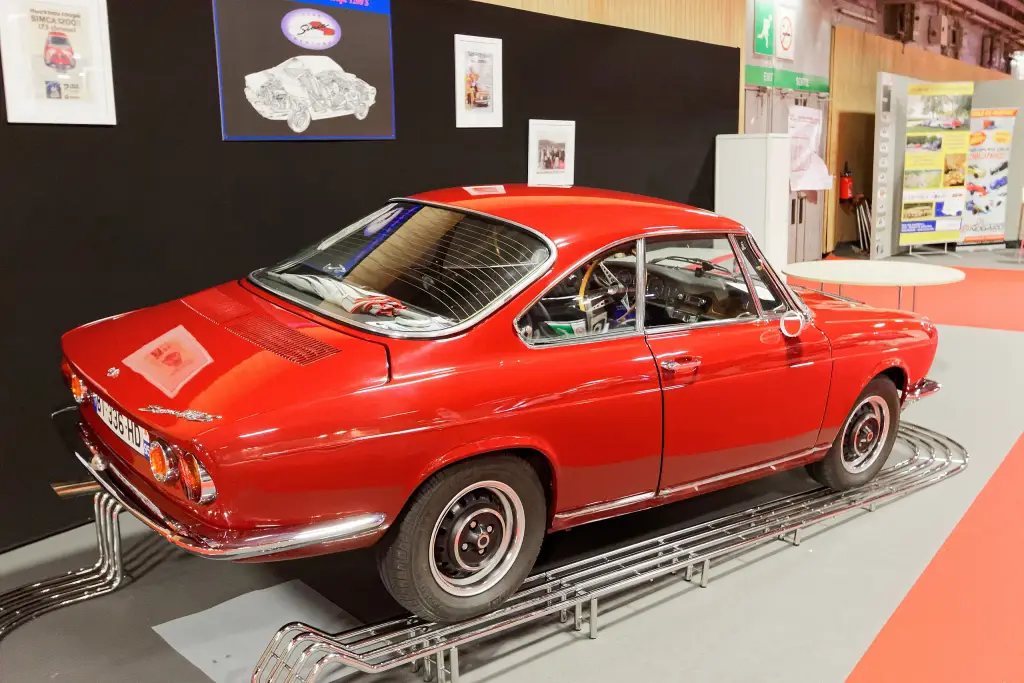
The car
The Coupé shared its chassis and mechanical parts with the saloon but had a lower centre of gravity and a more aerodynamic shape, so it handled and performed better. Its 944 cc engine had a higher compression ratio than the saloon’s and gave a claimed 52 hp instead of 45, for a top speed of 140 km/h against 125 km/h. It also had disc brakes on all four wheels, unusual at the time. Inside, the dashboard carried a generous set of gauges and switches that contrasted with the plain saloon. The Bertone body was widely admired but costly, and the car was priced against the Renault Floride rather than sold on price alone. About 10,600 were built before the 1967 upgrade.
The 1200S
In 1967 Bertone restyled the car: a pair of grilles appeared on top of the bonnet, echoing the Lamborghini Miura, and an opening was added at the front because the radiator had been moved there from the rear. That improved weight distribution, although the engine stayed at the back. The engine became a 1,204 cc four with two carburettors, giving 80 hp and a claimed 175 km/h; in 1968 power rose to 85 hp and the top speed to 179 km/h. The car was renamed the Simca 1200S.
Production
Bodies were built in Turin and travelled to France on their sides, in two rows, on specially configured railway wagons. About 25,000 1200S bodies made the journey before production ended in 1971, and because Poissy was short of capacity 3,114 cars were assembled at Chrysler Benelux in Rotterdam. The 1200S was not replaced directly, although the Matra Bagheera of 1973 can be seen as a belated successor.
Design and features
- Giugiaro styling: the Bertone body was widely praised and set the coupé apart from the boxy saloon.
- Better roadholding: a lower centre of gravity and a more aerodynamic shape than the Simca 1000 saloon.
- Disc brakes all round: unusual for a small car of the early 1960s.
- Radiator moved forward in 1967: the 1200S gained better weight distribution and Miura-style bonnet grilles.
Simca 1000 Coupé versions
- Coupé 1000 (1962–1967): 944 cc, 52 hp, 140 km/h.
- 1200S (1967–1971): 1,204 cc, 80 hp, front-mounted radiator.
- 1968 1200S: 85 hp and 179 km/h.
- Rotterdam-assembled cars: 3,114 built in the Netherlands for Benelux.
The coupé was based on the Simca 1000 saloon and used an engine later fitted to the Simca 1100. More cars are in the Simca collection.
Sources
- Simca 1000 Coupé, English Wikipedia: origins, engines, upgrade, production