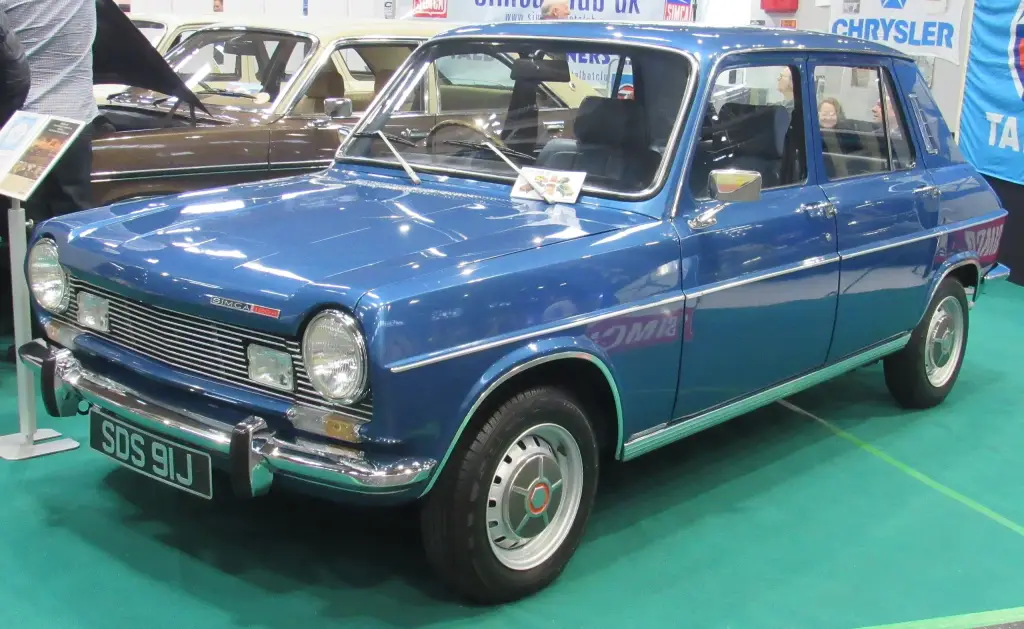
The Simca 1100 was a compact family car with a hatchback body, introduced in 1967 and produced for more than fifteen years. It combined a transverse engine and front-wheel drive with independent suspension and front disc brakes, and it became the pattern for European and Japanese compact hatchbacks.
Simca 1100 at a glance
| Project | 928, begun in 1962 |
|---|---|
| Production | 1967–1982; hatchbacks to 1981, vans to 1985 |
| Also known as | Talbot-Simca 1100 from mid-1979 |
| Layout | front-wheel drive, transverse engine |
| Bodies | three- and five-door hatchback, estate, van |
| Engines | 944, 1,118, 1,204 and 1,294 cc Poissy fours |
| Transmission | four-speed manual; Ferodo semi-automatic optional |
| Suspension | independent all round, torsion bars, anti-roll bars |
| Brakes | discs front, drums rear |
| Dimensions | 3.94 m long, 2.52 m wheelbase |
| Built | 2,188,737 including 39,608 vans |
| Successor | Simca-Talbot Horizon |
History of the Simca 1100
Project 928
The 1100 came out of “Project 928”, started in 1962 and finished by the engineers Philippe Grundeler and Charles Scales. Simca’s market research had shown growing demand for front-wheel drive in small cars, and in the spring of 1962 the company planned a family of front-drive saloons, estates and light vans for launch in 1966 or 1967, all inside the French 6 CV tax class between the Simca Mille and the Simca 1300. Transverse and longitudinal engine layouts were both tested, and the transverse one was approved in 1963. Chrysler, which had taken a controlling interest that year, let the project go ahead in 1964 with a target of summer 1967. The new 1,118 cc Poissy engine was 160 cc larger than the 944 cc unit of the 1000.
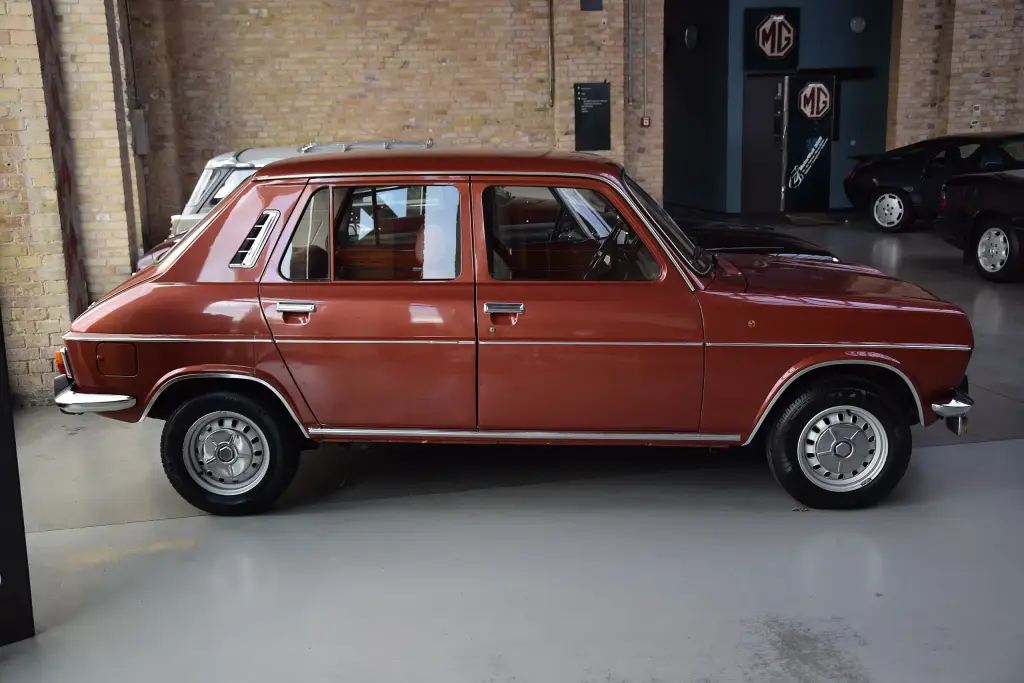
The car
Shown in Sardinia and at the Paris show in 1967, the 1100 was among the first unibody family hatchbacks to combine a transverse front engine with front-wheel drive, independent suspension with anti-roll bars, front disc brakes, rack-and-pinion steering and a folding rear seat. The engine was canted to allow a lower bonnet, and engine, gearbox and suspension were carried on a subframe. The body was welded to the frame rather than bolted. With only 15 cm more length than the Simca 1000 but a 30 cm longer wheelbase and more than 10 cm extra width and height, it offered much better interior space. The estate versions, called Break, were no longer than the hatchbacks but boxier and more practical.
The range
There were three- and five-door hatchbacks, an estate and a delivery van. Later a Simca 1200 with 1,204 cc and a Simca 1300 with 1,294 cc were added, and the old 944 cc unit remained as a cheaper option. The Simca 1204 was exported to the United States through 1971. In 1969 the Break and the three-door arrived; in 1970 the three-door 1100 Special appeared with the 1,204 cc engine and brake servo; in 1973 came the VF van line and the 1100 TI with 1,294 cc and 82 PS. The VF1 van, an estate without rear side windows, was delivered from 1974, and the Matra-Simca Rancho of 1977 was developed from the VF2 van.
Later years
The range was revised in 1975 with a new dashboard. When PSA took over Chrysler Europe at the end of 1978 the Simca 1100 models were renamed Talbot-Simca 1100 in mid-1979. Production of the saloon ended at the end of 1981, when its line at Poissy was given over to the Talbot Samba, but the vans continued, and the last Talbot 1100 City van was built in 1985. The hatchbacks had been replaced by the Simca-Talbot Horizon, which had been intended to replace the 1100 outright in 1978; the older car survived because the Rancho and the van derivatives kept its line open.
Design and features
- Modern package: transverse engine, front-wheel drive, independent suspension and front disc brakes in an affordable compact car.
- Folding rear seat: one of the first hatchbacks in production with a split-folding rear bench and a large tailgate.
- Influence: the layout is said to have been studied closely by Volkswagen before the Golf.
- Wide range: hatchbacks, estates, vans, a hot TI and the Rancho crossover all came from the same design.
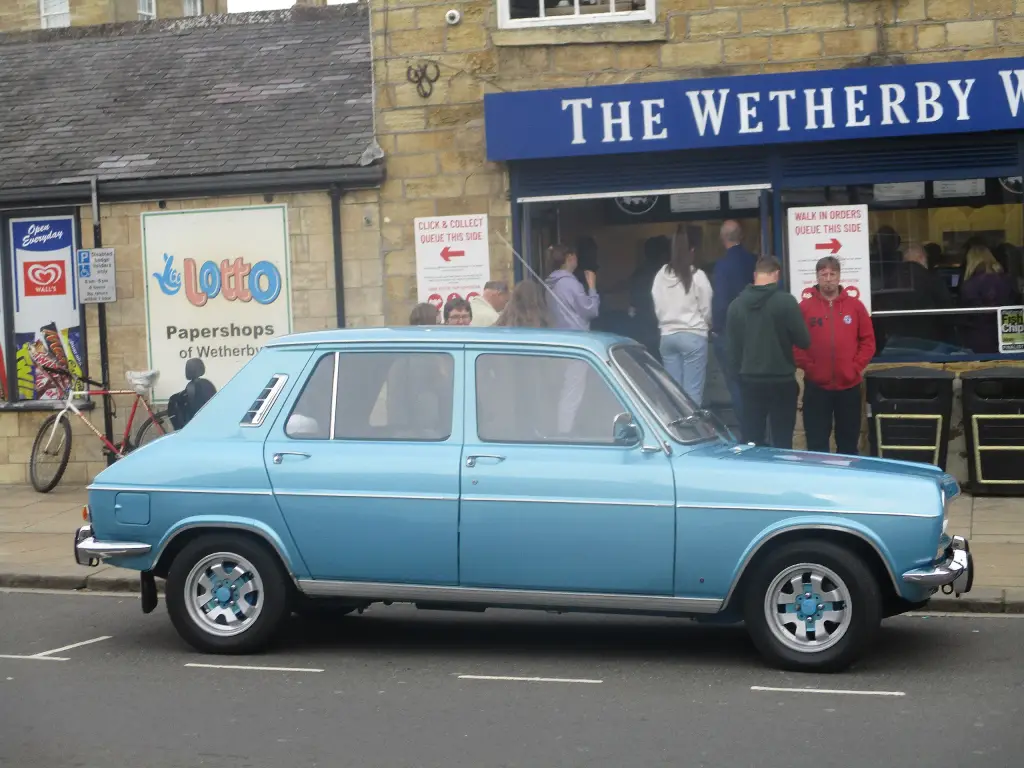
Simca 1100 versions
- 1100 (1967): 944 and 1,118 cc engines, three- and five-door hatchbacks and estates.
- 1100 Special (1970): three-door with the 1,204 cc engine and brake servo.
- 1100 TI (1973): 1,294 cc, 82 PS.
- VF vans (1973–1985): VF1, VF2 City van and VF3 on the 1100 floorpan.
- Matra-Simca Rancho (1977): a leisure vehicle developed from the VF2.
- Simca 1200 and 1204: 1,204 cc versions, the 1204 exported to the United States.
The 1100 replaced the Simca 1000 as the hatchback in the range and was itself succeeded by the Simca Horizon. Its engines also went into the Simca 1200S coupé. More cars are in the Simca collection.
Sources
- Simca 1100, English Wikipedia: project, engineering, models, US export
- Simca 1100, German Wikipedia: production total, model history, dimensions
- Simca 1100, French Wikipedia: launch, technical data, Spanish production