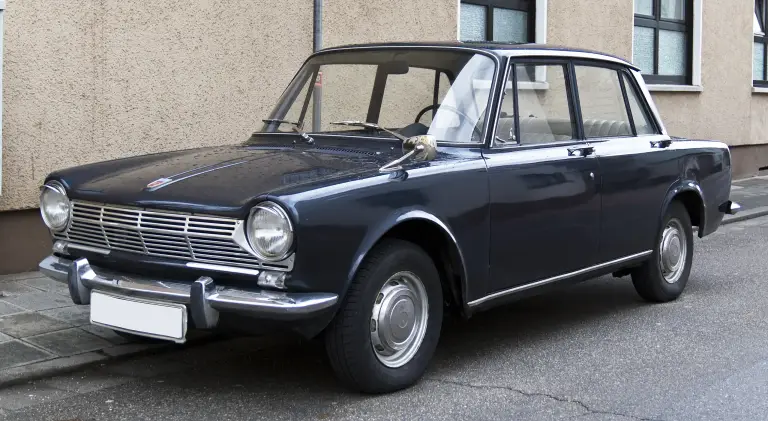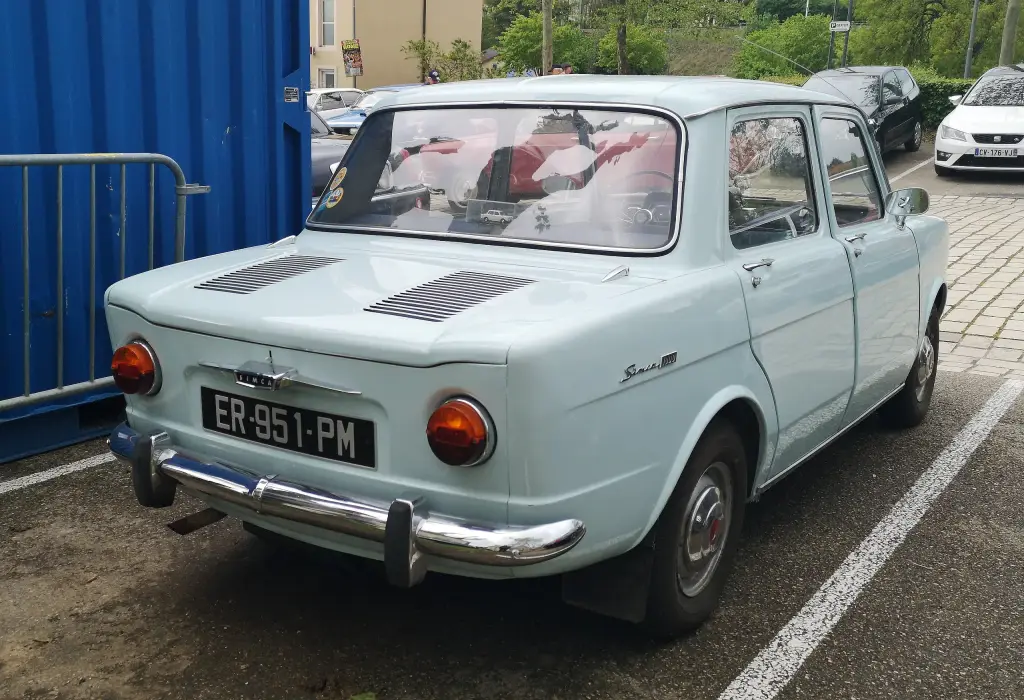
The Simca 1000, called the Simca Mille in French, was a small four-door saloon with a rear-mounted engine built by Simca from 1961 to 1978. Cheap and modern at its launch, it became one of the most familiar small French cars of the 1960s and stayed in production for 18 years.
Simca 1000 at a glance
| Production | 1961–1978 |
|---|---|
| Built | 1,650,000 |
| Layout | rear-engined, rear-wheel drive, four-door saloon |
| Engine | 944 cc Poissy four, 32 PS (24 kW) at launch |
| Later engine | 1,118 cc in the 1000 Special from 1968 |
| Gearbox | four-speed, fully synchronised |
| Dimensions | 3.80 m long, 1.49 m wide |
| Design | Mario Revelli de Beaumont |
| Origin | Fiat “Project 122” |
| Weight distribution | 35/65 front to rear |
| Coupé | Bertone body by Giorgetto Giugiaro, 1962 |
| Rallye 2 | 1972, 1,294 cc, 82 PS (60 kW) |
History of the Simca 1000
An Italian project for a French car
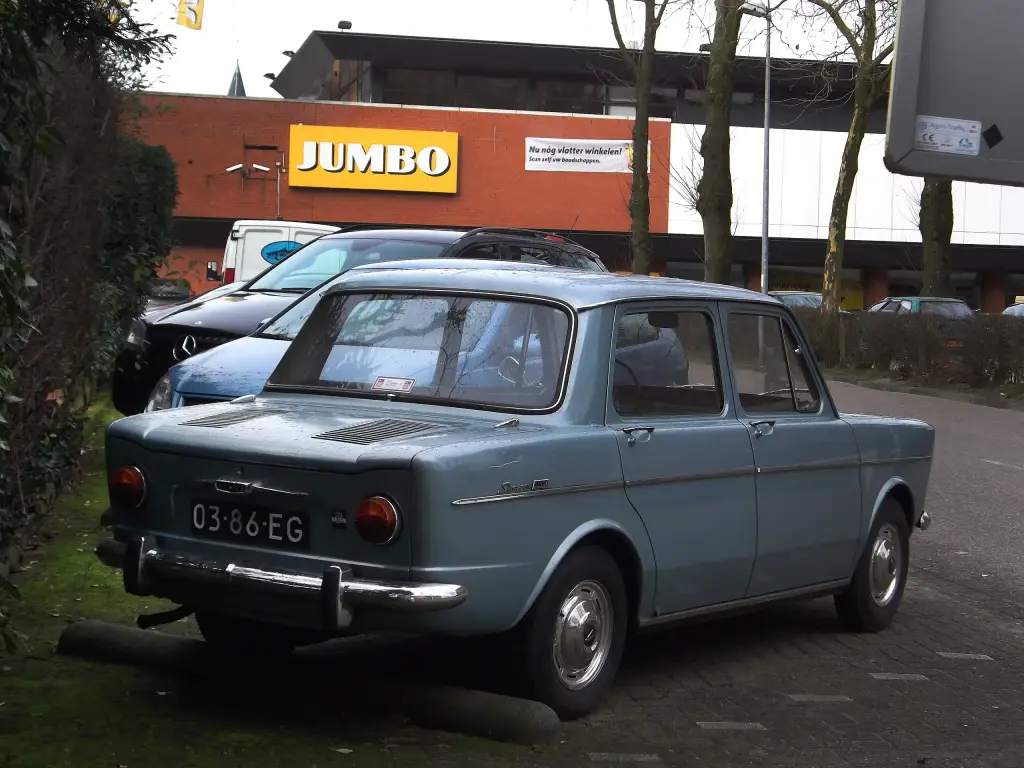
The Simca 1000 did not begin in France but in Italy. Simca’s head, Henri Pigozzi, had been born in Turin and was close to the Agnelli family, and Fiat remained Simca’s dominant shareholder until 1963. After the Fiat 600 of 1955, Fiat’s engineering department under Dante Giacosa ran two projects for a successor, and Pigozzi obtained the rights to one of them, “Project 122”, a four-door car larger than the 600. Simca’s styling chief Mario Revelli de Beaumont, who had come from General Motors in 1955, worked with Fiat’s Felice Mario Boano between 1959 and 1961 to turn the selected clay model into the production Simca 1000.
The launch
Production began on 27 July 1961 and the car was unveiled at the Paris Motor Show on 10 October 1961. It was inexpensive and modern, with a new water-cooled 944 cc Poissy four, and it was offered at first in three colours. Simca’s marketing was lively: having bought a Paris taxi business in 1958, in November 1961 it replaced 50 Ariane-based taxis with 50 Simca 1000s, so the little car appeared in press pictures against Paris landmarks. The taxis were withdrawn after a few months. Exports followed quickly, to South Africa by June 1963 and to the United States for the 1963 model year, with the Coupé arriving there in 1965.
The car
A rear engine was a first for Simca, although French and German makers had used the layout for small cars for more than a decade. The fuel tank sat behind the rear seat, giving a 35/65 front-to-rear weight distribution, a very light front end and responsive oversteer on winding roads. The interior was surprisingly roomy for the class, though the luggage locker under the front bonnet was small, and the spare wheel stood vertically behind the front bumper. The driver had an excellent view out.
Model history
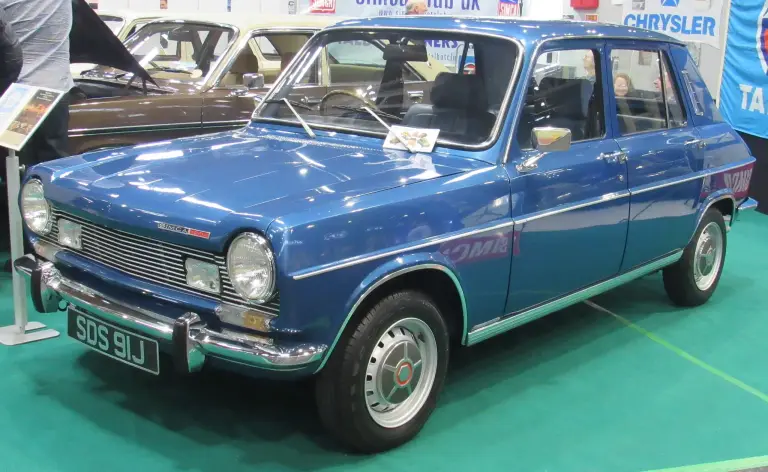
The Bertone-designed Coupé was shown at Geneva in 1962. A simpler Simca 900 appeared in November 1963, and a 1000 GL Automatique in 1965. The 1966 models received a new dashboard, and the 1000L replaced the 900. A facelift in 1968 brought larger headlamps and new indicators and tail lights, and the 1000 Special arrived with the 1,118 cc engine of the Simca 1100, at first with 52 PS. The Rallye 1 of 1970 had a 1,294 cc engine with 60 PS and zebra stripes across the tail; the Rallye 2 of 1972 added a twin-choke Solex and 82 PS. The range was updated for the last time in 1976, with a new bonnet and headlamps, and production ended in April 1978 after 1,650,000 cars. The Talbot Samba of 1981 was its eventual successor.
Design and features
- Rear engine and rear tank: a 35/65 weight split gave light steering and easy oversteer.
- Room for four: the boxy body was unusually spacious for a small car, at the cost of a small front luggage locker.
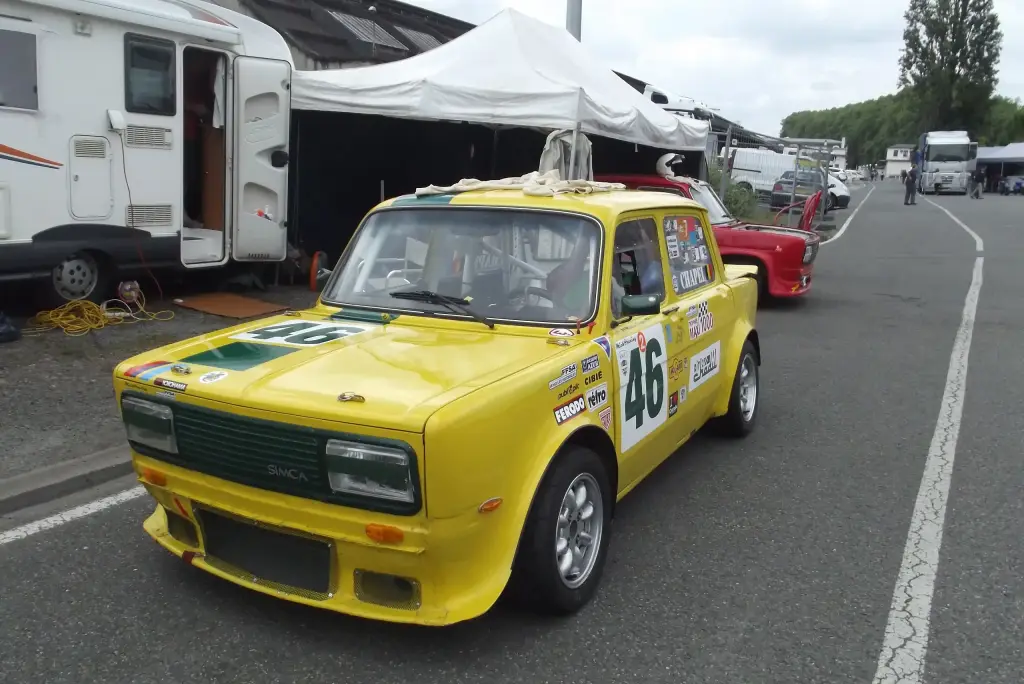
- Sporting versions: the Rallye 1 and Rallye 2 were cheap competition cars with striped paintwork and a matt-black bonnet.
- Long life: eighteen years in production with only two major updates, in 1968 and 1976.
Simca 1000 versions
- Simca 900 (1963–1966): a simplified, cheaper version of the 1000.
- 1000 GL Automatique (1965): the first automatic in the range.
- 1000 Special (1968): 1,118 cc engine from the Simca 1100.
- 1000 Rallye 1 (1970): 1,294 cc, 60 PS, zebra stripes and a black bonnet.
- 1000 Rallye 2 (1972): twin-choke carburettor, 82 PS, front-mounted radiator.
- 1976 model: new bonnet and headlamps for the final years.
The 1000 was the model below the Simca Aronde and was eventually replaced in the range by the Simca Horizon; its coupé is described under the Simca 1000 Coupé. More cars are in the Simca collection.
Sources
- Simca 1000, English Wikipedia: origins, launch, layout, exports
- Simca 1000, German Wikipedia: technical data, model updates, Rallye versions, production total
- Simca 1000, French Wikipedia: Fiat background, launch, market position