The Simca Vedette was an executive car built at Poissy from 1954 to 1961. Simca acquired it, along with the factory, from Ford France in 1954, and sold it under different model names according to trim, from the basic Trianon to the long-wheelbase Présidence.
Simca Vedette at a glance
| Production | 1954–1961 in France |
|---|---|
| Acquired from | Ford SAF, July 1954 |
| First shown | Paris Motor Show, October 1954, on the Ford stand |
| Engine | 2,351 cc sidevalve V8, Aquilon, 75 hp then 84 hp |
| Gearbox | three speeds, column shift |
| Front suspension | MacPherson struts |
| Brakes | drums on all four wheels |
| Tax class | 13 CV |
| First-generation names | Trianon, Versailles, Régence, Marly |
| Second-generation names | Beaulieu, Chambord, Présidence, Marly |
| Daily output | 150 under Ford, 250 under Simca |
| Built in France | 166,985 |
History of the Simca Vedette
Buying Ford’s French factory
In the early 1950s Henri Théodore Pigozzi wanted to expand Simca, which was enjoying great success with the Aronde, and at the same time Ford wanted to sell its French subsidiary, Ford SAF, whose large Poissy factory near Paris made the Ford Vedette. The plant was big enough for further expansion, and the Vedette was larger than anything Simca offered, so Pigozzi took over the whole factory and the rights to the cars built there. The new cars appeared at the Paris Motor Show in October 1954 on the Ford France stand, with no mention of Ford on the cover of the brochures; the name appeared once, in small print on the last page, because from 1 December 1954 customers were expected to call the cars Simcas. In export markets the change was slower, and in Belgium the cars were still shown by Ford in January 1955.
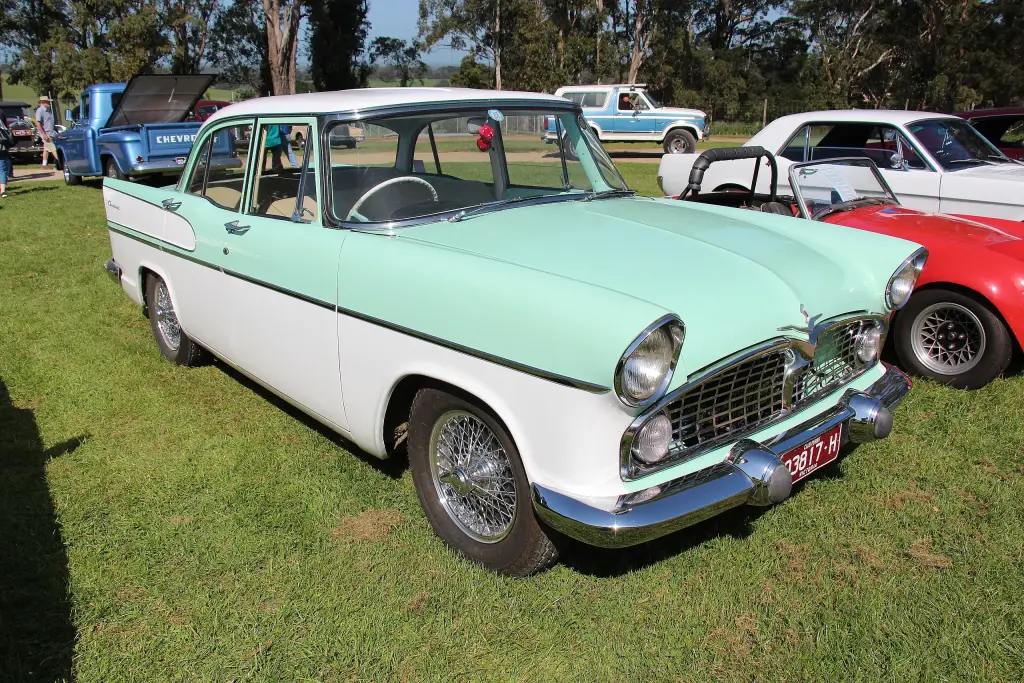
The first generation
The Vedette had an American-style four-door saloon body and a 2,351 cc sidevalve V8 called Aquilon, derived from Ford’s Flathead family and putting the car in the 13 CV French tax class. With a two-barrel Zenith-Stromberg carburettor it gave 75 hp in the first generation. Power went to a live rear axle through a three-speed gearbox with column shift; the front suspension used MacPherson struts and there were drum brakes all round. As with the Aronde, Simca sold trim levels under separate names taken from French baroque history: the basic Trianon, the mid-range Versailles and the top Régence. A large sliding glass moonroof called Vistadome was optional on all, and daily output rose from the 150 cars of the Ford years to 250.
Yearly revisions
Pigozzi kept up a schedule of yearly changes much like the American makers. For 1956 an estate called the Marly joined the range; the whole line was revised with a new front bumper plate holder, a rear plate that concealed the fuel filler, a pedal-operated windscreen washer and a second odometer. The Versailles and Régence gained central armrests, while the Trianon was simplified, losing bumper guards and chrome around the windscreen. In 1957 an optional Gravina automatic clutch was added, with better brakes and more direct steering; the Trianon regained its windscreen chrome, the other models got slimmer tail lights and a new front ornament, and V8 badges appeared on the wings of the Régence and Marly only.
The second generation and the end
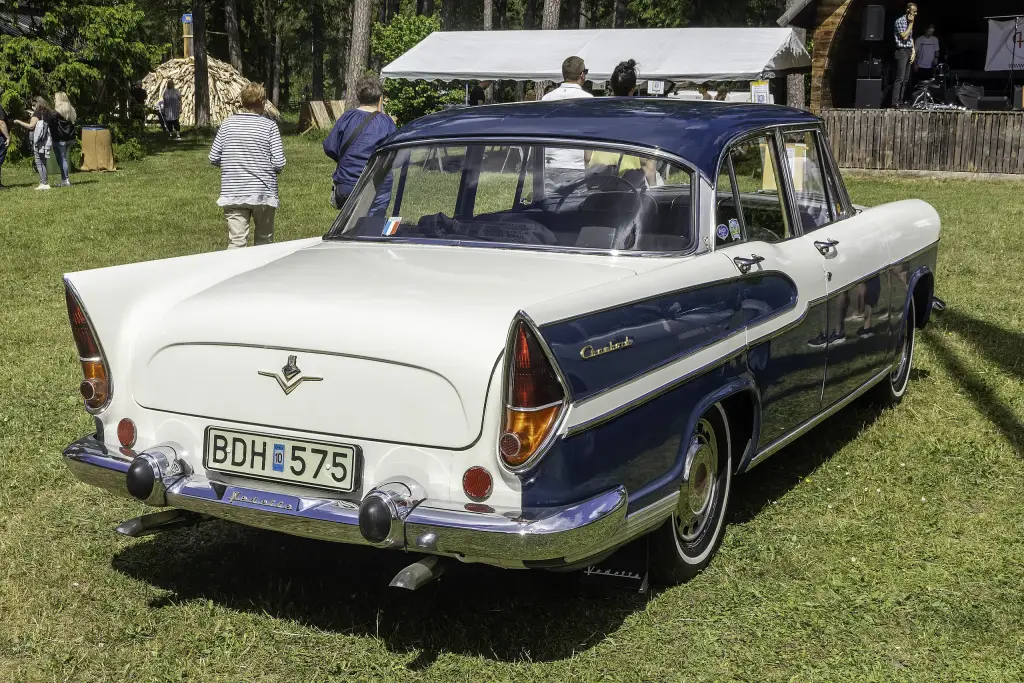
After three years the Vedettes received new names and a longer body with a more ornate front and big tailfins, even more American-looking than before. The engine was uprated to 84 hp as the Aquilon 84. The Versailles became the Beaulieu and the Régence the Chambord, while the estate kept the Marly name; the Présidence was a luxury version on a longer wheelbase. In France 166,985 Vedettes were built over seven years, including 42,439 in 1955, 44,836 in 1956 and only 3,813 in 1961, when the last French car left Poissy on 9 February. Production then moved to Brazil, and the Vedette also inspired the Chinese Dongfeng CA71; its smaller-engined sister was the Simca Ariane.
Design and features
- Small V8: a 2,351 cc sidevalve V8, unusually small but putting the car in the 13 CV class.
- American styling: a big six-seat saloon with tailfins, designed for the French market by Luigi Rapi.
- Names for trims: Trianon, Versailles, Régence, Beaulieu, Chambord and Présidence were equipment levels, not separate cars.
- Vistadome roof: an optional sliding glass panel that ran back into the roof.
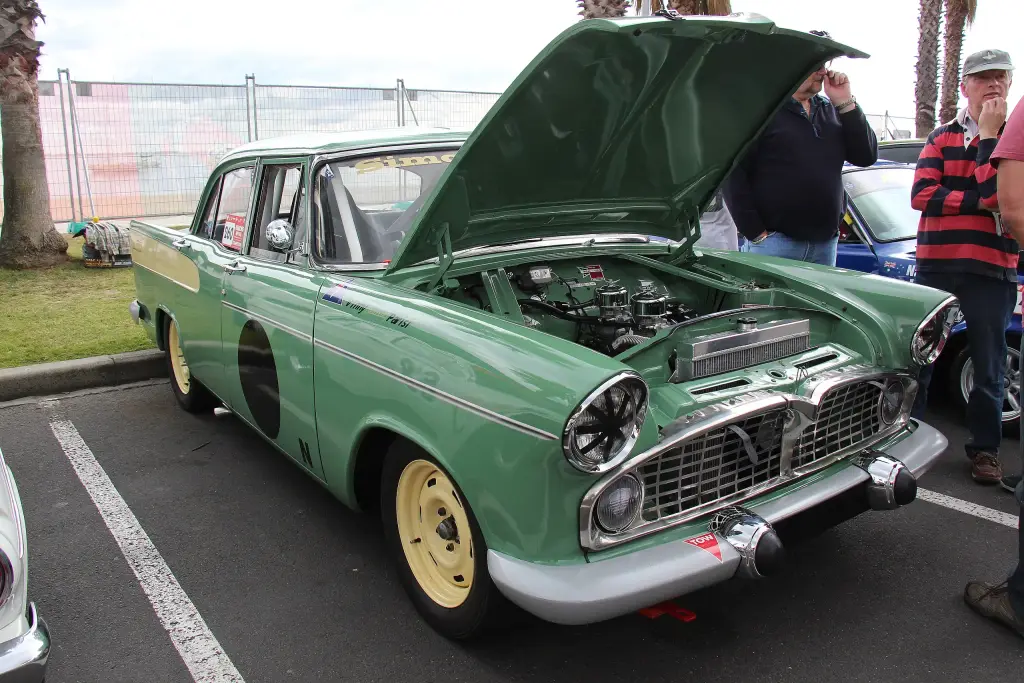
Simca Vedette versions
- Trianon (1954–1957): the basic first-generation car, later replaced by the Ariane.
- Versailles (1954–1957): mid-range trim, replaced by the Beaulieu.
- Régence (1954–1957): top trim of the first generation, replaced by the Chambord.
- Marly (1956–1961): the estate version.
- Chambord and Beaulieu (1957–1961): second-generation saloons with tailfins and the 84 hp engine.
- Présidence: luxury version on a longer wheelbase.
The Vedette’s smaller-engined sister was the Simca Ariane, and the Brazilian estate derived from it was the Simca Jangada. More cars are in the Simca collection.
Sources
- Simca Vedette, English Wikipedia: origins, first generation, revisions, second generation
- Simca Vedette, German Wikipedia: technical data, trims, yearly production, Brazil