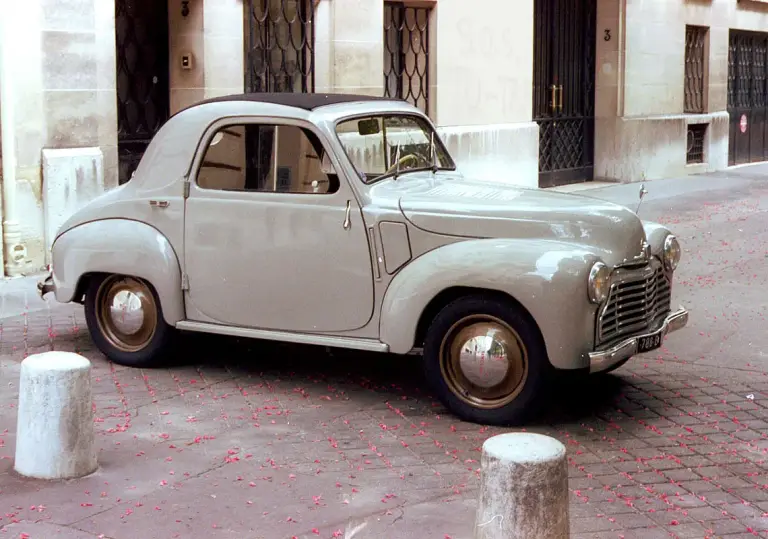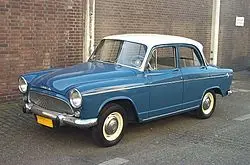
The Simca Aronde was built from 1951 to 1964 and was Simca’s first original design, all earlier models being based to some degree on Fiats, as well as its first unibody car. Its name means “swallow” in Old French, after the swallow in Simca’s logo.
Simca Aronde at a glance
| Production | 1951–1964 |
|---|---|
| Generations | 9 Aronde 1951–1955, 90A 1955–1958, P60 1958–1964 |
| Built | 1.4 million |
| Bodies | four-door saloon, estate, van, coupé and cabriolet versions |
| Engine, 9 Aronde | 1,221 cc, 44.5 bhp (33.2 kW) |
| Engine, 90A | 1,290 cc Flash |
| Engine, P60 | Rush 1.3 from October 1960; Rush-Super 70 PS from 1961 |
| Gearbox | four speeds, synchromesh on the top three ratios |
| Suspension | independent front on coil springs, live axle on leaf springs |
| Brakes | hydraulic drums, 250 mm |
| Record run, 1952 | 50,000 km at an average of 117 km/h |
| Record run, 1953 | 100,000 km in 40 days and nights |
History of the Simca Aronde
The first Simca of its own
Earlier Simcas were licence-built Fiats: the Simca 5 and 6 followed the Fiat 500 Topolino and the Simca 8 the Fiat 1100. After the war Fiat’s own replacement for the 1100 was delayed, so Simca developed its own model and kept only the engine. The Aronde therefore became the company’s first independent design and its first car with a self-supporting body and a front subframe. The name was taken from the swallow in the Simca emblem.
The 9 Aronde
The first Aronde appeared in the spring of 1951, but at first only a few hundred pre-production cars went to selected “guinea-pig” buyers; the full production version was ready for the Paris Motor Show and went on sale in October 1951. It had a 1,221 cc engine from the Simca 8 with 44.5 bhp, a Solex 32 carburettor and a four-speed gearbox with synchromesh on the top three ratios. The front suspension was independent on coil springs, the rear axle sat on semi-elliptic leaf springs, and there were hydraulic drum brakes of 250 mm all round. Inside, a moulded plastic dashboard looked very modern next to the metal one of the Peugeot 203. At first the battery was under the front seat; at the start of 1952 it was moved under the bonnet.
Bodies and records
Only a four-door saloon was offered at launch, but a three-door estate soon followed, first as the Aronde commerciale and later as the Châtelaine, with a horizontally split tailgate, along with the Messagère van and, in 1953, a part-glazed commerciale. The two-door coupé was coachbuilt by Facel and was replaced for 1953 by the Grand Large, based on the saloon body, with a three-piece wrap-around rear window and a pillarless side-window effect. A Figoni cabriolet was shown for 1953 but never produced for sale. A stripped Aronde Quotidienne was offered from January 1953 at 630,000 francs, 45,000 less than the base model. Production of the 9 Aronde passed 100,000 at Nanterre on 17 March 1953. Henri Pigozzi was fond of record runs: in May 1952 an Aronde covered 50,000 km at an average of 117 km/h, and in August 1953 another, taken at random from the line, covered 100,000 km in forty days and nights, breaking more than 30 international records.
The 90A and the P60
The second-generation 90A arrived in October 1955 with a facelifted front and rear and the new 1,290 cc Flash engine. Trim levels included Elysée and Montlhéry, named after the circuit, and in October 1957 the Océane cabriolet and Plein Ciel hardtop coupé were added, both built by Facel. The 500,000th Aronde was built in January 1957, the same year exports to the United States began. In September 1958 came the P60, a redesigned saloon, with a new Monaco coupé and a cheaper Etoile entry model using a 1,090 cc engine. From October 1960 a new Rush engine of 1.3 litres with a five-bearing crankshaft was used, and from September 1961 a 70 PS Rush-Super was offered in the Montlhéry Spéciale saloon and Monaco Spéciale coupé. The Aronde was built until 1964 and replaced by the Simca 1300 and 1500, presented in March 1963.
Design and features
- First own design: the Aronde ended Simca’s dependence on Fiat models, keeping only the engine.
- Unibody construction: Simca’s first car with a self-supporting body and a front subframe.
- Modern interior: a moulded plastic dashboard in 1951, against the Peugeot 203’s metal one.
- Record-breaking: long-distance runs at Montlhéry were used to advertise the car’s stamina.
Simca Aronde versions
- 9 Aronde (1951–1955): 1,221 cc engine, saloon, estate and Facel coupé.
- Grand Large (1953): coupé on the saloon body with a wrap-around rear window.
- Aronde Quotidienne (1953): a stripped, cheaper version at 630,000 francs.
- 90A (1955–1958): new front and rear, 1,290 cc Flash engine, Elysée and Montlhéry trims.
- Océane and Plein Ciel (1957): Facel-built cabriolet and hardtop coupé.
- P60 (1958–1964): redesigned saloon, Monaco coupé, Etoile entry model, Rush engines.
The Aronde replaced the Simca 8 and was replaced by the Simca 1300/1500; its engine later went into the Simca Ariane. The smaller Simca 1000 sat below it from 1961. More cars are in the Simca collection.
Sources
- Simca Aronde, English Wikipedia: launch, engineering, bodies, records, 90A
- Simca Aronde, German Wikipedia: origins, generations, P60 range, engines, production