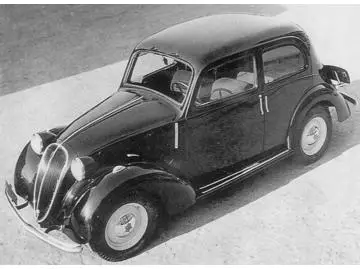
The Simca 8 was a small family car built in France between 1937 and 1951, a rebadged Fiat 508C Nuova Balilla made at Nanterre. It was sold as a saloon, coupé or cabriolet, and 113,165 were built.
Simca 8 at a glance
| Production | 1937–1951, including the war years |
|---|---|
| Based on | Fiat 508C Nuova Balilla |
| Built at | Nanterre, France |
| Bodies | four-door saloon, two-door cabriolet, coupé; estate after 1948 |
| Engine at launch | 1,089 cc four, 32 PS (24 kW) at 4,000 rpm |
| Engine from 1949 | 1,221 cc, 41 PS (30 kW), sold as the 8/1200 |
| Gearbox | four speeds |
| Brakes | hydraulic drums on all four wheels |
| Top speed | about 110 km/h |
| Tax class | 6 CV; 7 CV for the 1200 and Sport |
| Price, 1937 | 23,900 francs Normale, 25,900 francs Grande Luxe |
| Built | 113,165 |
History of the Simca 8
Launch
The Simca 8 was first shown at the Paris Motor Show in October 1937, and sales in France began almost immediately in November. It was a rebadged Fiat 508C “nuova Balilla”, built in Italian licence at the Simca plant in Nanterre, and it corresponded closely to the Fiat 1100. Its front had an egg-shaped grille and separate round headlights, and the body was far more streamlined than that of its predecessor, the Simca-Fiat 6 CV. The four-door saloon was unusual in having no central pillar: the front doors were hinged at the front and the rear doors at the back, so opening a front and a rear door together gave particularly easy access. In 1937 a Normale berline cost 23,900 francs and a Grande Luxe 25,900, against 21,300 and 22,500 francs for the Peugeot 202 that appeared six months later.
The 50,000-kilometre run
In the early summer of 1938 Simca’s boss Henri Pigozzi organised a three-part endurance run under the supervision of the Automobile Club de France. A single Simca 8 covered 50,000 kilometres: 10,000 laps of the Montlhéry circuit at an average of 115.1 km/h and 7.9 l/100 km, 20,000 kilometres on open roads at 65 km/h and 6.0 l/100 km, and 20,000 kilometres in Paris at 54 km/h and 6.5 l/100 km. The opening circuit run broke eight international records, and the exercise ended on 12 May 1938 with a press dinner at which journalists dined with the drivers, the ACF observers and the Simca directors. The printed summary invited readers to “buy the same car”.
Engineering
The “8” in the name did not mean eight cylinders: the car had four, and was rated 6 CV for tax. The number most likely stood for 1938, its first model year. At launch it used Fiat’s 1,089 cc engine with a claimed 32 PS at 4,000 rpm, fed through a Solex 30 mm carburettor, with overhead valves driven by rods and rockers from a side-mounted camshaft and an aluminium cylinder head that was unusual at the time. The four gear ratios were chosen so that consumption stayed reasonable even at 110 km/h. Steering was unusually precise and the hydraulic brakes efficient, but the engine was noisy under hard work, the semaphore indicators were fragile, the sophisticated front suspension suffered on France’s unpaved rural roads, and the cabin was only just large enough for four people with a small luggage space behind the back seat.
Later years
In September 1949, not long before the model was replaced, the Simca 8 received the Fiat-designed 1,221 cc engine that would also go into its successor, the Simca 9 Aronde. Sold as the Simca 8/1200, it developed 41 PS and had a redesigned front end, and in 1948 Simca had added a Sport model with a Pininfarina-designed body built by Facel-Métallon, whose 50 PS engine gave 135 km/h and whose production ended in 1952. After the war the range widened to include coupé, cabriolet and, after 1948, estate versions, but almost all cars sold were still berlines: early in 1947 a berline cost 330,000 francs against 420,000 for the cabriolet. In 1948 the Simca 8 was Simca’s best seller with about 14,000 cars, and it stayed on sale until the end of 1951, when the Simca 9 took over.
Design and features
- Pillarless saloon: front-hinged front doors and rear-hinged rear doors made entry especially easy.
- Frugal and lively: the four-speed gearbox was geared for reasonable consumption at 110 km/h.
- Hydraulic brakes: efficient and resistant to overheating, at a time when many rivals still used rods.
- Aluminium cylinder head: an unusual feature for a mass-produced car of 1937.
Simca 8 versions
- Berline (1937–1951): the four-door saloon, by far the most popular body.
- Cabriolet (1937–1951): the two-door open car offered from launch.
- 8/1200 (1949–1951): 1,221 cc engine and a redesigned front end.
- 8 Sport (1948–1952): Pininfarina body by Facel-Métallon, 50 PS, 135 km/h.
- Post-war estate: listed after 1948 but always a small part of sales.
The Simca 8 was replaced by the Simca 9, and its smaller stablemate was the Simca 5. The bigger cars of the range were the Simca Vedette. More cars are in the Simca collection.
Sources
- Simca 8, English Wikipedia: launch, endurance run, engine, bodies, prices, sales
- Simca 8, German Wikipedia: Fiat origin, technical data, Sport, production total, racing