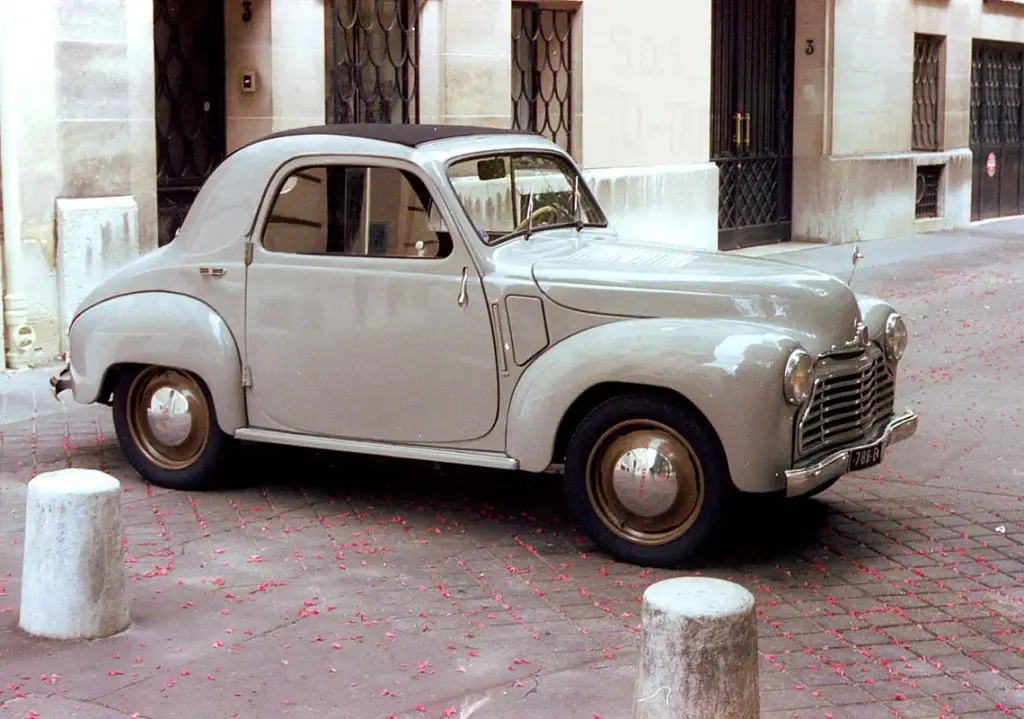
The Simca 6 was a small two-seat car and van built in France from 1947 to 1950. Developed from the Simca 5, it was the first Simca whose design showed real independence from Fiat, and it previewed the mechanical changes later used on the Fiat Topolino C.
Simca 6 at a glance
| Production | 1947–1950 |
|---|---|
| Built | 16,508 |
| First shown | Paris Motor Show, October 1947 |
| Bodies | two-door, two-seat coupé-style car; small van |
| Van payload | 250 kg |
| Engine | 569 cc four, 16.5 bhp at 4,400 rpm |
| Gearbox | four speeds, synchromesh on the top two ratios |
| Brakes | drums on all four wheels |
| Fuel economy | 5 litres for 108 km, about 4.62 l/100 km |
| Top speed | 90–95 km/h |
| Tax class | 3 CV |
History of the Simca 6
Independence from Fiat
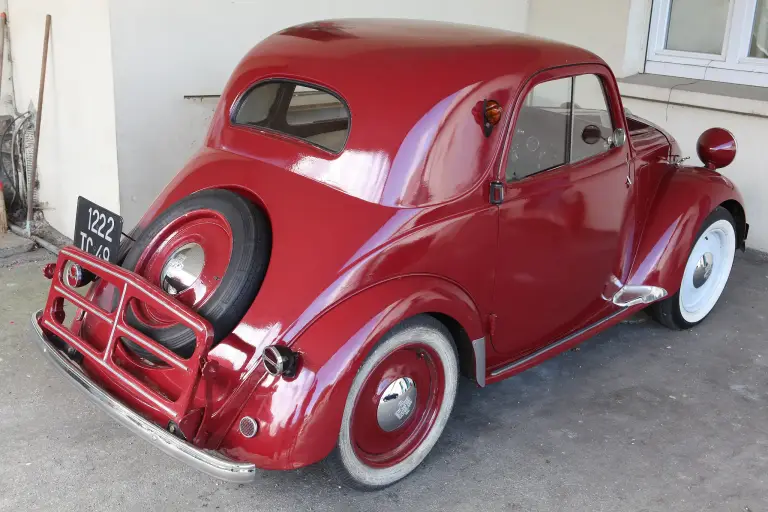
Simca had been set up as a French subsidiary of Fiat, and the Simca 5 had been a rebadged Fiat Topolino built in France. With the Simca 6, shown at the Paris Motor Show in October 1947, the development office at Nanterre showed a level of independent thinking not seen before in a Simca production model. The car was distanced from its Italian origins by a modified, Americanised front: the grille was widened and lowered, and the headlights were raised and integrated into the wing panels, along the lines of the new Peugeot 203 and Renault 4CV. The rear overhang was extended to make a small boot, reachable only from inside the car and almost entirely filled by the spare wheel.
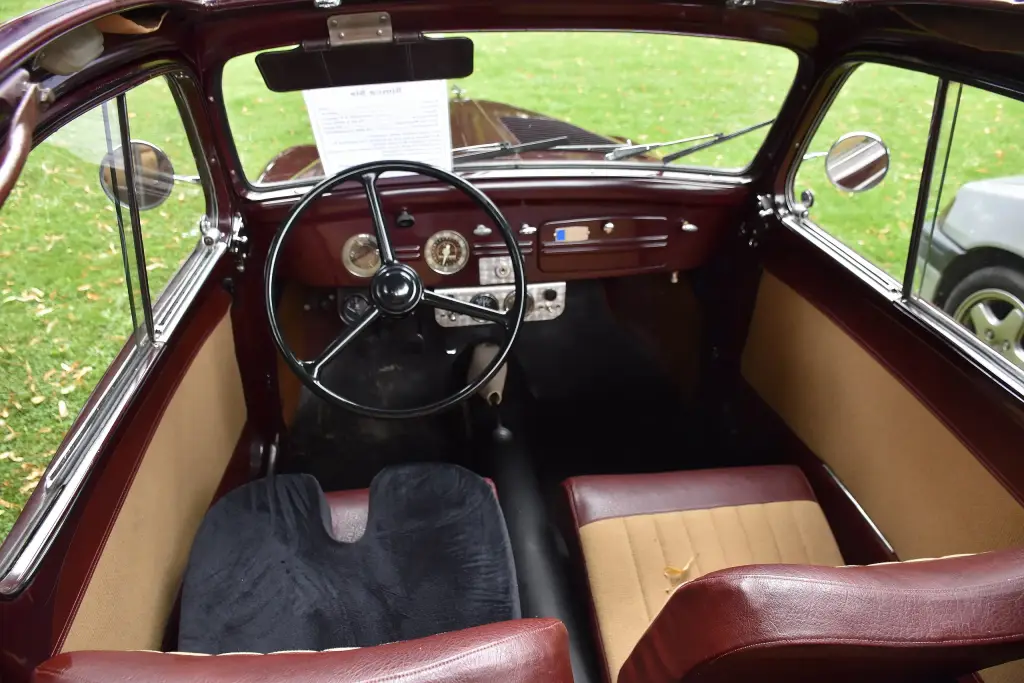
The car
The engine was the 569 cc unit of the Fiat Topolino B, with overhead valves worked by a side-mounted camshaft. Claimed output rose from 12 to 16.5 bhp at 4,400 rpm. The lightweight car inherited its predecessor’s economy, covering 108 km on five litres, and its advertised top speed of 90 to 95 km/h was considered excellent for its size and price. Mechanically it was conventional: a four-speed gearbox with synchromesh on the top two ratios and drum brakes on all four wheels. Besides the two-seat car there was a small van carrying up to 250 kg, and the new chassis had an extended rear with two semi-elliptic leaf springs and larger wheels.
A slow start
Despite its Paris showing the car got off to a slow start: only 11 were built in the last month of 1947 and 191 during the whole of 1948, while the older Simca 5 remained the company’s smaller volume model. Official type approval came in May 1948, series production began in the summer and the first cars were delivered in September 1948. In 1949 the Simca 6 replaced its predecessor, and the van version, approved that year, replaced the Simca 5 estate.
A short career
Production lasted only three years, with 16,508 cars of both body types built: about 200 in 1948, more than 10,000 in 1949 and a little over 5,000 in 1950. The little two-seater no longer matched French taste, which preferred the Renault 4CV and Citroën 2CV, and Simca decided to concentrate on modernising the Simca 8 into the future Simca 9. Its French customers had to move up to the larger Simca 8, and ten years passed before Simca returned to the small-car class with the Simca 1000. The Simca 6 had also anticipated the Fiat Topolino C, which arrived more than seventeen months later with the same upgraded mechanical parts but without the American-style chrome.
Design and features
- Independent front end: a widened, lowered grille and raised headlights set into the wings, unlike the Fiat original.
- New boot: an extended tail with a small compartment reachable only from inside, largely filled by the spare wheel.
- More power: 16.5 bhp from 569 cc, against 12 bhp in the Simca 5.
- Frugal: 5 litres of fuel for 108 km in a published test.
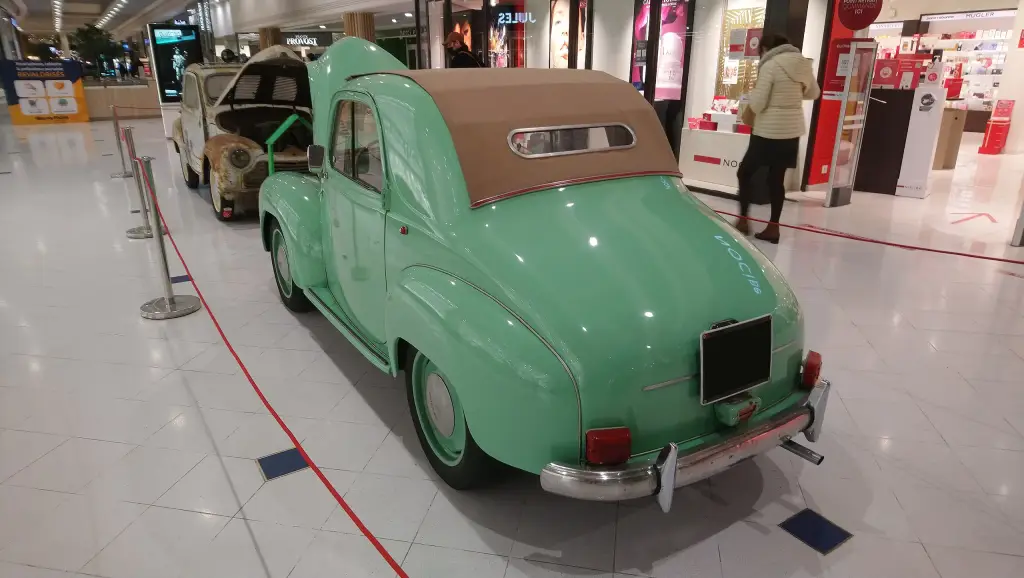
Simca 6 versions
- Two-seat car (1947–1950): the standard coupé-style body.
- Van (1948–1950): 250 kg payload, approved in 1949 to replace the Simca 5 estate.
- 1948 cars: the first full production year, only about 200 built.
- 1949–1950 cars: the model’s main production, more than 15,000 in two years.
The Simca 6 replaced the Simca 5 and was followed in the range by the larger Simca 8, later developed into the Simca 9. Simca did not return to small cars until the Simca 1000 of 1961. More cars are in the Simca collection.
Sources
- Simca 6, English Wikipedia: design changes, engine, performance, production
- Simca 6, German Wikipedia: type approval, yearly production, market context