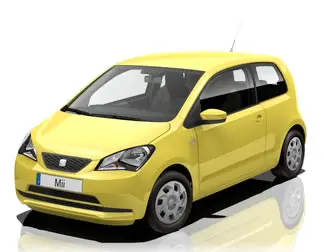
The SEAT Mii was SEAT’s city car, on sale from 2011 to 2021. Built in Bratislava as a rebadged Volkswagen Up with slightly different front and rear styling, it finally gave the Arosa a successor after seven years, and it was the smallest model in the range.
SEAT Mii at a glance
| Maker | SEAT, built by Volkswagen in Bratislava, Slovakia |
|---|---|
| Production | 2011–2021 |
| Basis | Volkswagen Up, rebadged |
| Family | Volkswagen New Small Family, with the Škoda Citigo |
| Engine | 1.0-litre three-cylinder petrol, 60 or 75 hp |
| Gearbox | five-speed manual |
| Seats | four |
| Length | 3.54 m, wheelbase 2.42 m |
| Safety feature | City Safety Assist, automatic braking below 30 km/h |
| Special edition | Mii by Mango, Geneva 2014 |
| Replaced | SEAT Arosa, after a gap since 2004 |
There is no separate English Wikipedia page for the Mii; this page uses the article on the Volkswagen Up, of which the Mii is a rebadged version. Free photographs of the Mii were not found on Wikimedia Commons, so the page has no photographs.
History of the SEAT Mii
A shared small car
The Mii belongs to the Volkswagen Group’s New Small Family, the series of city cars that also includes the Volkswagen Up and the Škoda Citigo. All three are rebadged versions of the Up with slightly different front and rear fascias, and all were built at the Volkswagen plant in Bratislava, Slovakia, where production began in December 2011. The Up itself went on sale in Germany on 3 December 2011, with deliveries to other European markets starting in April 2012. The SEAT version began limited production in October 2011 for the European market, sales started at the end of 2011 and the final version was launched in May 2012.
The car itself
The production car has a front engine and front-wheel drive on the NSF platform, with a three-cylinder 1.0-litre petrol engine in 60 and 75 hp forms and a five-speed manual gearbox. It is 3.54 m long on a wheelbase of 2.42 m and has a four-seat cabin. The design follows the three-door bodywork inspired by the 2007 Up concept, and the range was also offered with a natural gas engine under the eco-Up name. Along with the other two rebadged models, the Mii was the first car in its class to offer an automated braking system, which Volkswagen calls City Emergency Braking: a laser sensor detects the danger of a collision below 30 km/h and applies the brakes, and in the SEAT it is marketed as City Safety Assist, while Škoda calls it City Safe Drive.
Editions and the end
At the Geneva Motor Show in 2014 SEAT presented the Mii by Mango, a version aimed at women and made in collaboration with the Spanish fashion company Mango. The Mii replaced the SEAT Arosa, which had gone out of production in 2004 without a direct successor, and it filled the bottom of the range below the Ibiza. The SEAT version was withdrawn from sale in 2021, a year after the Škoda Citigo, and Volkswagen itself ended production of the Up in October 2023. No electric Mii was ever sold under the SEAT name: the battery-electric version of the family, launched in autumn 2013, was the Volkswagen e-up.
Design and features
- Group city car: the same New Small Family base as the Volkswagen Up and Škoda Citigo.
- Three-cylinder engine: a 1.0-litre petrol unit of 60 or 75 hp.
- City Safety Assist: automatic braking below 30 km/h, a first in the class.
- Late successor: the first proper replacement for the Arosa since 2004.
SEAT Mii versions
- Mii (2011–2021): the standard three- and five-door city car.
- Mii eco-Up: natural gas version of the shared family.
- Mii by Mango (2014): fashion edition shown at Geneva.
The Mii replaced the SEAT Arosa at the bottom of the range, below the SEAT Ibiza. More Spanish cars are in the SEAT collection.
Sources
- Volkswagen Up, English Wikipedia: platform, engines, production, Mii versions
- SEAT, Spanish Wikipedia: place of the Mii in the SEAT range