The SEAT Alhambra was SEAT’s large seven-seat MPV, built from June 1996 to 2020 at the Volkswagen Group’s AutoEuropa plant in Palmela, Portugal. It shared its platform with the Volkswagen Sharan and, in its first generation, with the Ford Galaxy, and almost 500,000 were sold in two generations.
SEAT Alhambra at a glance
| Maker | SEAT, built by AutoEuropa, Palmela, Portugal |
|---|---|
| Production | 1996–2020 |
| Class | seven-seat MPV |
| Platform partners | Volkswagen Sharan, Ford Galaxy (first generation) |
| Luggage space, first generation | 256 l with seven seats, 852 l with five, 2,610 l with two |
| Second generation | from October 2010, 4.85 m long, sliding rear doors |
| Four-wheel drive | 2.0 TDI, from February 2013 |
| Facelift | 2000, new SEAT image |
| Sold | almost 500,000 since 1996 |
| End of production | March 2020 |
This page is based on one source, the English Wikipedia article on the SEAT Alhambra.
History of the SEAT Alhambra
First generation, 1996
A prototype of the Alhambra was shown at the 1995 Geneva Salon, and the production car followed at the same show a year later, going on sale in June 1996. It shared most of its components and design with the Volkswagen Sharan Mk1 and the Ford Galaxy Mk1, yet SEAT fitted more equipment for a given price. The car had seven seats, and the five rear seats could be folded or unclipped and removed completely, leaving a flat-floored load space that was unique among SEAT models at the time. Load volume ranged from 256 litres with all seven seats in place to 852 litres with five and 2,610 litres with only the front seats fitted. All three cars were built on the same line at the AutoEuropa joint venture in Palmela, Portugal.
A long first life
The Alhambra was essentially unchanged from 1996 to 2010, although a major restyling in 2000 brought it into line with the new SEAT image. It remained faithful to the original design produced under the Volkswagen Group and Ford technology-sharing agreement. When Volkswagen and Ford began losing market share to newer MPVs such as the Toyota Previa and Mitsubishi Space Wagon, they changed the design of their own versions, but SEAT kept the original shape. In 2009 the Alhambra Ecomotive arrived with a 2.0 TDI engine of 140 PS and CO2 emissions of 159 g/km. The first generation won the Monovolume do Ano award in Portugal in 1997.
Second generation, 2010–2020
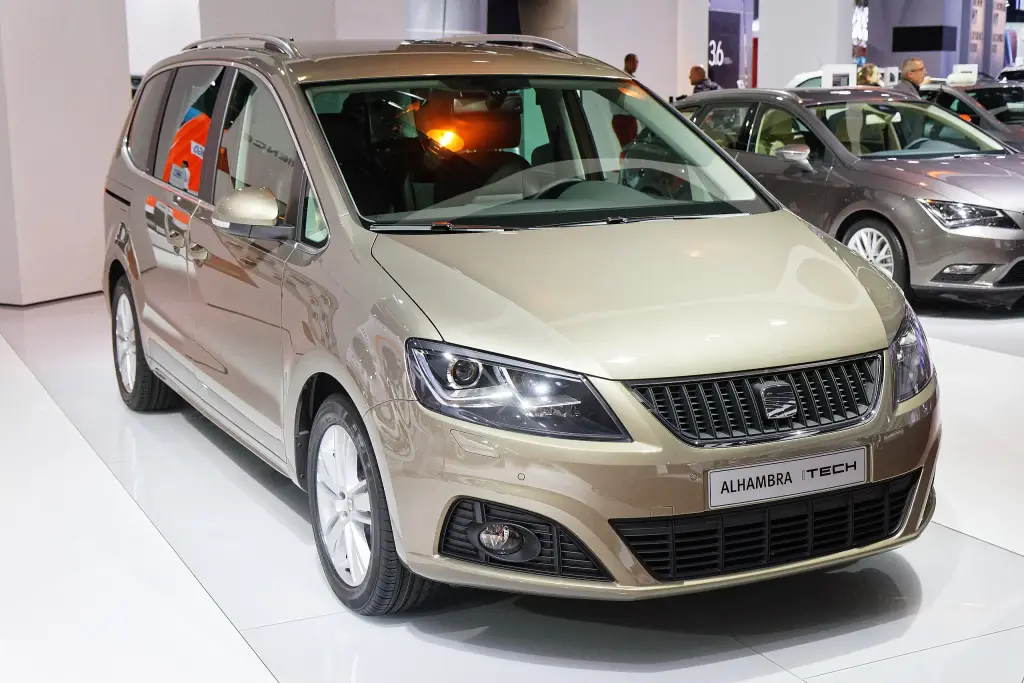
The second generation went on sale in October 2010. At 4.85 m it was 22 cm longer and 9 cm wider than the car it replaced, and like the Sharan it gave access to the middle row through sliding doors. In February 2013 SEAT added a four-wheel-drive version with permanent all-wheel drive, the 2.0 TDI of 140 PS and a six-speed manual gearbox. In September 2015 the UK diesel models were revised to meet Euro 6, with outputs rising from 140 to 150 PS and from 177 to 184 PS. The second generation scored five Euro NCAP stars in 2010 and four in 2019, and collected a long list of MPV awards, among them several “Best MPV” titles from the British magazine What Car?. SEAT announced in March 2020 that production would end that month.
Design and features
- Seven seats: five removable rear seats and a flat floor, unusual in the class in 1996.
- Group platform: developed with the Volkswagen Sharan and, at first, the Ford Galaxy.
- Two generations: the original of 1996 and the larger, sliding-door car of 2010.
- Four-wheel drive: offered on the second generation from 2013.
SEAT Alhambra versions
- Alhambra Mk1 (1996–2010): the original seven-seater, restyled in 2000.
- Alhambra Ecomotive (2009): 2.0 TDI of 140 PS, 159 g/km of CO2.
- Alhambra Mk2 (2010–2020): longer and wider, with sliding rear doors.
- Alhambra 4WD (2013): permanent all-wheel drive with the 2.0 TDI.
The Alhambra was the largest car in the range above the SEAT Altea, and the SEAT Mii was the smallest. More Spanish cars are in the SEAT collection.
Sources
- SEAT Alhambra, English Wikipedia: generations, dimensions, engines, awards, end of production