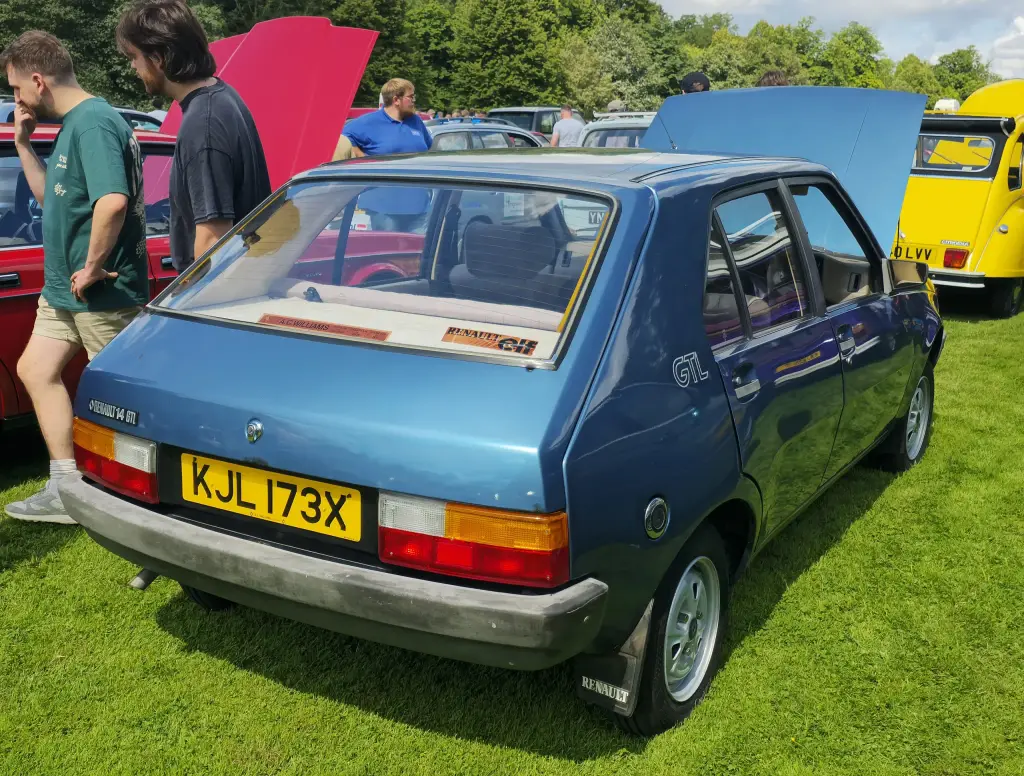
The Renault 14 is a small family hatchback produced from 1976 to 1983, and the first car built in large volumes at Renault’s then new Douai plant. It was developed to take on the Volkswagen Golf, and used a transverse engine co-developed with Peugeot.
Renault 14 at a glance
| Maker | Renault, Douai, France |
|---|---|
| Production | 1976–1983 |
| Shown | January 1976, production from June 1976 |
| Class | small family hatchback |
| Engines | 1.2-litre and 1.4-litre X-type, 60 or 70 PS |
| Engine position | transverse, inclined back by 72°, spare wheel above it |
| Rear seat | folding or completely removable |
| Replaced by | Renault 11, from 1983 |
Based on one source, the English Wikipedia article on the Renault 14.
History of the Renault 14
A hatchback for the Golf era
The Renault 14 was first shown in January 1976, with production starting in June that year at Douai, the first car built there in large volumes after pilot runs of the Renault 5. With front-wheel drive, it was developed for the small family hatchback sector that the Volkswagen Golf had popularised in 1974. It began with L and TL trim and a 1.2-litre single-overhead-camshaft engine, and later 1.4-litre versions joined: the GTL with 60 PS and the TS with 70 PS.
The suitcase engine
Both engines were of the X type, commonly called the Douvrin or ‘suitcase’ engine, developed jointly with Peugeot; the 14 turned out to be the only Renault to use it. The packaging was clever: the spare wheel sat in front, under the bonnet and above the transverse four-cylinder engine, which was inclined backwards by 72 degrees, making the 14 the first Renault with a transverse engine fitted like the Mini’s. The rear seat could be folded or removed completely, and the motoring press praised the exterior styling as fresh and ahead of its time. The 14 kept Renault’s old rear suspension with two full-width torsion bars one behind the other, and the resulting wheelbase difference of 32 mm between left and right.
The pear
In 1979 Renault widened the range to make up for a slow start, adding a GTL that took wheels and trim cues from the new Renault 18 and a TS with a twin-choke carburettor, power raised from 57 to 70 hp, halogen headlamps and electric front windows, a first in the French class. Sales were nevertheless hampered by an advertising campaign that compared the car to the shape of a pear to stress its interior space, and by a preview at the Pompidou Centre as a bare bodyshell. The car then gained a reputation for early body corrosion and was nicknamed the ‘rotten pear’ by the press; in France ‘la poire’ still means the 14. Within four years it faced the Ford Escort Mk3, Opel Kadett, Fiat Ritmo and Talbot Horizon, and it was replaced by the Renault 11 in 1983.
Design and features
- Transverse engine: a space-saving layout for Renault, with the unit inclined 72 degrees.
- Spare wheel under the bonnet: above the engine, freeing space in the boot.
- Removable rear seat: the bench could be folded or taken out entirely.
- Peugeot-shared Douvrin engine: a joint design used by no other Renault.
Renault 14 versions
- 14 L and TL (1976): 1.2-litre engines at launch.
- 14 GTL (1979): 1.4-litre 60 PS with Renault 18 styling cues.
- 14 TS (1979): 70 hp, halogen headlamps and electric front windows.
The 14 sat between the Renault 5 and the Renault 18 and was replaced by the Renault 9 and 11. More cars are in the Renault collection.
Video: Renault 14 factory film
Video by americanads on YouTube.
Sources
- Renault 14, English Wikipedia: engines, packaging, trims, reception