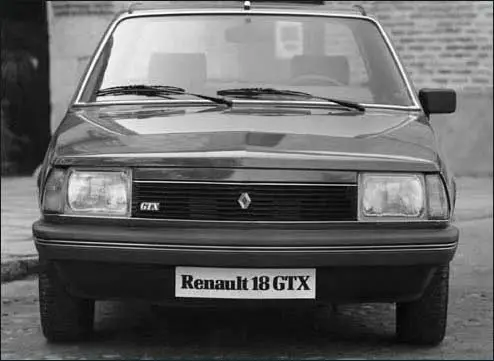
The Renault 18 is a large family car produced from 1978 to 1989, with South American production continuing until 1994. It was Renault’s first true ‘world car’, developed in only eighteen months on the underpinnings of the Renault 12.
Renault 18 at a glance
| Maker | Renault, Flins, France |
|---|---|
| Production | December 1977–1989, to 1994 in South America |
| Body | four-door saloon, later estate |
| Developed from | Renault 12 |
| Development time | about eighteen months |
| Launch | Geneva Salon, March 1978 |
| Engines | 1,397 cc 64 PS and 1,647 cc 79 PS |
| Built in | France and ten other countries |
| Related | Renault Fuego coupé |
Based on one source, the English Wikipedia article on the Renault 18.
History of the Renault 18
Eighteen months
The Renault 18 was meant to replace the Renault 12, which had been in production since 1969 and was ageing by the late 1970s, although the 12 stayed on until 1980. Unlike the earlier car the 18 was designed quickly: only eighteen months passed between its conception and its launch, mainly because it was based on the 12’s underpinnings. Production began at Flins in December 1977, the car was presented at the Geneva Salon in March 1978 and sales started the following month. Production peaked early, in 1979, after which sales declined gradually; the 1.4-litre version was initially the most popular, then the 1.6, and by 1986 the two-litre engine accounted for the largest share.
The initial range
At first the 18 was a four-door saloon only, in TL, GTL, TS and GTS trim. The TL and GTL used the 1,397 cc Cléon petrol engine, developed from the 1,289 cc unit of the Renault 12, with 64 PS and a four-speed gearbox. The TS and GTS had the 1,647 cc A-type engine of the Renault 17 TS, but without fuel injection, which lowered output to 79 PS. The car also formed the basis of the closely related Renault Fuego coupé, with which it shared the floorpan and drivetrain, although the Fuego initially used the negative-offset front suspension of the larger Renault 20/30; that layout became standard across the 18 range from the 1983 model year.
A world car
Renault had already sold the 12 in countries such as Argentina, but its first true world car was the 18, whose slogan was Meeting International Requirements; it was built in France and in ten other countries on four continents. In 1981 the Indian public-sector project Maruti Udyog chose the 18 to be built there at 100,000 cars a year, including a pick-up to compete with small Japanese trucks, but a closer review ordered by Rajiv Gandhi concluded that the economics did not make sense and a smaller, cheaper car would be better; Maruti instead built the Suzuki Alto under licence. The 18 also served as the basis for the Renault Eve research car, powered by a 1.1-litre engine from the Renault 5 and using a microprocessor, sensors, an electronically controlled carburettor and a continuously variable transmission, with a drag coefficient of just 0.239.
Design and features
- Fast development: eighteen months from conception to launch, thanks to the Renault 12 base.
- World production: built in France and ten other countries on four continents.
- Fuego connection: the coupé shared the floorpan and drivetrain with the saloon.
- Renault Eve: a fuel-economy research car with a 0.239 drag coefficient built on the 18.
Renault 18 versions
- 18 TL and GTL: 1,397 cc 64 PS with a four-speed gearbox.
- 18 TS and GTS: 1,647 cc 79 PS without fuel injection.
- 18 estate: the load-carrying version added later.
- Renault Fuego: coupé derivative sharing the floorpan.
- Renault Eve: experimental fuel-efficient research car.
The 18 replaced the Renault 12 and shared its floorpan with the Renault Fuego. Its larger relative was the Renault 20/30; more cars are in the Renault collection.
Sources
- Renault 18, English Wikipedia: development, engines, world production, Renault Eve