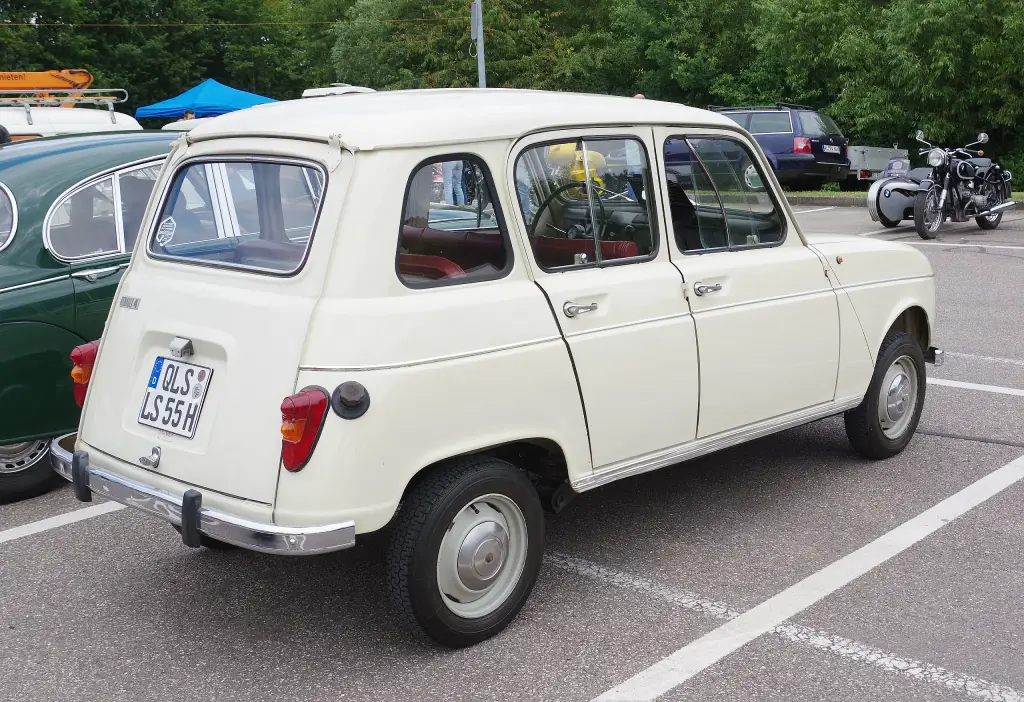
The Renault 4, or R4, known in France as the Quatrelle, is an economy car built from 1961 to 1994. It was first marketed as a short estate but its single-piece top-hinged tailgate makes it the world’s first mass-produced hatchback.
Renault 4 at a glance
| Maker | Renault, France, and twenty factories worldwide |
|---|---|
| Production | 1961–1994 |
| Bodies | hatchback, van (Fourgonnette), estate |
| Layout | front-wheel drive, longitudinal engine |
| Engines | OHV four-cylinders from 782 cc |
| First million | by 1 February 1966 |
| Built | over eight million |
| Simplified version | Renault 3, offered in 1961 and 1962 |
Based on one source, the English Wikipedia article on the Renault 4.
History of the Renault 4
An answer to the 2CV
The Renault 4 was Renault’s response to the 1948 Citroën 2CV, and Renault could study the 2CV’s strengths and weaknesses before designing it. The Citroën had made motoring affordable for low-income buyers, especially farmers, for whom the car was a working tool, but by the late 1950s it was outdated: rural roads had improved, motorways were being built and farming was becoming mechanised. The 2CV was also popular in towns, where its rural brief made it less than ideal, and the late-1950s car had a top speed of only 70 km/h from a noisy air-cooled twin.
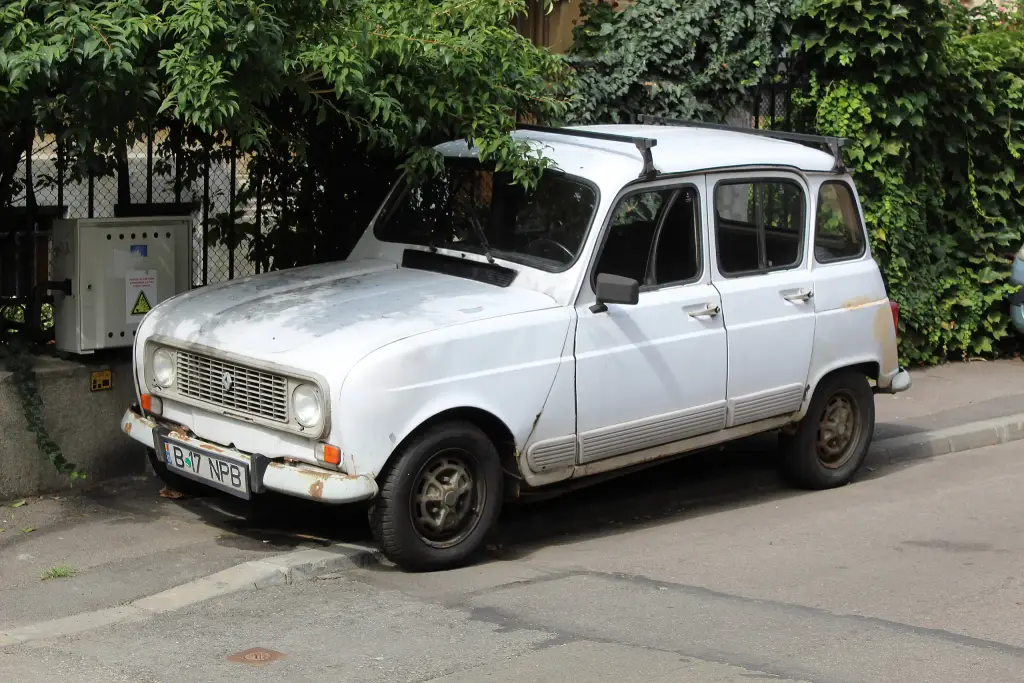
Front-wheel drive and a hatchback
The R4 was the first time Renault used front-wheel drive in a family car, the first of a string of Renault front-wheel drives with longitudinal engines that included the R5, R6 and R16. Its short rear body and top-hinged single-piece tailgate make it the first mass-produced hatchback. A bare-bones Renault 3 was offered alongside it in 1961 and 1962. The car arrived as decades of economic stagnation gave way to growing prosperity and surging car ownership in France.
Eight million
The first million cars were built by 1 February 1966, less than four and a half years after launch, and over eight million were eventually made in twenty factories on four continents. The Renault 4 succeeded because of the timing of its introduction and its value-for-money design, and by early 2020 its 33-year production run ranked as the seventeenth longest-lived single generation in history. The R4 also supplied much of the internals and many mechanical components to the later and more fashionable Renault 5.
Design and features
- First mass-produced hatchback: a short rear body with a single top-hinged tailgate.
- Front-wheel drive: Renault’s first front-drive family car, with a longitudinal engine.
- Working tool: a simple, cheap car for country roads and load carrying.
- Long life: built for 33 years in twenty factories on four continents.
Renault 4 versions
- Renault 4 (1961): the original hatchback.
- Renault 3 (1961–1962): the stripped entry-level version.
- Renault 4 Fourgonnette: the van version.
- Later R4s: larger engines, up to 1,108 cc, and updated trim through the 1970s and 1980s.
The Renault 4 inspired the shape of the Dacia Duster and was the starting point for the Renault 5. Its van version is related to the Renault Express; more cars are in the Renault collection.
Video: Renault 4: a car to fall in love with
Video by AUTO BILD on YouTube.
Sources
- Renault 4, English Wikipedia: origins, layout, production totals