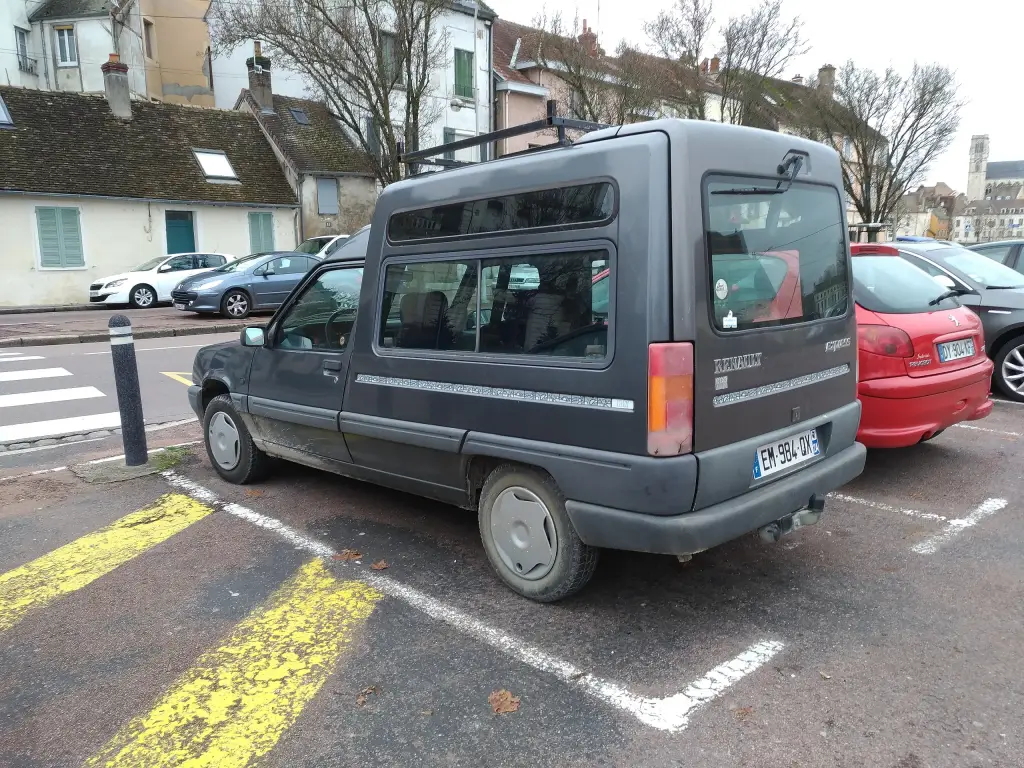
The Renault Express is a panel van introduced in July 1985 as the successor to the Renault 4 Fourgonnette, based on the second-generation Renault 5. It was sold as the Renault Extra in Britain and Ireland and as the Renault Rapid in German-speaking countries.
Renault Express at a glance
| Maker | Renault; Nordex in Uruguay |
|---|---|
| Production | 1985–April 2001 |
| Based on | second-generation Renault 5 (Super 5) |
| Wheelbase | about 15 cm longer than the Renault 5 |
| Bodies | panel van with up to two seats, five-seat combi, pick-up |
| Rear access | double doors with or without a giraffe hatch, or a tailgate |
| Suspension | MacPherson struts front, trailing arms and torsion bars rear |
| Other names | Renault Extra, Renault Rapid |
Based on one source, the English Wikipedia article on the Renault Express.
History of the Renault Express
A van from the Super 5
The Express succeeded the R4 Fourgonnette in July 1985. Technically it was based on the second-generation Renault 5, identical to it except for a few stylistic changes up to the A-pillar, and it used the shorter front doors of the five-door car. Compared with the Renault 5, the wheelbase was lengthened by about 15 cm, the roof over the driver’s cab was raised and a box structure was added behind the B-pillar.
Bodies and work uses
The van came with no glazing or partial glazing and up to two seats, or as a glazed combi with five seats. Rear access was through double doors, with or without a giraffe hatch above for long items, or through a large upward-opening tailgate. It was also supplied as a pick-up, as a factory wheelchair van and with various special bodies including refrigerated trucks and workshop vehicles.
Suspension and long life
As with its predecessors the Renault 4 F4 and F6, all wheels were independently suspended, the front by MacPherson struts and wishbones and the rear by trailing arms with torsion bars, unlike most rivals such as the Volkswagen Caddy or Opel Combo with a dead axle and leaf springs; Ford even bought the Express rear suspension design. The van was sold as the Renault Extra in the United Kingdom and Ireland and as the Renault Rapid mainly in German-speaking countries, and it stayed in production until April 2001 in Uruguay, where Nordex S.A. built it for South America.
Design and features
- Super 5 roots: the same front end and doors as the five-door Renault 5.
- Longer wheelbase: about 15 cm more than the car, with a raised cab roof.
- Independent rear suspension: trailing arms and torsion bars instead of a dead axle.
- Three names: Express, Extra and Rapid depending on the market.
Renault Express versions
- Express panel van: up to two seats, partly or fully unglazed.
- Express combi: glazed five-seat version.
- Express pick-up: open load bed.
- Renault Extra and Rapid: British, Irish and German-speaking market names.
The Express replaced the Renault 4 Fourgonnette and was based on the Renault 5; the larger Renault Trafic covered heavier work. More Renaults are in the Renault collection.
Sources
- Renault Express, English Wikipedia: structure, bodies, suspension, market names