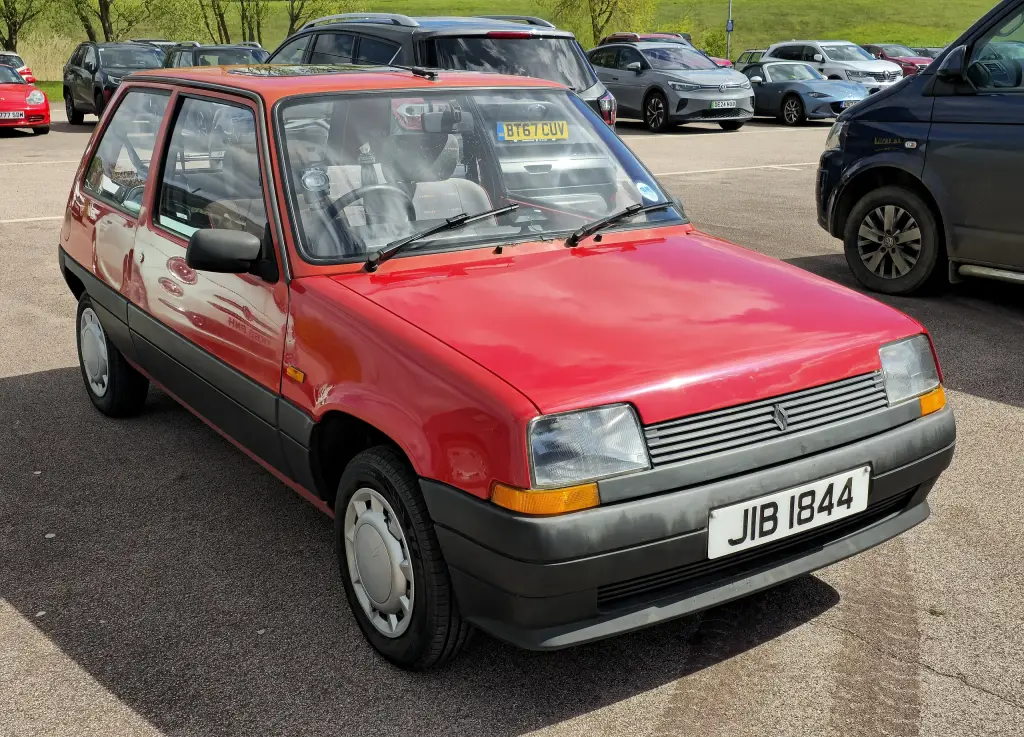
The Renault 5 is a supermini produced from 1972 to 1996 over two generations, with three or five doors and seating for five. It was the best-selling car in France from 1972 until 1986, and more than 5.5 million were built.
Renault 5 at a glance
| Maker | Renault, France |
|---|---|
| Production | 1972–1996, two generations |
| Styling | Michel Boué |
| Launch | 28 January 1972 |
| First generation | 1972–1985, front mid-engine, front-wheel drive |
| Second generation | Super 5, 1984–1996, front engine, front-wheel drive |
| American name | Le Car, 1976–1983 |
| Built | over 5.5 million |
Based on one source, the English Wikipedia article on the Renault 5.
History of the Renault 5
Boué’s hatchback
The first images of the Renault 5 appeared on 10 December 1971 and the car was launched on 28 January 1972. It was styled by Michel Boué, who designed it in his spare time outside his regular duties; Renault executives were so impressed that they authorised a formal development programme immediately. The car had a steeply sloping rear hatch, and Boué wanted the tail lights to run from the bumper up into the C-pillar, as on much later cars, but they stayed at a conventional height. It reached Britain in autumn 1972, where with the new Fiat 127 it competed against the Mini and Hillman Imp, without rivals from Ford or Vauxhall. The Renault 5 narrowly missed the 1973 European Car of the Year award, which went to the Audi 80, and Boué died of cancer at the end of 1972, months after his car was launched.
Renault 4 mechanicals
The R5 borrowed its mechanicals from the Renault 4, with a longitudinally mounted engine driving the front wheels and torsion bar suspension, and OHV engines shared with the Renault 4 and the larger Renault 8. At launch there were 782 cc and 956 cc versions depending on trim, a 5TS and 5LS with the 1,289 cc engine of the Renault 12 arrived in April 1974, entry-level engines grew to 845 cc in 1976 and later top models reached 1,397 cc.
Le Car and the Super 5
The R5 was sold in the United States and Canada as Le Car from 1976 to 1983. The second generation, the Super 5 or Supercinq, was produced from 1984 to 1996 with a front engine and front-wheel drive, replacing the front mid-engine layout of the original. A four-door saloon derivative, the Renault 7, was built in Spain by FASA-Renault from 1974 to 1984 and exported to selected markets.
Design and features
- Michel Boué styling: a compact hatchback designed outside working hours by a Renault employee.
- Renault 4 mechanicals: longitudinal engine, front-wheel drive and torsion bars.
- Wide engine range: from 782 cc at launch to 1,397 cc in later models.
- Le Car: the American and Canadian name used from 1976 to 1983.
Renault 5 versions
- R5 first generation (1972–1985): the original three- and five-door hatchback.
- 5TS and 5LS (1974): 1,289 cc versions with the Renault 12 engine.
- Super 5 (1984–1996): second generation with a conventional front engine layout.
- Renault 7 (1974–1984): Spanish-built four-door saloon variant.
The 5 took its mechanicals from the Renault 4 and its rally version became the Renault 5 Turbo; its saloon relative was the Renault 7. More cars are in the Renault collection.
Video: The story of the Renault 5
Video by automotorbgcom on YouTube.
Sources
- Renault 5, English Wikipedia: design, engines, generations, production