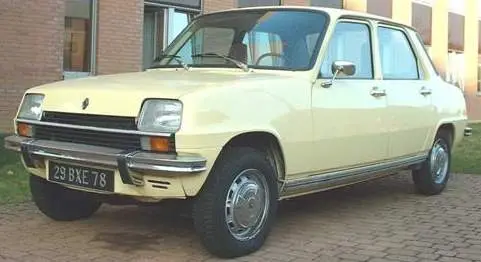
The Renault Siete, renamed Renault 7 in 1979, is a four-door saloon version of the Renault 5, produced and sold in Spain by FASA-Renault in Valladolid from 1974 to 1984.
Renault 7 at a glance
| Maker | FASA-Renault, Valladolid, Spain |
|---|---|
| Production | 1974–1984 |
| Body | four-door saloon |
| Based on | Renault 5 |
| Wheelbase | just under 6 cm longer than the Renault 5 |
| Boot | 400 dm³ against 270 dm³ in the Renault 5 |
| Initial engine | 1,037 cc, 50 PS |
| From 1980 | 1,108 cc, 45 PS |
| Built | 159,533 |
Based on one source, the English Wikipedia article on the Renault 7.
History of the Renault 7
A booted Renault 5
The Renault Siete was very similar to the Renault 5 hatchback launched two years earlier and mechanically identical, but had four doors and a saloon-style boot instead of the hatchback’s three doors and tailgate. The wheelbase was extended by just under 6 cm, although the car kept the wheelbase difference between left and right sides typical of several Renaults, caused by two full-width torsion bars placed one behind the other ahead of the rear wheels. The boot held 400 dm³ against 270 dm³ in the Renault 5. The 7 also used conventional chromed metal bumpers instead of body-coloured plastic ones, which gave it a more refined look, and its dashboard and interior details differed from the French hatchback.
Engines and updates
It was initially powered by a 1,037 cc engine, an enlarged version of the Renault 5’s 956 cc unit, producing 50 PS, and was mostly sold in Spain. The car received small annual updates; in 1979 it was more extensively restyled with a new interior and rear lights, and its name changed to Renault 7, since Siete is Spanish for seven. An engine upgrade to 1,108 cc followed in 1980; claimed power fell to 45 PS but torque rose from 7.4 kg·m at 3,000 rpm to 8.0 kg·m at 2,000 rpm. A five-door version of the Renault 5 was launched in 1980 using the door pattern of the Spanish Renault 7.
The end
Production ended in 1984, after the Renault 9 and 11 had arrived worldwide and the Renault 5 had been redesigned as the Supercinq on the 9/11 floorpan. The 7 had limited success outside Spain because Renault offered the larger Renault 12 for a small premium, and mainly Spanish sales did not justify developing a new saloon based on the Supercinq. A total of 159,533 were built.
Design and features
- Saloon body: four doors and a separate boot instead of the Renault 5 hatchback.
- Bigger boot: 400 dm³ against 270 in the hatchback.
- Chrome bumpers: conventional metal bumpers for a more refined appearance.
- Spanish-built: made only by FASA-Renault in Valladolid.
Renault 7 versions
- Renault Siete (1974–1979): 1,037 cc, 50 PS.
- Renault 7 (1979): restyled with new interior and rear lights.
- Renault 7 1,108 cc (1980): 45 PS with more torque.
The 7 was a saloon version of the Renault 5 and used engines shared with the Spanish Renault 6. More cars are in the Renault collection.
Video: Renault 7 Siete club, Spain
Video by Lluis Marco on YouTube.
Sources
- Renault 7, English Wikipedia: body, dimensions, engines, production