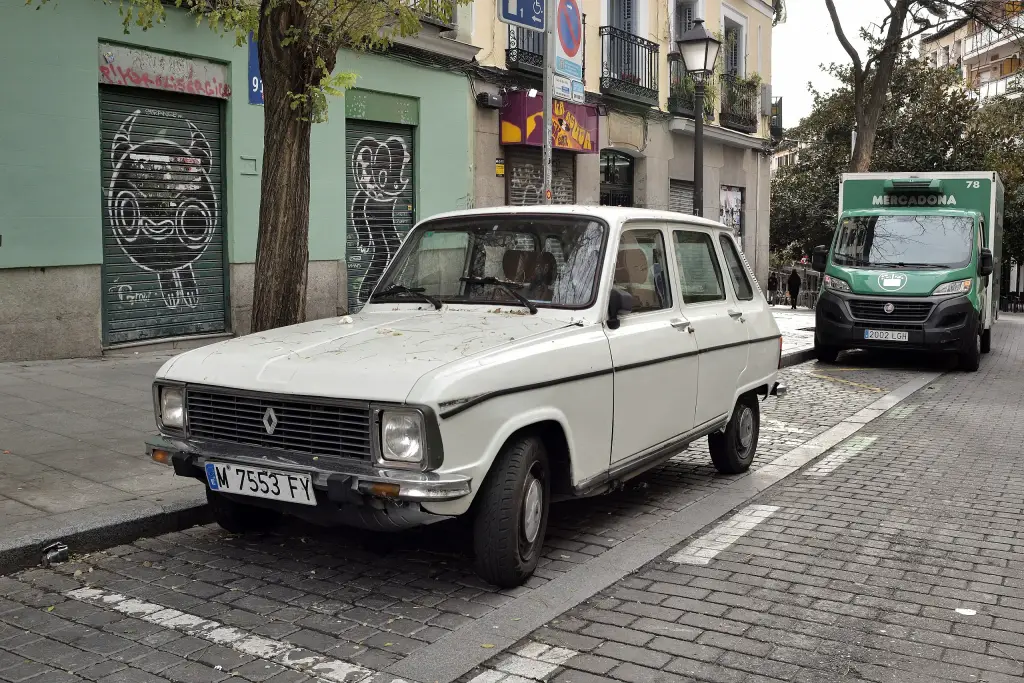
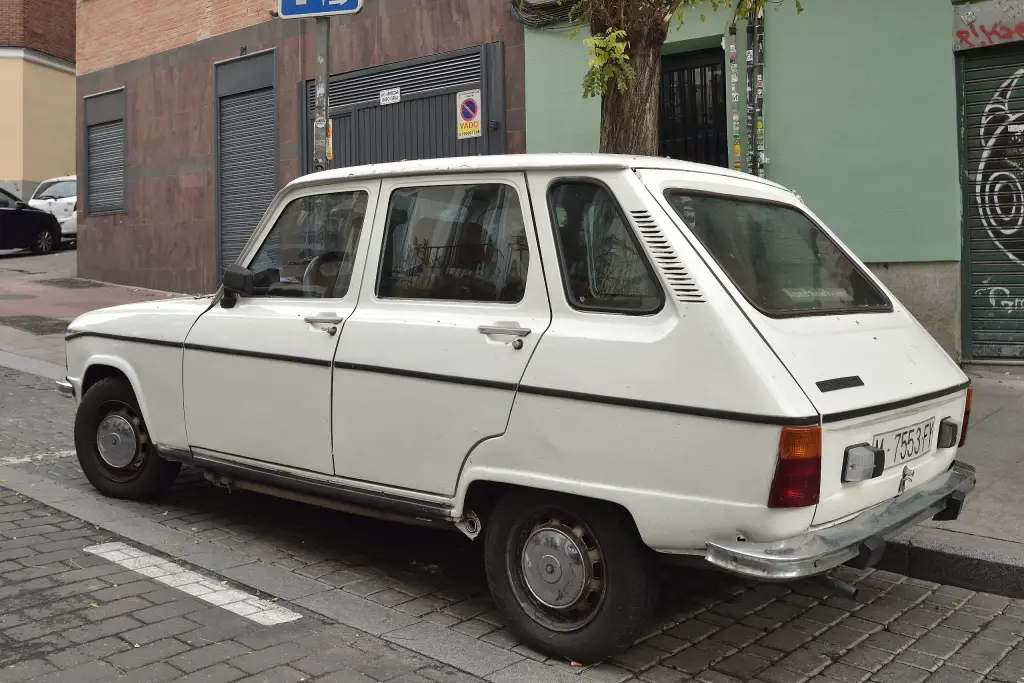
The Renault 6 is a small family car produced from 1968 to 1986 on the platform of the Renault 4. It was 20 cm longer than the R4, with a five-door hatchback body and styling that resembled the larger Renault 16.
Renault 6 at a glance
| Maker | Renault, France; FASA-Renault, Spain |
|---|---|
| Production | 1968–1986 |
| Body | five-door hatchback |
| Platform | Renault 4 |
| Launched | Paris Motor Show, 1968 |
| Engines | 845 cc, then 1.1-litre Cléon-Fonte |
| Spanish engines | 956 cc, later 1,037 cc and 1,108 cc |
| Spanish production | 328,000 cars to 1986 |
Based on one source, the English Wikipedia article on the Renault 6.
History of the Renault 6
An upmarket Renault 4
The Renault 6 was launched at the 1968 Paris Motor Show as an upmarket alternative to the Renault 4, which was 20 cm shorter, and was aimed at the Citroën Ami 6 and the new Citroën Dyane. It used the Renault 4 platform and at first its 845 cc engine, but the body was larger and more modern, and it looked like a smaller Renault 16. The gear lever was mounted in the dashboard with a linkage reaching forward over the engine, as on the Renault 4. French production began in October 1968 and the car was sold in Europe until 1980, continuing elsewhere until 1986.
The 1.1-litre engine
In its first two years the press criticised the R4-derived engine for being too weak in the heavier R6, and partly as a result the 6 had worse fuel economy than the larger but older rear-engined Renault 8. At the 1970 Paris Motor Show Renault showed a version with the 1.1-litre Cléon-Fonte engine already used in the Renault 8 since 1962, raising power from 34 to 45 PS, and it was widely regarded as a big improvement. That car also had more equipment, a new gearbox and cooling system and front disc brakes; the new cooling system needed an extra grille below the original one, and the disc brakes meant redesigned wheel rims with openings. The small-engined model stayed on sale until June 1979 and was called the Renault 6 L from August 1977.
Spain
For the Spanish market the R6 was fitted with a 956 cc engine, because cars over 1,040 cc were taxed more heavily there; a 1,037 cc unit followed, and from 1981 the 1,108 cc engine appeared in the 6 GTL, with 50 PS DIN, an engine also used in Spanish-built Renault 5s and 7s. The R6 was built in Spain until 1986, with 328,000 cars made there. In 1973 the Teilhol/ACL-built 6 Rodéo appeared, an open, plastic-bodied utility vehicle based on the 6.
Design and features
- Larger than the Renault 4: 20 cm longer, with a five-door hatchback body and Renault 16 looks.
- Front disc brakes: added with the 1.1-litre engine in 1970, along with a new gearbox.
- Dashboard gear lever: the Renault 4 layout with a linkage over the engine.
- Spanish tax engines: 956, 1,037 and 1,108 cc units to stay under local tax thresholds.
Renault 6 versions
- 6 (1968): 845 cc original.
- 6 with 1.1-litre engine (1970): 45 PS, front disc brakes and more equipment.
- 6 L (1977): the small-engined model renamed before it was dropped in 1979.
- 6 GTL (1981): Spanish model with the 1,108 cc engine.
- 6 Rodéo (1973): open plastic-bodied utility vehicle by Teilhol/ACL.
The 6 was based on the Renault 4 and its Spanish saloon relative was the Renault 7; it sat below the Renault 16. More cars are in the Renault collection.
Video: Renault 6 TL
Video by Gianluca Baldisserri on YouTube.
Sources
- Renault 6, English Wikipedia: launch, engines, Spanish production, Rodéo