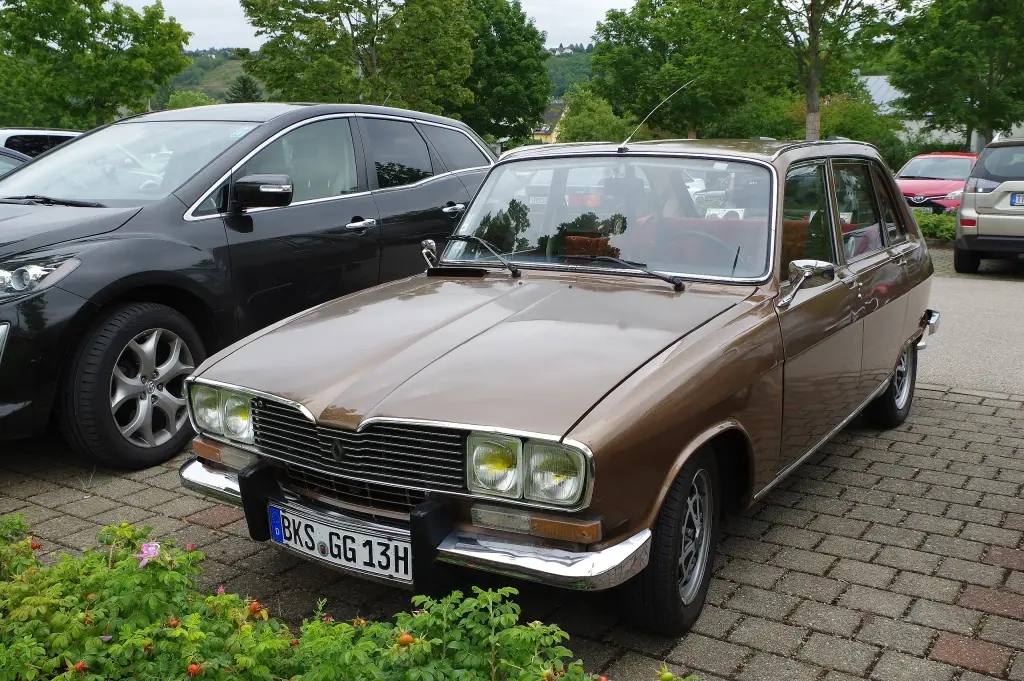
The Renault 16 is a large family car built by Renault in a single generation from 1965 to 1980, in Le Havre. It was a five-door hatchback and the first French car to win the European Car of the Year award.
Renault 16 at a glance
| Maker | Renault, Sandouville, France |
|---|---|
| Production | 1965–1980 |
| Body | five-door hatchback |
| Layout | front-wheel drive, engine inline behind the transmission |
| Suspension | torsion bars, unequal wheelbase left to right |
| Engine | aluminium four-cylinder |
| Built | 1,845,959 |
| Award | European Car of the Year, the first for a French car |
| Replaced | Renault Frégate |
Based on one source, the English Wikipedia article on the Renault 16.
History of the Renault 16
Replacing the Frégate
In the early 1960s Renault was building a series of small cars, including the hatchback Renault 4 and the rear-engined Dauphine, and wanted to replace its larger family car, the Renault Frégate of 1951–1960, which had managed only 163,383 units. Series production of the Renault 16 started in March 1965 at the recently completed Sandouville plant near Le Havre; the car had its formal launch at the Geneva Motor Show in March 1965 and went on sale in France and most other left-hand-drive markets in June. It was a great success, with 1,845,959 built over fifteen years. It sold well in most of Europe and in Canada, where SOMA-Renault built it from knock-down kits until 1974, though in the United States only a small number were sold.
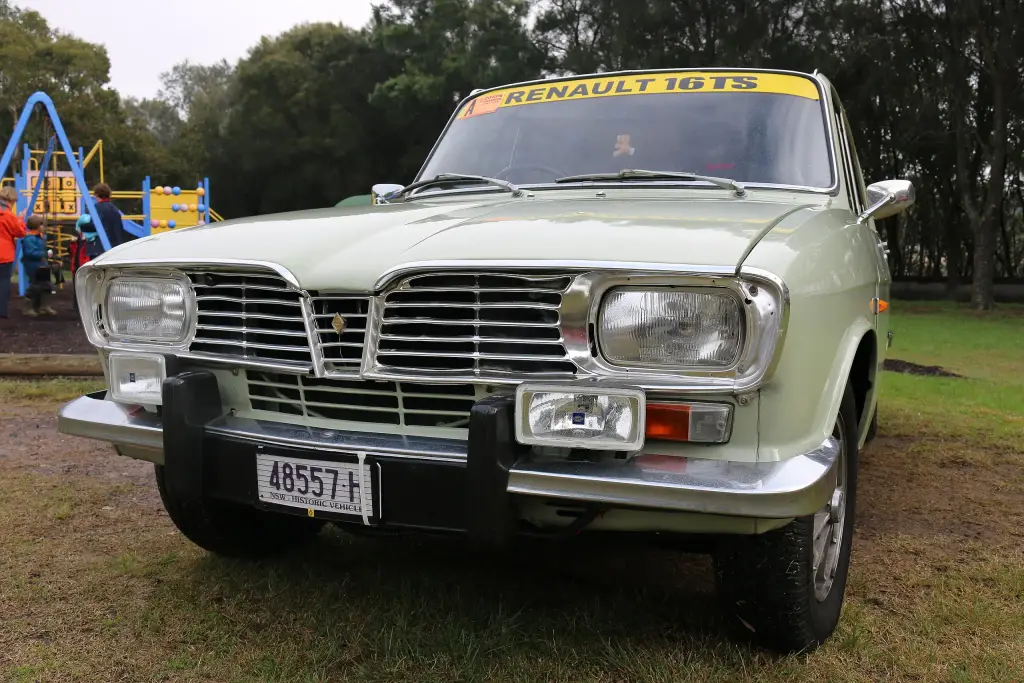
The hatchback idea
The layout was front-wheel drive with the engine mounted inline behind the transmission, torsion bar suspension, a column-mounted gear lever and an aluminium engine with an electric cooling fan. The 16 brought the hatchback body to the mid-size family segment, allowing the interior to be arranged in seven different ways. Before the term existed, journalists struggled to describe it: Motoring Illustrated wrote in May 1965 that the car was ‘neither a four door saloon and nor is it quite an estate’, but ‘a little different’.
An unequal wheelbase
The 16 is noted for an unequal wheelbase left to right, as on the earlier Renault 4 and later Renault 5: the rear axle shafts are not in line and the left wheelbase is 70 mm longer than the right to accommodate the transverse torsion bars. That, with the soft front seats, gave a particularly smooth ride even over big bumps. The engine sat longitudinally at the front behind the gearbox, keeping weight near the centre for good handling, but access for servicing was so difficult that its successor, the Renault 20, kept the north-south layout while putting the engine ahead of the gearbox. The column-mounted gearchange, required by the transmission position, freed space in the front cabin and was rare in western Europe.
Design and features
- Hatchback body: a first in the mid-size class, with seven interior arrangements.
- Engine behind the gearbox: a north-south layout that balanced the weight but complicated servicing.
- Unequal wheelbase: the left side is 70 mm longer to clear the transverse torsion bars.
- Column gearchange: rare in western Europe and it gave a more spacious front cabin.
Renault 16 versions
- 16 (1965): the original hatchback in its base trim.
- 16 TS: the more powerful version whose engine later went into the Renault 15 and 17.
- 16 TX: the best-equipped model, with a 1,647 cc engine and fuel injection.
- SOMA-Renault cars: Canadian assembly from knock-down kits until 1974.
The 16 replaced the Renault Frégate and shared its more powerful engines with the Renault 15 and 17. Its successor in the range was the Renault 20/30; more cars are in the Renault collection.
Video: Preview Renault 16 TS
Video by vincentvermegen on YouTube.
Sources
- Renault 16, English Wikipedia: design, production, awards, Canadian assembly