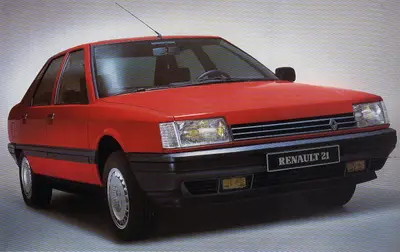
The Renault 21 is a large family car produced between 1986 and 1995, and sold in North America as the Renault Medallion and later the Eagle Medallion. A total of 2,096,000 were built.
Renault 21 at a glance
| Maker | Renault, France |
|---|---|
| Production | 1986–1995 |
| Bodies | saloon, Nevada estate, liftback from 1989 |
| Unveiled | 20 November 1985, launched February 1986 |
| Engines | 1.7 transverse, 2.0 and 2.0 turbo longitudinal |
| Four-wheel drive | Quadra transmission on TXi and turbo saloons |
| Estate | Nevada, sold as Savanna in Britain, seven seats |
| Also sold as | Renault Medallion and Eagle Medallion in North America |
| Built | 2,096,000 |
Based on one source, the English Wikipedia article on the Renault 21.
History of the Renault 21
Launch
The car was first shown on 20 November 1985 and officially launched in February 1986 as the successor to the Renault 18, which had been on sale for eight years. A seven-seat station wagon, the R21 Nevada, marketed as the Savanna in Britain, followed a few months later. It had a sharp, angular design quite different from the rounded Ford Sierra and Opel Ascona of the period, and right-hand-drive sales in Britain began in June 1986. What Car? named the Renault 21 GTS the Best Family Saloon in 1987, and the Savanna took Car of the Year and Best Family Estate.
Two engine layouts
Unusually, the 21 was offered with very different engine installations: the 1.7-litre version had a transverse engine and gearbox, but Renault had no gearbox suitable for a more powerful transverse engine, so the faster versions mounted the engine longitudinally. The two versions had barely perceptibly different wheelbases, and the engine bay was large enough for either layout without losing passenger space. In an era of inflexible production technology, building differently configured engine bays on one line, and the extra inventory it demanded of Renault and its dealers, hurt the model’s profitability.
The Nevada estate
The estate was slightly longer than the saloon and could be ordered with seven seats, two of them a forward-facing folding bench for children up to about ten years old that used much of the luggage space when raised. Roof rails were standard.
1989 revamp
In May 1989 the car was heavily revised inside and out, with a sleeker shape similar to the recently updated Renault 25, and a liftback body was added, which soon outsold the saloon in France. A 2.0-litre Turbo joined the range, and the TXi 2.0 12-valve and 2.0 Turbo saloons could be ordered with the Quadra four-wheel-drive transmission. The Nevada got four-wheel drive with the eight-valve 2.0 and the naturally aspirated 2.1 diesel, since the 12-valve and turbo engines were not offered in that body.
Design and features
- Mixed engine layouts: transverse 1.7 and longitudinal 2.0 units in the same range.
- Seven-seat estate: the Nevada, sold as the Savanna in Britain, with a child bench in the boot.
- Quadra four-wheel drive: available on TXi and Turbo saloons from 1989.
- Angular styling: deliberately different from the rounded rivals of the mid-1980s.
Renault 21 versions
- 21 saloon (1986): the original four-door.
- 21 Nevada / Savanna: the long estate with up to seven seats.
- 21 liftback (1989): added in the revamp and soon the most popular body.
- 21 Turbo and TXi Quadra: the performance versions, with four-wheel drive available.
The 21 succeeded the Renault 18 and sat below the Renault 25; its sports version shared its engine family with the 25 Turbo. More cars are in the Renault collection.
Video: Renault 21 Turbo 4×4 rally car
Video by Rally95Video on YouTube.
Sources
- Renault 21, English Wikipedia: launch, engine layouts, estate, 1989 revamp