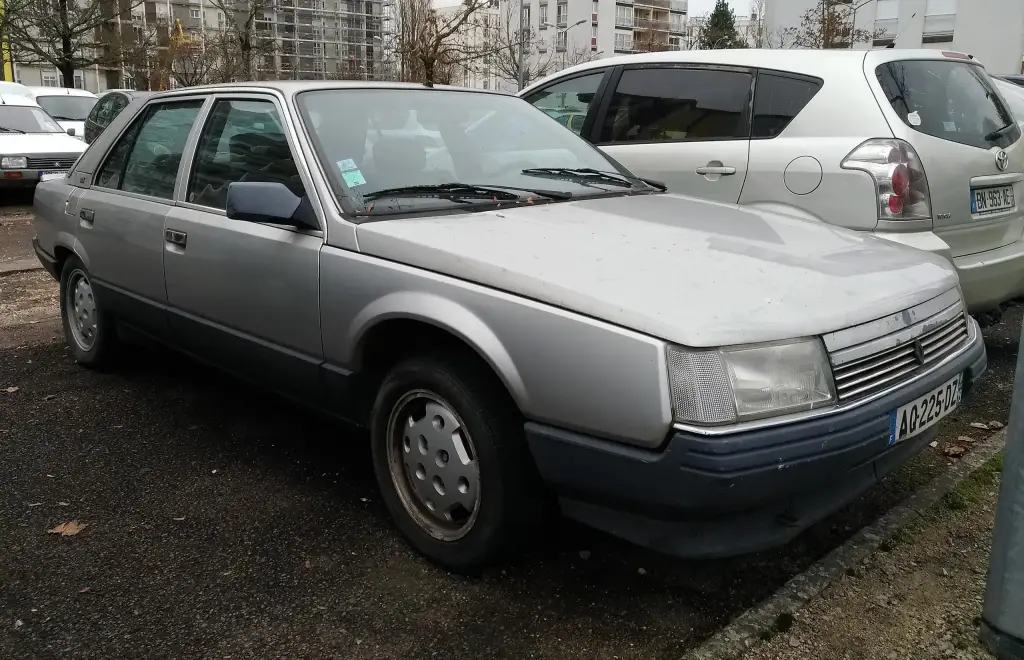
The Renault 25 is an executive car produced from 1983 to 1992 and built at Sandouville near Le Havre. It was Renault’s flagship, the most expensive and largest model in the range, and it placed second in the 1985 European Car of the Year ranking.
Renault 25 at a glance
| Maker | Renault, Sandouville, France |
|---|---|
| Production | 1983–1992, sales from March 1984 |
| Body | five-door liftback |
| Styling | Gaston Juchet and Robert Opron |
| Interior | Marcello Gandini |
| Drag coefficient | 0.28 on 2-litre models, 0.33 on diesel and V6 |
| Engines | 2.0 and 2.2 petrol, 2.1 diesel, 2,458 cc turbo and 2,849 cc V6 |
| Built | 780,976 |
Based on one source, the English Wikipedia article on the Renault 25.
History of the Renault 25
A large step forward
Introduced at the end of 1983 for a March 1984 start of sales, the 25 was a big advance on the Renault 20 and 30 it replaced. Its five-door liftback body was drawn by Gaston Juchet and Robert Opron, of Citroën SM fame, and the unconventional shape was meant to give a notchback look and overcome buyers’ preference for formal saloons outside France. The wraparound rear window was one of Opron’s signature features, used on the SM, the Renault Fuego and the Renault 11.
Aerodynamics and engineering
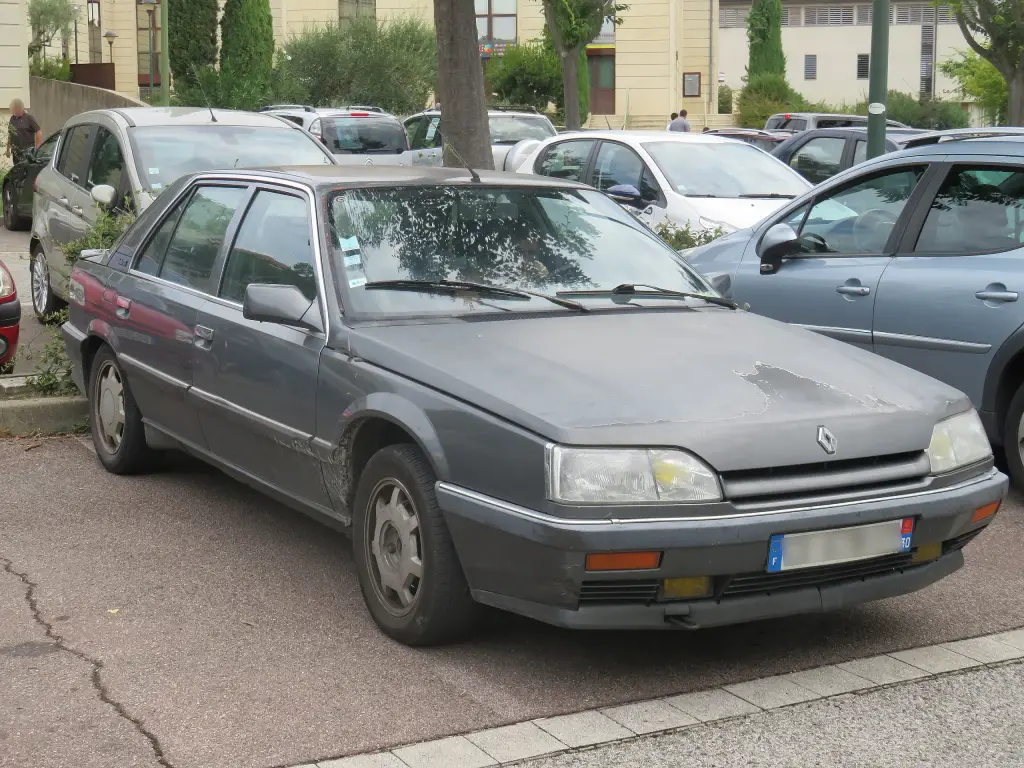
The car was designed from the start for aerodynamic efficiency, with a drag coefficient as low as 0.28 on two-litre models, rising to 0.33 for the diesel and V6; the TS briefly held the unofficial title of the world’s most aerodynamic mass-production car. All versions were front-wheel drive, with four-cylinder engines of 2.0 and 2.2 litres petrol injection or 2.1 litres diesel, and six-cylinder units of 2,849 cc and a 2,458 cc turbo, mounted longitudinally ahead of the front axle. A turbodiesel version of the J8S engine was also offered. The 25 was praised for ride comfort and handling, despite slight understeer and torque steer on V6 Turbo models, and the new manual gearbox was widely praised for precision, although a detent spring could make fifth gear slip into third.
The futuristic interior
The passenger compartment was designed by the Italian stylist Marcello Gandini and was controversial, but it was quiet, spacious and well lit. The 25 had an express up-and-down driver’s power window, voice alerts for badly shut doors, bonnet or boot, low oil pressure, engine temperature and blown bulbs, and one of the world’s first remote stereo controls mounted to the right of the steering column. It was the first Renault entry in the full-size segment outside France since the Second World War. The automatic transmission was the car’s least durable part.
Design and features
- Low drag: a coefficient of 0.28 on two-litre cars, a selling point for fuel economy.
- Opron styling: a liftback with a wraparound rear window shaped to look like a saloon.
- Gandini interior: a futuristic dashboard with voice alerts and remote stereo controls.
- V6 engines: 2,849 cc and a 2,458 cc turbo, mounted longitudinally.
Renault 25 versions
- 25 TS: the aerodynamic two-litre model with a Cd of 0.28.
- 25 V6 and V6 Turbo: the six-cylinder flagships.
- 25 diesel and turbodiesel: 2.1-litre J8S engines.
- 25 TX and TXE: the better-equipped petrol versions.
The 25 replaced the Renault 20/30 and shared its marketplace with the Renault 21; the later Renault Safrane took over as flagship. More cars are in the Renault collection.
Video: Renault 25 turbodiesel comparison test
Video by Materiaal46 on YouTube.
Sources
- Renault 25, English Wikipedia: styling, aerodynamics, engines, equipment