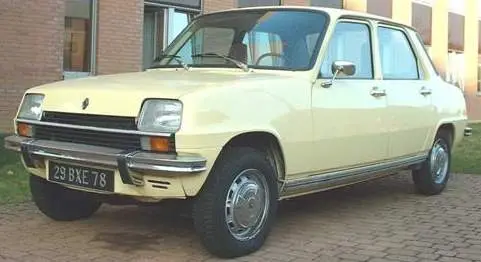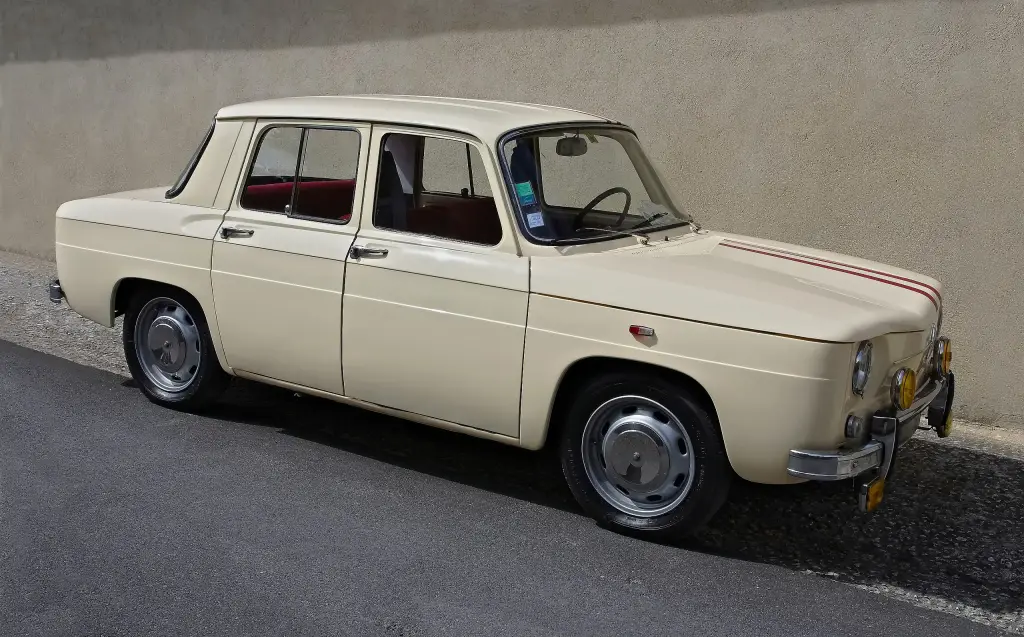
The Renault 8 is a four-door saloon with a rear engine and rear-wheel drive, launched in 1962 and sold in France until 1973. It was based on the Renault Dauphine and became the basis for the larger Renault 10.
Renault 8 at a glance
| Maker | Renault, France; FASA-Renault in Spain |
|---|---|
| Production | 1962–1973 in France, to 1976 in Spain |
| Model code | R1130 |
| Body | four-door saloon |
| Layout | rear engine, rear-wheel drive |
| Wheelbase | 2,270 mm, shared with the Dauphine |
| Engine | 956 cc Cléon-Fonte, 44 PS |
| Brakes | four-wheel discs, a first for a saloon of this size |
| Licensed versions | Dacia 1100 in Romania, 37,546 built |
Based on one source, the English Wikipedia article on the Renault 8.
History of the Renault 8
From the Dauphine
The Renault 8 was released in June 1962 as model R1130, based on the Renault Dauphine and sharing its basic architecture and 2,270 mm wheelbase. Its boxy styling followed closely the first prototype, drawn at unusually short notice by Philippe Charbonneaux. Although the 8 was actually 30 mm narrower than the Dauphine, Renault managed to fit front seats each 60 mm wider than the Dauphine’s. The car was powered by an all-new 956 cc Cléon-Fonte engine developing 44 PS, which followed the Renault 4 in having a sealed-for-life cooling system. A distinctive innovation on French-built cars was four-wheel disc brakes, a first for a saloon of this size.
In America
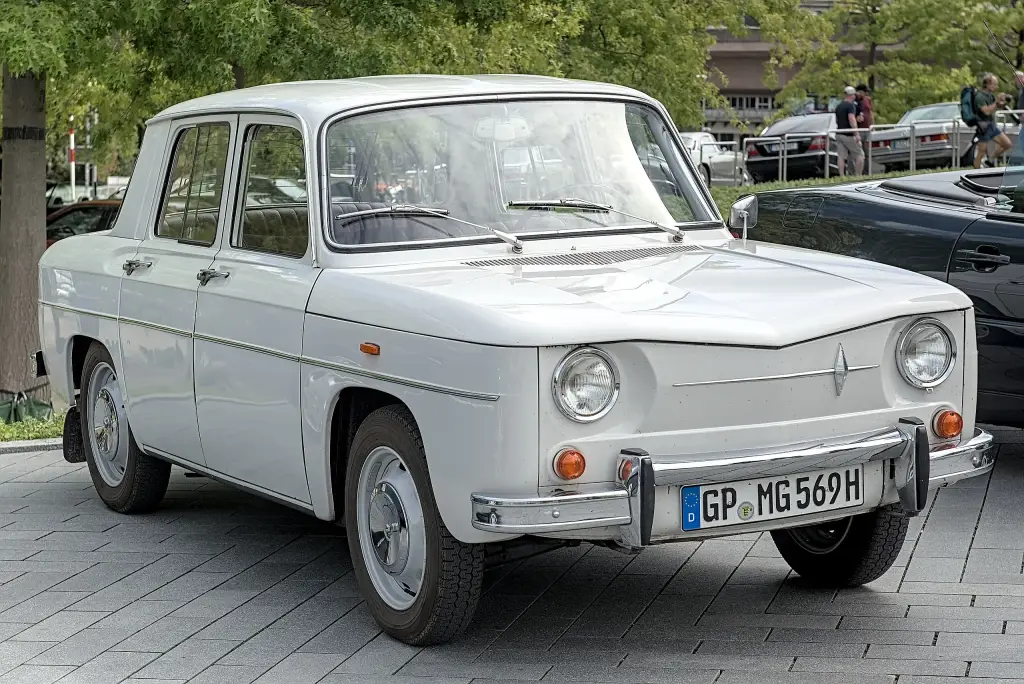
The 8 was sold in the United States with marketing that acknowledged the Dauphine’s shortcomings for American owners. A new and more powerful engine was built and many changes made, but most criticism of the car concerned driving on the new Interstate highways, since the 8 was designed for French conditions. In town, it was nimble and easy to thread through crowded traffic.
Spain and elsewhere
When Renault’s Spanish affiliate introduced its own version in 1965 for the tariff-shielded Spanish market, it came with rear drum brakes instead of discs, and the adapted Spanish car stayed in production until 1976. The 8 was also built in Bulgaria until 1970 and, in Romania, under licence between 1968 and 1972 as the Dacia 1100, of which 37,546 were made. In France production and sales ended in 1973, by which time the related Renault 10 had already been replaced, two years earlier, by the front-wheel-drive Renault 12.
Design and features
- Four-wheel disc brakes: a first for a French saloon of this size, although Spanish cars kept rear drums.
- New Cléon-Fonte engine: 956 cc and 44 PS with sealed-for-life cooling.
- Wider seats than the Dauphine: despite a body that was 30 mm narrower.
- Licensed production: built in Spain, Bulgaria and Romania as the Dacia 1100.
Renault 8 versions
- R8 (1962): the original 956 cc saloon.
- 8 Major: better-equipped version with a larger engine.
- 8 Gordini: the tuned rally version prepared under the Gordini name.
- Renault 8 TS: the later sporting model.
- Dacia 1100: Romanian licence version built between 1968 and 1972.
The 8 came from the Renault Dauphine and led to the Renault 10; its sporting version belongs with Gordini. More cars are in the Renault collection.
Video: Renault 8 TS
Video by Pedro Caballero on YouTube.
Sources
- Renault 8, English Wikipedia: design, engine, brakes, licensed production