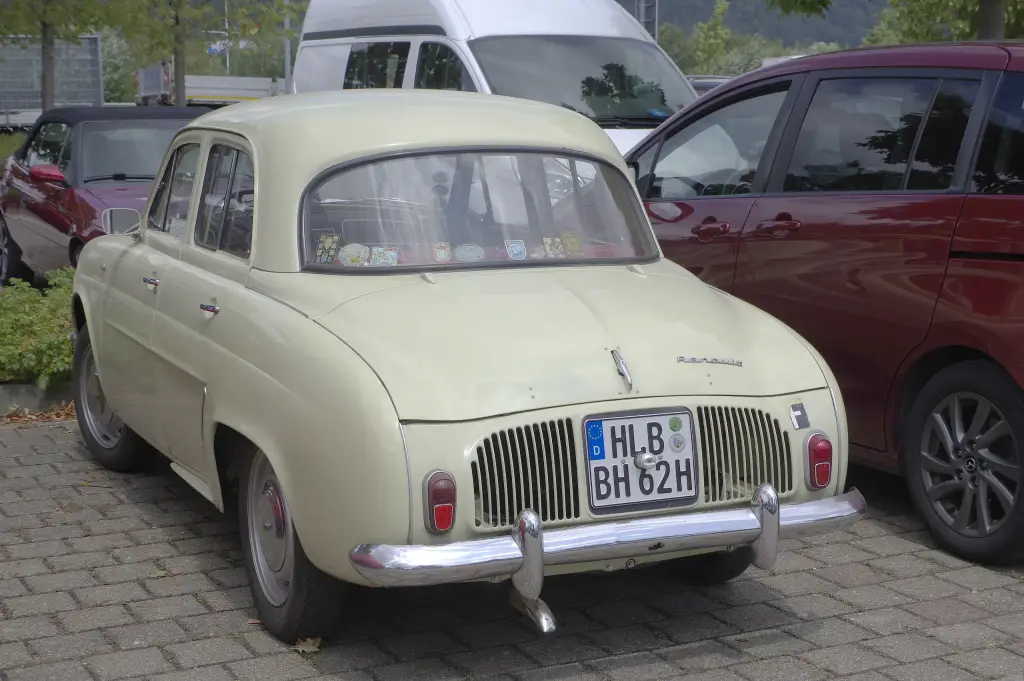
The Renault Dauphine is a rear-engined, rear-wheel-drive four-door saloon marketed by Renault from 1956 to 1967 in a single generation. More than two million were built, many of them under licence outside France.
Renault Dauphine at a glance
| Maker | Renault, France, and licensees abroad |
|---|---|
| Production | 1956–1967 |
| Body | four-door saloon, three-box styling |
| Layout | rear engine, rear-wheel drive |
| Project | 109, engineering started in 1949 |
| Versions | Ondine, Dauphine Gordini, Ondine Gordini, 1093 racer, Teimoso |
| Built | more than two million |
| Derivative | Renault Caravelle / Floride coupé and convertible |
Based on one source, the English Wikipedia article on the Renault Dauphine.
History of the Renault Dauphine
The successor to the 4CV
Pierre Lefaucheux, Louis Renault’s successor as chairman, had defied the post-war Ministry of Industrial Production, which wanted Renault converted only to truck manufacture, and instead built cars; by 1954 the 4CV had passed 500,000 units. The Dauphine was born in a conversation between Lefaucheux and engineer Fernand Picard, who agreed that the 4CV suited the post-war years but that French buyers would soon need a car for a rising standard of living and the coming autoroutes. Internally known as Project 109, its engineering began in 1949 under Picard, Robert Barthaud and Jacques Ousset.
An economy car for Europe
The Dauphine is a three-box four-door saloon with its engine at the rear. Along with the Citroën 2CV, Volkswagen Beetle, Morris Minor, Mini and Fiat 600, it pioneered the modern European economy car. Renault marketed many versions, including a luxury model called the Renault Ondine, a stripped version for Brazil called the Dauphine Teimoso in 1965, sporting Dauphine Gordini and Ondine Gordini models and the 1093 factory racing car.
Derivatives
The best-known derivative was the Caravelle, also sold as the Floride, a two-door coupé and convertible built on the Dauphine’s floorpan and engine. The Dauphine was also built under licence by other manufacturers outside France, which helped carry production past two million.
Design and features
- Rear engine: the layout inherited from the 4CV, in a larger three-box body.
- Many versions: from the basic car to the luxury Ondine and the Gordini sports models.
- Racing pedigree: the 1093 factory racing model.
- Licensed production: built outside France as well as at home.
Renault Dauphine versions
- Dauphine (1956): the standard saloon.
- Ondine: the luxury version.
- Dauphine Gordini and Ondine Gordini: sporting versions prepared by Gordini.
- 1093: the factory racing model.
- Dauphine Teimoso (1965): a decontented Brazilian version.
The Dauphine replaced the Renault 4CV and was available with Gordini tuning; its coupé derivative is the Renault Caravelle. More cars are in the Renault collection.
Video: 1965 Renault Dauphine Gordini
Video by klassikgarage on YouTube.
Sources
- Renault Dauphine, English Wikipedia: origins, versions, production