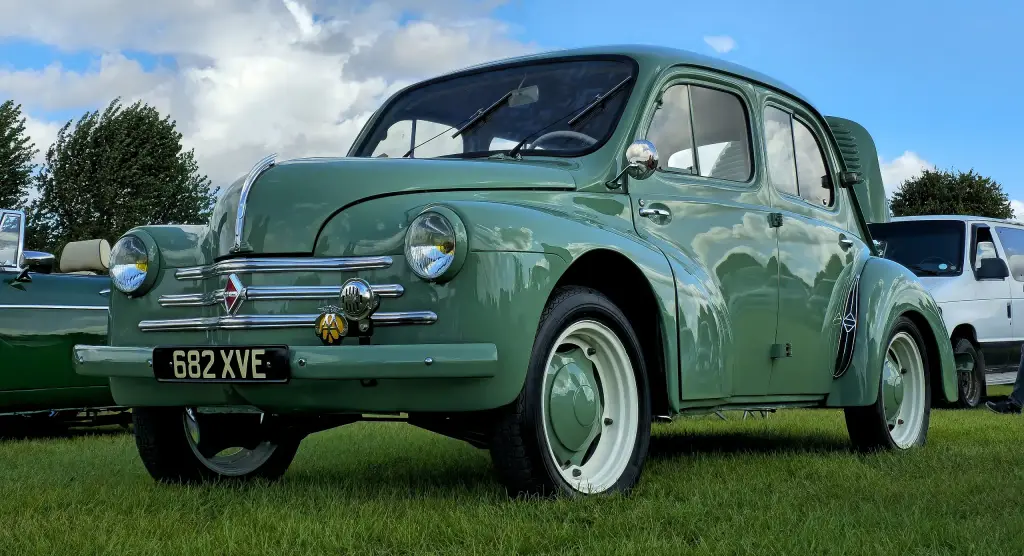
The Renault 4CV is a four-door economy car with a rear engine and rear-wheel drive, produced from August 1947 to July 1961. It was the first French car to sell over a million units and was succeeded by the Dauphine.
Renault 4CV at a glance
| Maker | Renault, France |
|---|---|
| Production | August 1947–July 1961 |
| Body | four-door, monocoque construction |
| Length | 3.6 m |
| Layout | rear engine, rear-wheel drive |
| Doors | front doors hinged at the rear (suicide doors) |
| Project code | 106E |
| First million | the first French car to reach it |
| Name | from the French tax horsepower rating, quatre chevaux |
Based on one source, the English Wikipedia article on the Renault 4CV.
History of the Renault 4CV
Designed in secret
The 4CV was conceived and designed covertly by Renault engineers during the German occupation, when the company was under strict orders to build only commercial and military vehicles. Between 1941 and 1944 Renault was under the technical direction of Wilhelm von Urach, a francophile engineer who had worked for Daimler-Benz from 1927 to 1940 and failed to notice the small car project. A team led by technical director Fernand Picard, recently returned from Renault’s aero-engine division, and Charles-Edmond Serre planned a small, economical car for the austerity expected after the war, in contrast to Louis Renault’s own belief that the company should concentrate on its traditional Juvaquatre and Primaquatre. Louis Renault approved the project, coded 106E, in May 1941; because new passenger cars were forbidden, it was presented as a low-priority spin-off from a new engine for a post-war Juvaquatre.
The Volkswagen question
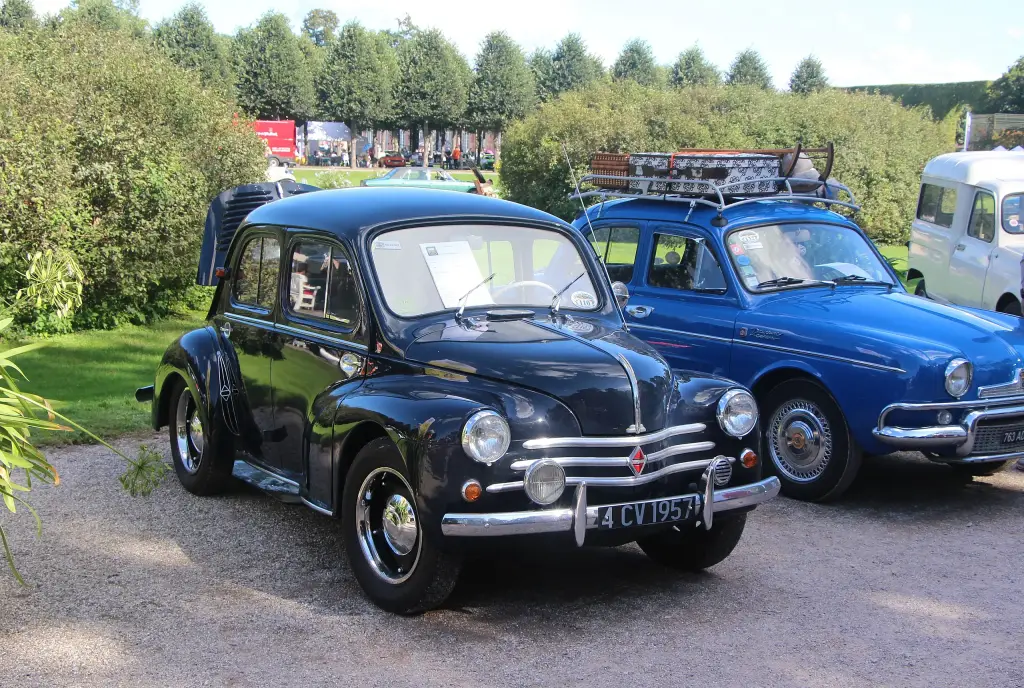
In November 1945 the government invited Ferdinand Porsche to France to discuss moving the Volkswagen project there as war reparations, and on 15 December 1945 Porsche was asked to advise Renault on the 4CV. Pierre Lefaucheux, the former resistance leader who had become Renault’s head, was furious that anyone should think the almost production-ready 4CV was inspired by the Volkswagen, and more furious that politicians had sent Porsche at all. Nine meetings took place, Lefaucheux insisted they had no influence on the design, and Porsche cautiously said the car would be ready for large-scale production within a year. Porsche was then arrested on war crimes allegations concerning forced labour; his son Ferry was released after a payment, but Ferdinand spent twenty months in a Dijon jail without a trial. The first two-door prototype was finished in 1942 and two more followed over the next three years.
Production
Until a simplification in 1945 the 4CV had a dummy grille of six thin horizontal chrome strips, meant to distract attention from its resemblance to the Volkswagen. Part of its success came from new manufacturing methods pioneered by Pierre Bézier, who as director of production engineering in 1949 designed the transfer lines that machined most of the car’s mechanical parts.
Design and features
- Rear engine: a small four behind the rear axle, with rear-wheel drive.
- Monocoque body: 3.6 m long with front doors hinged at the rear.
- Secret origins: developed under German occupation as project 106E.
- Mass production: transfer machines designed by Pierre Bézier cut costs and raised output.
Renault 4CV versions
- 4CV (1947): the original four-door saloon.
- Renault 750: export version sold under that name in some markets.
- Later 4CVs: updated trim and higher-output engines through the 1950s.
The 4CV was replaced by the Renault Dauphine, and its engine family also served in the Renault Caravelle. More cars are in the Renault collection.
Sources
- Renault 4CV, English Wikipedia: origins, Porsche episode, production methods