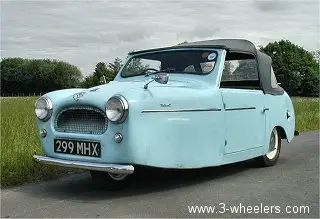
The Reliant Regent was a small three-wheeled delivery van built by the Reliant Motor Company in Tamworth, England, from 1950 to 1956. It succeeded the similar Reliant Van and was replaced by commercial versions of the Reliant Regal, the model that made the company’s name.
Reliant Regent at a glance
| Production | 1950–1956, Tamworth |
|---|---|
| Body | three-wheeled delivery van and light commercial |
| Payload | about 10 cwt (500 kg) |
| Engine | 747 cc side-valve four-cylinder |
| Power | 17 bhp (12.5 kW) |
| Gearbox | four-speed, central change |
| Frame | ladder frame of rectangular steel tubes |
| Front suspension | parallelogram fork with a barrel spring |
| Brakes | mechanically operated drums on all three wheels |
| Wheels | perforated steel discs, a first for Reliant |
| Built | 2,953 |
| Smaller model | Reliant Prince Regent, 1952–1954 (247 built) |
The English Wikipedia has no article on the Regent, and this page follows the German one, which is the only source used. Based on one source.
History of the Reliant Regent
A van with three wheels
The Regent replaced the Reliant Van, from which it differed mainly in detail. Its chassis was a ladder frame of rectangular steel tubes, with a driven rear axle on leaf springs and, at the front, two longitudinal members bent upwards to carry a single front wheel. That wheel was guided by a parallelogram fork with a barrel spring, and it was steered by a wheel rather than by the handlebar usual on a motorcycle fork. Behind the front wheel sat the water-cooled side-valve four-cylinder engine, derived from the engine of the Austin Seven. With 747 cc it produced 17 bhp (12.5 kW), which went through a four-speed gearbox with a central change and a short propeller shaft to the rear axle differential. All three wheels had mechanically operated drum brakes.
The Regent introduced perforated steel disc wheels in place of the wire-spoke wheels of its predecessor, another first for Reliant. Depending on the job it had to do, the van was available with several bodies: a four-seat motor rickshaw with a fabric roof, a flatbed with a steel cab, and closed delivery and sales vans with an all-steel body. In every case the motorcycle fork with the front wheel, its mudguard and its single steering headlamp stuck out from the front of the driver’s cab.
Prince Regent and the end of the line
Besides the “large” Regent, with a payload of about 10 cwt (500 kg), Reliant also offered a smaller version called the Reliant Prince Regent, which was sold from 1952 to 1954. In seven years 2,953 Regents were built, while the Prince Regent was made only 247 times in three years.
In 1956 commercial versions of the Regal replaced the two small vans. From 1963 vans became model lines of their own within the Reliant range again: they were sold at first as the 5 cwt Van and from 1966 as the Supervan.
Design and features
- Single front wheel: steered through a parallelogram fork with a barrel spring, with the wheel and headlamp outside the cab.
- Ladder frame: rectangular steel tubes with a leaf-sprung rear axle.
- Austin Seven ancestry: the 747 cc side-valve engine came from the Austin Seven.
- Disc wheels: the first Reliant with perforated steel discs instead of wire spokes.
- Many bodies: from a four-seat rickshaw to closed all-steel delivery vans.
Reliant Regent versions
- Regent (1950–1956): the full-size van with a payload of about 10 cwt.
- Prince Regent (1952–1954): a smaller version, 247 built.
- Rickshaw body: four seats under a fabric roof.
- Flatbed with steel cab: an open commercial body.
- Closed delivery and sales vans: all-steel bodies for tradesmen and shops.
The Regent was replaced by the van versions of the Reliant Regal, which in turn led to the Reliant Robin. More vehicles are in the Reliant collection.
Sources
- Reliant Regent, German Wikipedia: chassis, engine, bodies, production totals