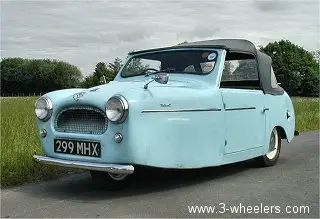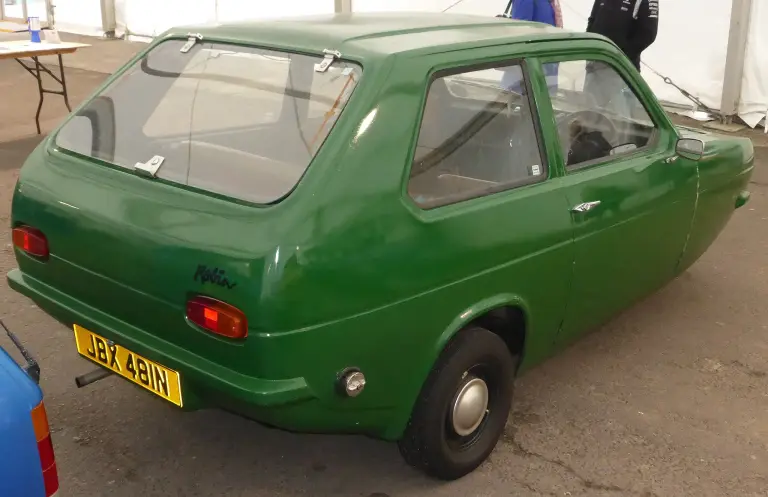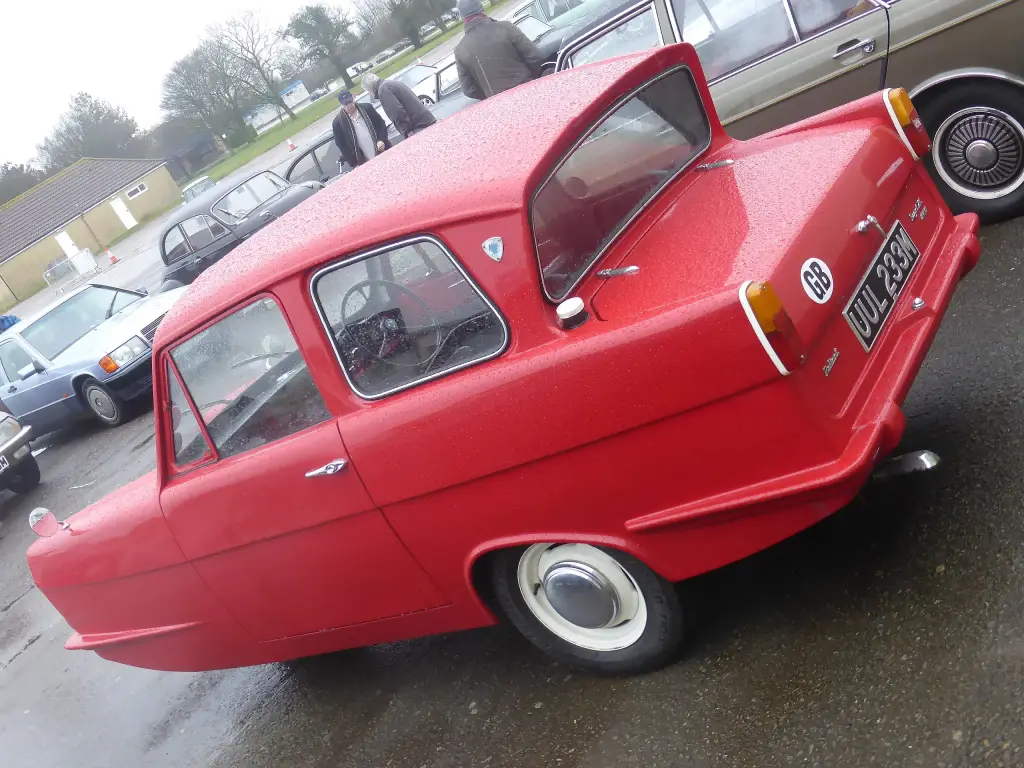
The Reliant Regal is a small three-wheeled car and van that was manufactured from 1952 to 1973 by the Reliant Motor Company in Tamworth, England. It replaced the earlier Reliant Regent three-wheeled cyclecar van, and it was itself replaced in 1973 by the Reliant Robin.
Reliant Regal at a glance
| Production | 1952–1973, Tamworth |
|---|---|
| Bodies | saloon, van, estate, pickup |
| Early cars | Mk I to Mk VI, 1953–1961 |
| Regal 3/25 | from October 1962, 598 cc |
| Regal 3/30 | from 1969, 701 cc |
| Regal 21E | with 21 extra fittings |
| Weight | under 7 cwt (355.6 kg) |
| Construction | fibreglass body on a steel chassis |
| Licence | could be driven on a full class A motorcycle licence |
| Replaced by | Reliant Robin, 1973 |
The article follows the English Wikipedia page on the Regal. Based on one source.
History of the Reliant Regal
From the Regent to the Mk VI
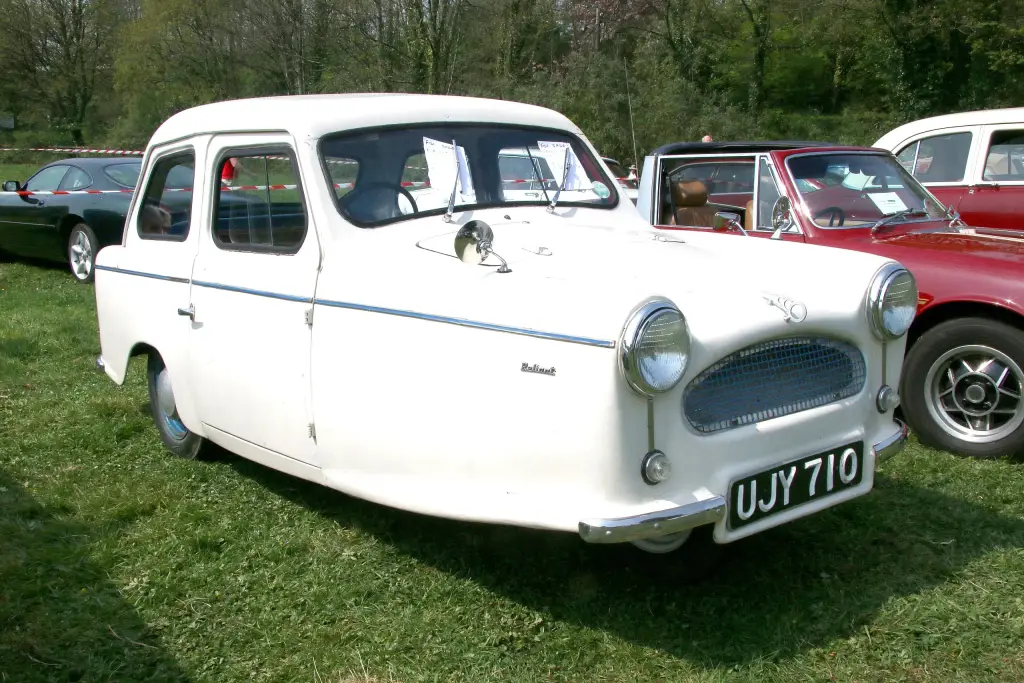
The Regal replaced the earlier Reliant Regent three-wheeled cyclecar van, a design that had its origins in a vehicle Reliant bought from the Raleigh Bicycle Company. Following the launch of the Mk I in 1953, the Regal went through many revisions in a short time, with the first generation using the original wooden frame and separate-panel bodywork through to the Mk VI of 1961. The Mk II of 1954 was mostly similar to the Mk I but had an updated windscreen; the Mk III of 1956 was heavily updated and had an all fibreglass body for the first time; it was followed by the Mk IV in 1958, the Mk V in 1959 and the Mk VI in 1960.
The Mk I and Mk II had aluminium bodies and 747 cc side-valve engines. As the price of aluminium rose sharply in Europe during the 1950s, Reliant developed an expertise in glass-fibre panels and replaced the aluminium piece by piece, until the 1956 Mk III had a wholly glass-fibre body. Unlike Panhard, which reacted to the cost of aluminium by using heavier steel panels, Reliant kept the Regal light, so it could use smaller, cheaper and more economical engines. The Mk VI was the last Regal with a side-valve engine: by 1962 Reliant had developed its own all-aluminium 600 cc overhead-valve unit.
The Regal 3/25 and the 3/30
In 1962 Reliant introduced the Mk VII, code-named TW7 (Three Wheeler 7). It had the new overhead-valve engine, a new steel chassis and a bonded shell design, new styling, and it was badged according to its number of wheels and horsepower. The Regal 3/25 was sold from 1962 to 1968 with a 600 cc engine producing 25 bhp (actually 598 cc and 24 bhp). In 1969 the Regal 3/30 arrived with a 700 cc engine producing 30 bhp (actually 701 cc and 29 bhp). The Regal 21E and 21E 700 were also offered: the 21E came with 21 extras that were otherwise optional, including a spot light, a fog light, chrome-plated bumper over-riders, sun visors, an oil gauge, outer wheel trims and metallic paint.
The 3/25 was available as a saloon, van, estate and pickup. The estate was essentially a van, badged as a Supervan, but with rear side windows and fold-down removable rear seats. Unlike earlier Regals it had no wooden frame, but a unitary body of reinforced fibreglass, moulded in two main parts, outer and inner, which were bonded together and bolted to a steel chassis. In April 1968 Reliant’s sales director T. H. Scott drove the 50,000th Regal 3/25 off the assembly line at Tamworth, a year before BMC celebrated its two-millionth Mini.
A few months later, in August 1968, the 701 cc engine introduced in the Reliant Rebel the previous autumn found its way into the Regal. For the three-wheeler the compression ratio was lowered to 7.5:1, reducing the claimed output to 29.5 bhp from the Rebel’s 35 bhp; even so it was a useful increase over the 26 bhp claimed for the 600 cc unit it replaced.
In popular culture
A Supervan III is the yellow van belonging to Del Boy and Rodney Trotter in the BBC sitcom Only Fools and Horses; several were used in filming and many people claim to own genuine screen-used vans, though few have proof. In Mr. Bean a running gag involves a light blue 1972 Supervan III that gets tipped over, crashed into or bumped out of its parking space, and the gag continued in the animated series. The 2011 Pixar film Cars 2 features a French character named Tomber patterned on a Regal saloon, and a Regal appears in the closing ceremony of the 2012 London Olympics, falling apart with Batman and Robin inside.
Design and features
- Three wheels, motorcycle licence: under UK law the lightweight Regal counted as a tricycle and could be driven on a full class A motorcycle licence.
- Glass-fibre bodywork: rust-free panels kept the car light, from the 1956 Mk III onwards.
- Supervan versions: van and estate models with a side-hinged rear door were marketed as the Reliant Supervan from 1962.
- Well equipped 21E: 21 extras, including a spot light, fog light, sun visors and metallic paint.
Reliant Regal versions
- Mk I to Mk VI (1953–1961): wooden frame and separate panels, then aluminium, then glass fibre.
- Regal 3/25 (1962–1968): 598 cc, the first of the TW7 generation.
- Regal 3/30 (1969–1973): 701 cc engine.
- Regal 21E and 21E 700: cars with the 21-extra specification.
- Supervan and Supervan III: the van and estate versions with a side-hinged rear door.
- Pickup: a commercial body on the 3/25 chassis.
The Regal was replaced by the Reliant Robin, and it shared its engine family with the four-wheeled Reliant Rebel. More cars are in the Reliant collection.
Video: 1963 Reliant Regal Slatty – fun in the snow
Video on YouTube.
Sources
- Reliant Regal, English Wikipedia: history, models, engines, popular culture